
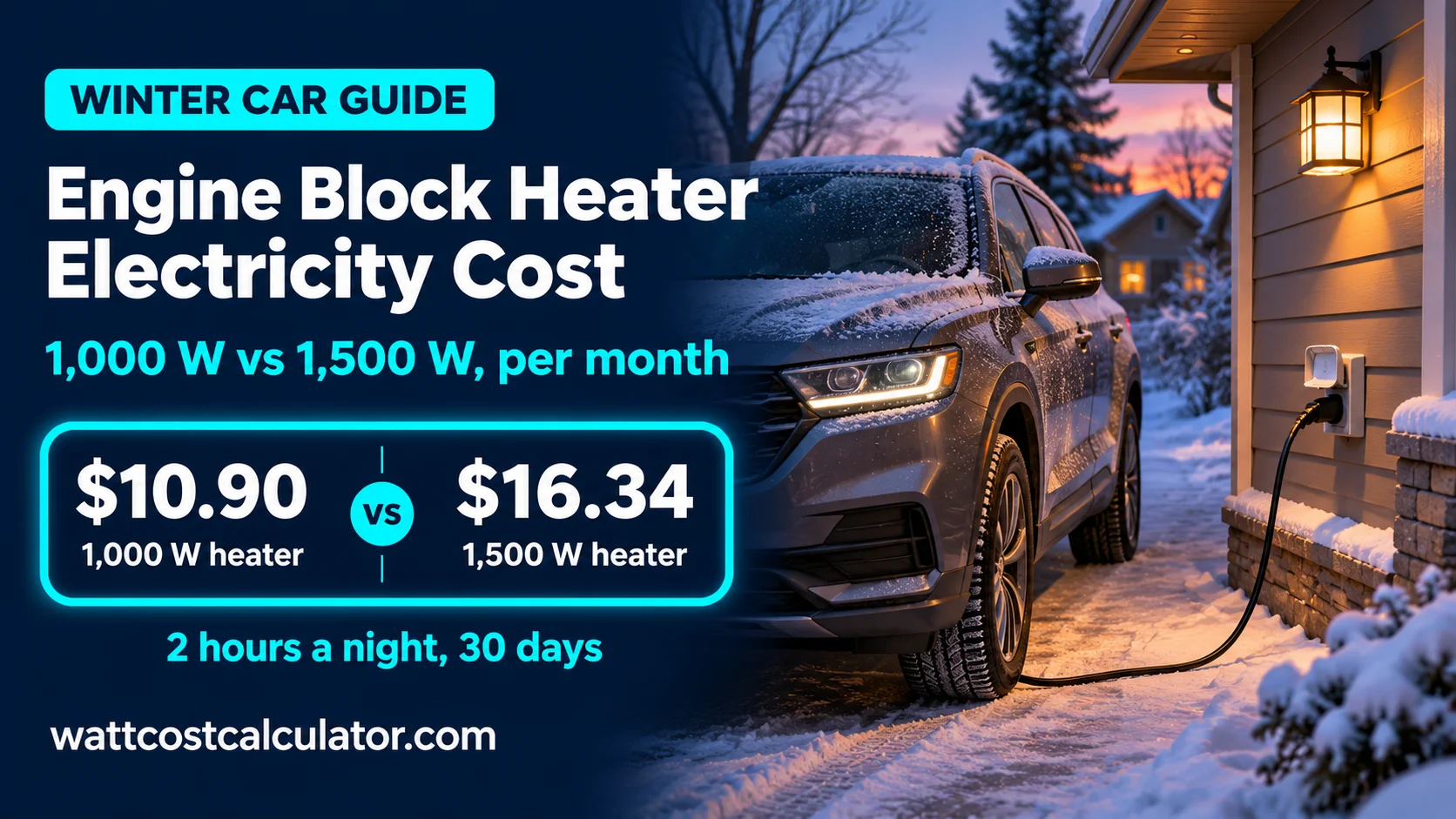
Plugging in a 1,000 W engine block heater for 2 hours a night costs about $10.90 per 30-day month, and a 1,500 W heater costs about $16.34 on the same schedule. Those figures assume full rated power for the whole plug-in time. The total depends less on the heater’s wattage than on how many hours you plug in, and how many nights a winter you need it. A 3-hour plug-in on the 1,500 W heater costs about $24.52 per month, so the schedule matters as much as the model.
- What a block heater does and why runtime matters
- The calculation in one line
- Monthly cost by heater wattage and plug-in time
- The same schedule in four states
- Planning a whole winter
- Circuit capacity: why 1,500 W is at the edge on a 120 V outlet
- Cord, outlet, and safety basics
- Timers and when to use them
- How cold weather changes the schedule
- Practical ways to cut the bill
- Frequently asked questions
- Sources and method
What a block heater does and why runtime matters
An engine block heater warms the coolant in the engine. A warm block reduces the strain on the battery and the oil at startup, and it lets the engine reach operating temperature faster. The heater is a resistive element, so nearly all of its electrical input becomes heat in the coolant. That makes the energy use simple to calculate: watts multiplied by hours gives watt-hours, and the rest is a matter of rate.
The practical question is not how much power the heater draws. It is how long the heater must run before the engine is ready to start. A heater that runs for a long time on a mild night wastes energy, and a heater that runs too short on a very cold night may not warm the engine enough. Timers and temperature-based controllers can help match the runtime to the night, which the rest of this guide covers.
The calculation in one line
Monthly cost equals watts multiplied by hours per night, multiplied by 30 nights, divided by 1,000, and then multiplied by the rate. A 1,000 W heater for 2 hours a night uses 2.0 kWh per night, or 60 kWh over 30 nights. At 18.16 cents per kWh from the U.S. Energy Information Administration’s August 2026 residential average, that is $10.90. A 1,500 W heater for the same 2 hours uses 90 kWh and costs $16.34. The formula is the same for any wattage and any schedule, so you can check any heater’s label and plug-in time.
Monthly cost by heater wattage and plug-in time
The table below assumes the heater runs for the listed time every night for 30 nights, at full rated power, at 18.16 cents per kWh. It is a ceiling for planning, not an expected bill.
| Heater (rated watts) | 1 hour per night | 2 hours per night | 3 hours per night |
|---|---|---|---|
| 1,000 W | 30 kWh, $5.45 | 60 kWh, $10.90 | 90 kWh, $16.34 |
| 1,500 W | 45 kWh, $8.17 | 90 kWh, $16.34 | 135 kWh, $24.52 |
Moving from 1,000 W to 1,500 W at the same time adds 50 percent to the bill. Moving from 1 hour to 3 hours at the same wattage triples it. For most drivers the plug-in time is the bigger lever, which is why a timer is the first thing to consider.
The same schedule in four states
Electricity rates change the bill by a wide margin. The table below uses the EIA August 2026 residential averages from Table 5.6.A for the 2-hour-a-night schedule.
| Location (EIA August 2026 average) | Rate | 1,000 W, 2 hours, 30 days | 1,500 W, 2 hours, 30 days |
|---|---|---|---|
| Washington | 14.63 cents/kWh | $8.78 | $13.17 |
| United States | 18.16 cents/kWh | $10.90 | $16.34 |
| New York | 28.65 cents/kWh | $17.19 | $25.79 |
| California | 29.75 cents/kWh | $17.85 | $26.78 |
For a winter that runs five months, the 1,500 W heater at the U.S. average rate with 2 hours a night costs about $82 for the season. The same heater in New York costs about $129 for the same five months. Use your own rate from the bill, because the difference between a standard rate and a time-of-use rate can change the answer.
Planning a whole winter
A single night is easy to calculate, but a block heater is used across a season. Suppose you plug in the 1,000 W heater for 2 hours on 30 nights a month for five winter months. That is 300 kWh, or about $54.48 at the U.S. average rate. The 1,500 W heater on the same schedule uses 450 kWh, or about $81.72. In New York the same 1,500 W schedule is about $128.92 for the season, which shows why the rate matters as much as the heater.
Not every night needs the full run. If half the nights in a winter are mild enough to skip the heater, the seasonal totals fall by roughly half. Keep a simple log of the temperature and whether you plugged in. Over one winter, the log shows how many hours you actually used, which is a more accurate basis for next year’s estimate than the rated figures in this guide.
Keep in mind that the monthly figure is a planning number. Your real bill will be lower if the heater cycles, lower still if you plug in only on the coldest nights, and higher if you park outside in a windy spot. Treat the table as the ceiling for each schedule, and use your own log to set the actual number.
Circuit capacity: why 1,500 W is at the edge on a 120 V outlet
A 1,500 W load on a 120 V outlet draws about 12.5 amps. A common household circuit is rated at 15 A, and standard electrical practice limits a continuous load to 80 percent of the breaker rating, which is 12 A on a 15 A circuit. A block heater that runs for hours is a continuous load. A 1,500 W heater therefore slightly exceeds the continuous limit on a 15 A circuit, and it leaves no room for anything else on that circuit.
A 1,000 W heater draws about 8.3 amps at 120 V. That fits within the continuous limit of a 15 A circuit with room to spare. Use a dedicated outdoor, GFCI-protected outlet for either heater. Do not share the circuit with a garage freezer, a space heater, or a power tool. If you need a 1,500 W heater, check whether the outlet is on a 20 A circuit, which has more continuous capacity. A licensed electrician can confirm the circuit and the breaker size for your garage or driveway.
Cord, outlet, and safety basics
Use an outdoor-rated, grounded outlet with GFCI protection. The cord should be rated for the heater’s current and for outdoor use. Do not run the cord through a door or window seal, where the insulation can be pinched and damaged. Avoid extension cords unless the cord is rated for the full load and is as short as possible. A thin or long extension cord can overheat under a continuous 8 to 12 amp load.
Before you drive, unplug the heater and check that the cord is clear of the engine, the belts, and the snow. Trapped snow or ice around the plug can cause a poor connection, which heats the plug and the outlet. Inspect the cord and the plug for cracks or discoloration at the start of each winter. Replace any damaged cord before using the heater.
Timers and when to use them
A timer keeps the heater from running longer than the night requires. A simple outlet timer set to run for 2 hours before the morning start covers many cases. A thermostat-controlled heater that turns on only when the coolant is below a set temperature can save more energy on mild nights, because it does not run at all when the engine stays warm.
For a typical morning, set the timer to start the heater about two hours before you leave. If you leave at 7:00 AM, the timer starts at 5:00 AM and stops when the engine is ready. A timer that runs longer than needed is the most common source of waste, so start with a shorter run and extend it only on nights when the car starts slowly. Keep the timer’s start and stop times in a note on the timer itself, so anyone else who uses the car can follow the same schedule.
Test your timer on a few nights. Check the engine temperature gauge at the start, or feel the upper radiator hose after a short run, to see whether the time you set is enough for your climate. Adjust the timer up or down based on what you observe, not on a fixed rule.
How cold weather changes the schedule
The colder the night, the more heat the engine needs before it starts easily. A night at a mild temperature may need little plug-in time, while a deep-freeze night may need the full run. A cold start also draws more battery current, so the heater helps the battery as well as the engine. Plan for the coldest nights in your area, then use a shorter schedule for milder nights to keep the monthly cost down.
Vehicles that sit outside for long periods in cold weather often need more plug-in time than a garaged vehicle. A garage that stays above freezing can cut the required time, because the engine starts from a warmer point.
Practical ways to cut the bill
Choose the smallest heater that starts your vehicle reliably. Check the heater’s label and the vehicle owner’s manual for the recommended rating, and compare with the wattage you already have before buying a larger unit.
Use a timer or thermostat control. A timer limits runtime, and a thermostat control avoids running on mild nights.
Plug in only when the forecast is cold. On mild days, skip the heater entirely.
Keep the engine out of the wind. A garage or a sheltered parking spot reduces heat loss, so the heater needs less time.
Check your rate. If your utility offers a time-of-use plan with a cheaper overnight window, a timer set for that window can lower the cost without changing the runtime.
Frequently asked questions
Does a block heater use more power than a space heater? A 1,000 to 1,500 W block heater draws about the same power as a typical space heater. It usually runs for hours at a time rather than all day, so the total kWh per night is the number to compare.
Do I need a timer? A timer is a simple way to keep the heater from running longer than needed. For most drivers, it is the easiest way to lower the bill without giving up a warm start.
Can I run a block heater on a standard household outlet? A 1,000 W heater fits within a 15 A circuit’s continuous capacity. A 1,500 W heater is at the limit, so use a dedicated, GFCI-protected outdoor outlet, and confirm the circuit with an electrician.
How do I calculate my own cost? Multiply the heater’s watts by the hours you plug in each night, multiply by 30 nights, divide by 1,000, and then multiply by your rate in dollars per kWh. Use the calculator below to test your own numbers.
What would this cost in your home?
Adjust the starting values to match your appliance and electricity plan.
Sources and method
Monthly energy is calculated as watts multiplied by hours per night, multiplied by 30 nights, divided by 1,000. Cost is the energy multiplied by the residential rate. The rate is the U.S. average of 18.16 cents per kWh from the EIA Electric Power Monthly, Table 5.6.A for August 2026, and the state averages in the table come from the same table. Circuit current is calculated as watts divided by 120 V. The U.S. Department of Energy Energy Saver site gives general guidance on household energy use and efficiency.
Last checked: November 21, 2026. These are calculated estimates from rated wattage and average tariffs, not measured results for any specific vehicle or heater. Check your heater’s label and your electrician’s guidance before installing a new outlet.

Waterbed Heater Electricity Cost: 170 W vs 325 W Per Month
A waterbed heater costs about $22.23 to $42.49 a month at 18.16¢/kWh if it runs 24 hours at 170 W or 325...

Infrared Sauna Electricity Cost: Cost Per 1-Hour Session by Model
An infrared sauna costs about $0.25 to $0.49 per one-hour session at 18.16¢/kWh, depending on model. Here is the cost per session...

Heated Dog Bed Electricity Cost: Small vs Medium Pad Per Month
A heated dog bed costs about $2.62 to $5.23 a month at 18.16¢/kWh if it runs 24 hours at 20 W to...

Hot Tub Electricity Cost in Winter: 240V vs. 120V Plug-and-Play Spas
Running a full-foam 240V hot tub in freezing winter weather costs roughly $51.76 per 30-day month at 18.16¢/kWh, while an uninsulated 120V...