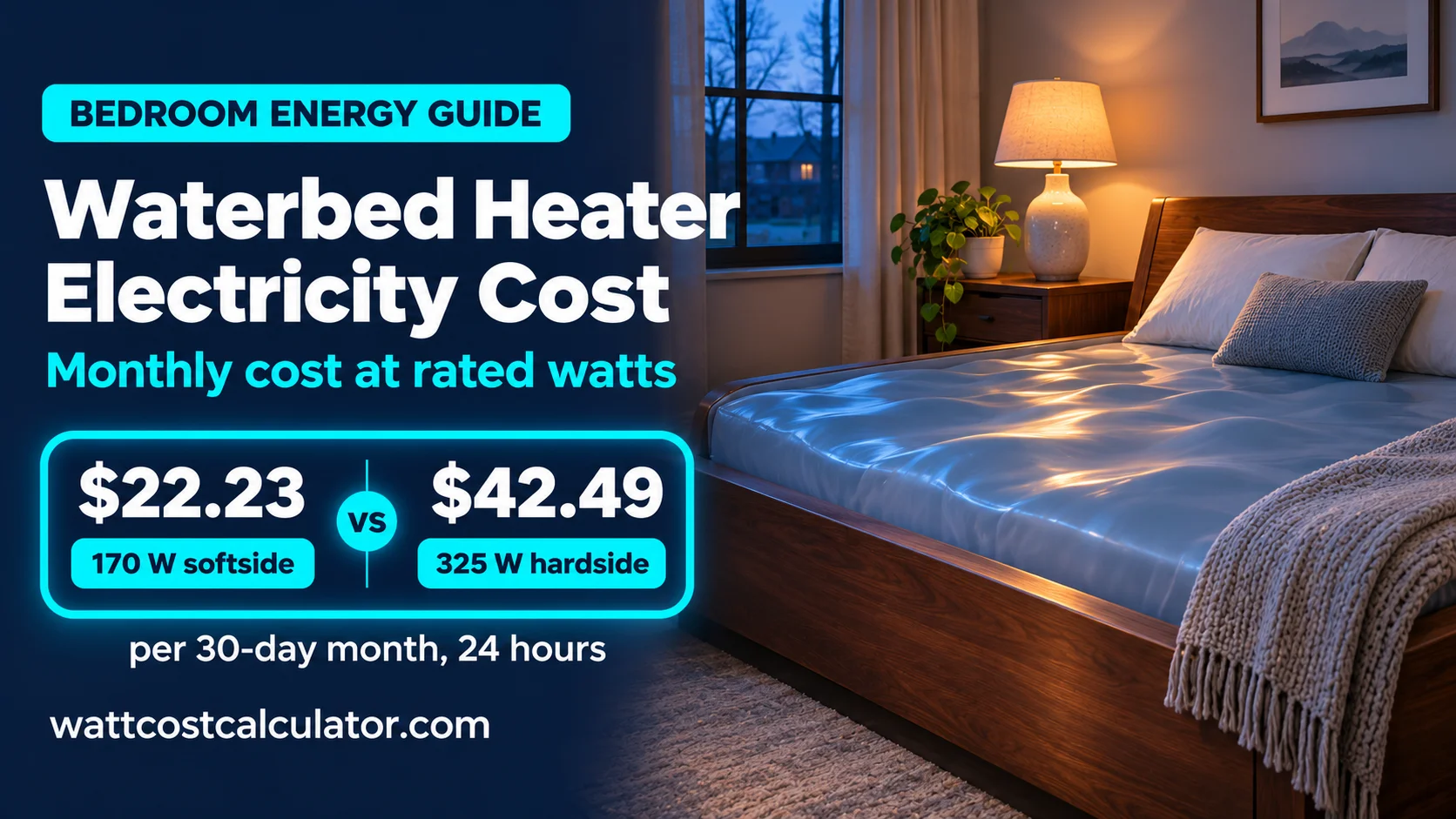
A 170 W waterbed heater running continuously costs about $22.23 per 30-day month , and a 325 W heater costs about $42.49 . Those are upper bounds at full rated power for 24 hours. A thermostat-controlled heater runs only part of the time, so most owners pay less. The heater rating matters more than the mattress size, because the heater’s power sets the maximum draw and the thermostat sets how often that draw happens.
- What the heater is actually doing
- Rated wattage: 170 W and 325 W
- Monthly and yearly cost at 18.16 cents/kWh
- Duty cycle and real-world use
- The same heater in four states
- Electrical load and circuit planning
- Choosing between 170 W and 325 W
- Seasonal use and shoulder months
- Practical ways to cut the bill
- Is a waterbed heater expensive to run?
- Can I run a waterbed heater on a standard outlet?
- Frequently asked questions
- Sources and method
What the heater is actually doing
A waterbed heater does not heat a room. It heats a water-filled mattress, and the water is a large thermal mass. Water holds much more heat per degree than air, so once the bed reaches its set temperature, the element does not need to run at full power to hold it there. It only needs to replace the heat that leaves through the vinyl bladder, the frame, the cover, and the bedding. That is why a heater with a higher wattage does not simply double the bill in practice. It reaches the set point faster, then cycles off.
Heat loss is the variable that matters most. A bed in a cold bedroom with a single cotton cover loses heat faster than a bed with a thick topper or a fitted quilt. A bed next to a window or an exterior wall loses heat faster than one in the middle of an interior room. The heater works harder in those conditions, and its duty cycle rises. This is why a single wattage rating cannot tell you the real cost of a particular bed.
Rated wattage: 170 W and 325 W
The two common 110 V models are the ones this guide uses. Backer HTI publishes a 170 W 110 V model (WB6403) for soft-side and tube mattresses, sold in cases of 14, and a 325 W 110 V model (WB6405) for hardside and soft-side mattresses, sold in cases of 14. Both are listed in a 12 by 24 inch size. A European 230 V model is listed at 250 W. Only these published ratings are used in the calculations below, and the mattress type each model is paired with comes from the same listing.
Ratings are maximum power draw, not average use. The heater’s thermostat decides how often the element is on. Check the label on your own heater, because mattress type, bed size, and the brand all affect what you should buy.
Monthly and yearly cost at 18.16 cents/kWh
The table below assumes the heater runs at full rated power for 24 hours, every day, for 30 days. It is a ceiling used for planning, not an expected bill.
| Heater type | Rated watts | Energy per 30 days | Cost per 30 days | Cost per year |
|---|---|---|---|---|
| Soft-side or tube (110 V) | 170 W | 122.4 kWh | $22.23 | $266.73 |
| Hardside or soft-side (110 V) | 325 W | 234.0 kWh | $42.49 | $509.93 |
The 325 W heater uses about 1.9 times as much electricity as the 170 W heater at the same hours. The ratio stays the same at any rate, so the choice between the two comes down to whether the bed needs the extra output, not to the rate in your area.
Duty cycle and real-world use
A better estimate than full-time rated power is the heater’s duty cycle, the share of time it is on. A bed in a heated room with a thick topper may run only a few hours a day at the heater’s setting, while a bed in a cold, drafty room may run much longer. If you measure the heater on a plug-in energy meter for a full week, you get the real average power, and that is the number to use in the calculator.
For a planning figure, run the heater for 8 hours a day, which is a common pattern for a bed that is warmed before bed and turned down overnight. At 18.16 cents per kWh, a 170 W heater on 8 hours a day costs about $7.41 per month, and a 325 W heater costs about $14.16. These are estimates, not measurements. Your duty cycle depends on bedroom temperature, the setting, and how you use the bed.
The same heater in four states
Rates differ by state. The table below uses the EIA August 2026 residential averages from Table 5.6.A and assumes full-time operation at rated power, the same upper-bound basis as above.
| Location (EIA August 2026 average) | Rate | 170 W, 30 days | 325 W, 30 days |
|---|---|---|---|
| Washington | 14.63 cents/kWh | $17.91 | $34.23 |
| United States | 18.16 cents/kWh | $22.23 | $42.49 |
| New York | 28.65 cents/kWh | $35.07 | $67.04 |
| California | 29.75 cents/kWh | $36.41 | $69.61 |
In California and New York, the gap between the two heaters is about $32 to $33 per month at full-time use. In Washington it is about $16. A rate-based decision is therefore most useful when you already know your heater’s real duty cycle.
Electrical load and circuit planning
A 110 V heater draws current in proportion to its wattage. At 110 V, a 170 W heater draws about 1.55 amps, and a 325 W heater draws about 2.95 amps. Both are small loads on a standard 15 A or 20 A household circuit. The problem is sharing. A waterbed plugged into a circuit that also serves a space heater, a hair dryer, or a dehumidifier can trip the breaker when the heater cycles on, and a tripped breaker leaves the bed cold overnight.
Keep the heater on its own outlet where possible. Keep the cord clear of the bed frame and the mattress edge, because a pinched or kinked cord overheats. If your home has GFCI protection in bathrooms or near the bed, follow the manufacturer’s instructions on whether the heater should be plugged into a GFCI-protected outlet. Check the manual for the maximum continuous load the heater is rated for.
Choosing between 170 W and 325 W
The choice is about recovery time and heat loss, not about the rate on your bill. A 170 W heater is enough for a bed with a thin cover in a warm room, where the water loses heat slowly. A 325 W heater makes sense when the bed is in a cold room, sits against an exterior wall, or has a thick mattress that needs more time to warm through. A higher wattage reaches the set point faster, which helps if you warm the bed only for a short period before sleep.
A larger heater does not always mean a larger bill. If the bed is well insulated, the 325 W unit may spend most of its time cycling off, and its real average power can be close to the 170 W unit’s. The only reliable way to know is to measure. Run the heater for a week on a plug-in meter, then compare the two options with your own numbers.
Mattress type matters as well. Softside and tube mattresses have a thinner water layer and a different heat path than hardside beds, so the manufacturer’s pairing of wattage to mattress type is a sensible starting point. Do not install a higher-wattage heater in a bed that the manufacturer lists for a lower wattage, because the heater can overheat the mattress and the bladder.
Seasonal use and shoulder months
Demand changes with the season. In late spring and early autumn, many bedrooms stay warm enough that a waterbed heater runs only occasionally, or not at all. In deep winter, especially in a room with a cold floor or a drafty window, the heater runs for longer. This means the annual cost is usually lower than twelve times the monthly figure at full power.
If you live in a region with a mild winter, the annual average might be closer to the shoulder-month figure than to the peak. If you live in a cold region, plan for the heater to run more in the coldest months. Either way, the table figures are the ceiling for planning, and the calculator lets you test the duty cycle that matches your house.
Practical ways to cut the bill
Lower the thermostat by a few degrees. Every heater has a setting range in its manual. A cooler setting means the element runs less often, and most sleepers do not notice a small change once they are under the covers.
Insulate the top of the bed. A quilted topper or a heavy fitted cover reduces heat loss from the top surface, which is where most of the heat goes when the bed is not covered by a body. Less heat loss means less duty cycle.
Warm the bed before bed, then turn it down. Running the heater to bring the bed up to temperature before you lie down, then lowering the setting for sleep, can cut the total run time compared with holding the high setting all night.
Turn it off when you are away. If your heater’s manual allows it, switch it off during trips. Warm the bed again before you return.
Check the heater and the bladder against the manual. Follow the manufacturer’s maintenance guidance for the heater and the bladder.
Is a waterbed heater expensive to run?
At full rated power for 24 hours, a 170 W heater costs about $22 a month at the U.S. average rate. A 325 W heater costs about $42. Thermostat cycling usually brings the real cost below these numbers. Compared with a space heater rated near 1,500 W, which is covered in our space heater electricity cost guide, a waterbed heater is a small load, because it heats a bed rather than a room.
Can I run a waterbed heater on a standard outlet?
Backer’s 110 V models plug into a standard household outlet. Keep the cord away from the bed frame, check the cord and plug for heat or damage, and follow the manufacturer’s rules on outlet type. Use the calculator below for your own heater and rate.
What would this cost in your home?
Adjust the starting values to match your appliance and electricity plan.
Frequently asked questions
Does a waterbed heater use more electricity than an electric blanket? It depends on the duty cycle. The answer depends on the wattage listed on each product and on how long each one runs. Compare the labels, then multiply by hours, as shown above. Compare the two with the electric blanket vs space heater cost guide.
Can I save money by running the heater only at night? Yes, if the bed warms up quickly enough for your schedule. Test it for a week and check whether the bed is comfortable at the start of the night.
Does the mattress type change the wattage I need? Yes. Softside and tube mattresses are usually paired with the 170 W model, and hardside mattresses or thicker beds are usually paired with the 325 W model. Use the manufacturer’s guidance for your mattress before you buy.
Sources and method
Monthly energy is calculated as rated watts multiplied by 24 hours and 30 days, divided by 1,000. Cost is that energy multiplied by the residential rate. Wattage ratings come from the Backer HTI waterbed heater product page, which lists the 110 V WB6403 at 170 W and the WB6405 at 325 W. The electricity rates are from the EIA Electric Power Monthly, Table 5.6.A for August 2026. Circuit current is calculated as watts divided by 110 V. The U.S. Department of Energy Energy Saver site gives general guidance on reducing home heating and appliance energy use.
Last checked: November 21, 2026. These are calculated estimates from rated wattage and average tariffs, not measured results for any specific bed or heater.

Infrared Sauna Electricity Cost: Cost Per 1-Hour Session by Model
An infrared sauna costs about $0.25 to $0.49 per one-hour session at 18.16¢/kWh, depending on model. Here is the cost per session...
Engine Block Heater Electricity Cost: 1,000 W vs 1,500 W Per Month
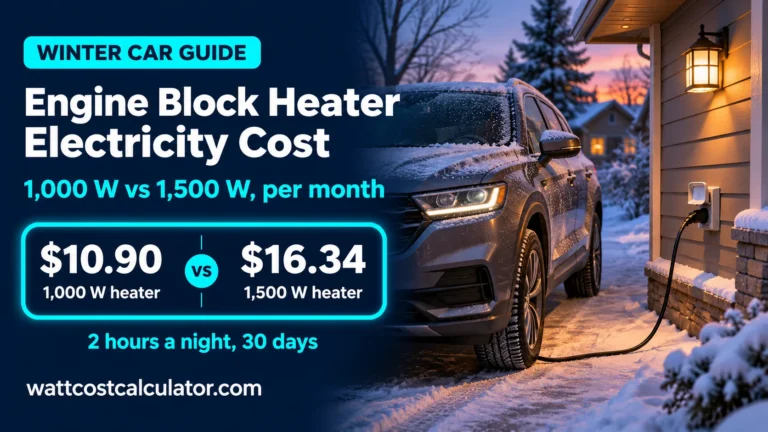
An engine block heater costs about $10.90 to $16.34 a month at 18.16¢/kWh when plugged in 2 hours a night at 1,000...

Heated Dog Bed Electricity Cost: Small vs Medium Pad Per Month
A heated dog bed costs about $2.62 to $5.23 a month at 18.16¢/kWh if it runs 24 hours at 20 W to...

Hot Tub Electricity Cost in Winter: 240V vs. 120V Plug-and-Play Spas
Running a full-foam 240V hot tub in freezing winter weather costs roughly $51.76 per 30-day month at 18.16¢/kWh, while an uninsulated 120V...