
A Clearlight Sanctuary 1 rated at 1,740 W costs about $0.32 per one-hour session at full rated power, and the Sanctuary 3 rated at 2,680 W costs about $0.49 . At three sessions a week, that is roughly $4.11 and $6.33 per 30-day month . Those are ceilings. Heaters cycle on and off with their controls, so a session’s real energy use is usually lower than full rated power for the whole hour.
- What the session actually draws
- Rated power for two Clearlight models
- Cost per session and per month at 18.16 cents/kWh
- The same sessions in four states
- Electrical planning: the part that changes the real cost
- Duty cycle and how to measure your own number
- Garage and basement installs
- Ways to lower the cost per session
- How this compares with other wellness appliances
- Frequently asked questions
- Sources and method
What the session actually draws
An infrared sauna is a set of radiant heaters around a wooden cabin. The heaters heat the body surfaces directly and warm the air only a little. The electrical draw depends on three things: the rated wattage, how long the heaters are actually on, and how long the cabin takes to reach its target temperature. The first two are printed on the spec sheet. The third is the one most owners underestimate.
A cold cabin needs a warm-up period before a session feels right. During warm-up, the heaters run near full power. Once the surfaces reach the set point, the controller pulses the heaters to hold it. A one-hour session with a 15-minute warm-up therefore uses more energy than a one-hour session on a cabin that stayed warm from the last use. This is why the cost per session is best treated as a range, with the top end set by full rated power and the bottom set by the duty cycle you measure.
Rated power for two Clearlight models
Clearlight publishes electrical specifications on its official pages for its Sanctuary line. The two models used here are the Sanctuary 1 and the Sanctuary 3.
– Sanctuary 1: 120 V, 1,740 W, 14.6 A, on a 120 V / 15 A standard household outlet, with a NEMA 5-15P plug. Clearlight lists a 20 A circuit for the configuration with the full spectrum upgrade heater. – Sanctuary 3: 240 V, 2,680 W, about 11.2 A, on a 240 V outlet with a NEMA 6-15P plug, which usually means a dedicated circuit installed by a licensed electrician.
Clearlight publishes the Premier line on the same official product pages, and the current U.S. ratings are used here. The Premier IS-1 is rated 120 V, 1,370 W and 11.42 A, on a 15 A circuit with a NEMA 5-15P plug. The Premier IS-3 is rated 120 V, 2,050 W and 17.1 A, on a 20 A circuit with a NEMA 5-20P plug. At 18.16 cents per kWh, a one-hour session at full rated power uses 1.37 kWh on the Premier IS-1, about $0.25, and 2.05 kWh on the Premier IS-3, about $0.37. The cost table below works through the two Sanctuary models; the Premier figures follow the same method and land in the same range.
Cost per session and per month at 18.16 cents/kWh
A one-hour session at full rated power uses rated kilowatts multiplied by one hour. The Sanctuary 1 uses 1.74 kWh per session, and the Sanctuary 3 uses 2.68 kWh. At 18.16 cents per kWh, the costs are shown below. The monthly figure assumes three sessions a week, about 13 per 30-day month.
| Model (rated watts) | Energy per session | Cost per session | Cost per month (13 sessions) | Cost per year (3 per week) |
|---|---|---|---|---|
| Sanctuary 1 (1,740 W, 120 V) | 1.74 kWh | $0.32 | $4.11 | $49.32 |
| Sanctuary 3 (2,680 W, 240 V) | 2.68 kWh | $0.49 | $6.33 | $75.96 |
The Sanctuary 3 uses about 1.54 times the energy of the Sanctuary 1 for each session. Because the difference is linear with wattage, the choice between the two should rest on capacity, bench size, and wiring, not on the monthly bill alone.
The same sessions in four states
Electricity prices vary across the country. The table below applies the EIA August 2026 residential averages from Table 5.6.A to the same three-sessions-a-week schedule.
| Location (EIA August 2026 average) | Rate | Sanctuary 1, per month | Sanctuary 3, per month |
|---|---|---|---|
| Washington | 14.63 cents/kWh | $3.31 | $5.10 |
| United States | 18.16 cents/kWh | $4.11 | $6.33 |
| New York | 28.65 cents/kWh | $6.48 | $9.98 |
| California | 29.75 cents/kWh | $6.73 | $10.36 |
In California, the Sanctuary 3 costs about $3.63 more per month than the Sanctuary 1 at the same schedule. In Washington, the gap is about $1.79. The electricity bill is a small part of owning either model, but it grows with the rate, so a high-rate home sees a larger gap.
Electrical planning: the part that changes the real cost
The Sanctuary 1 is the most important wiring case in this article. At 120 V, 1,740 W draws about 14.5 amps. A 15 A circuit is rated for a continuous load of about 12 A, which is 80 percent of the breaker rating under common electrical practice. A sauna that runs at full power for an hour is a continuous load. On a 15 A circuit shared with a bathroom fan, a hair dryer, or a dehumidifier, the breaker can trip during a session, which interrupts the heat and can leave the cabin cold partway through. Clearlight’s electrical guidance lists a 20 A circuit for the Sanctuary 1 with the full spectrum upgrade, which is the safer choice for that setup.
The Sanctuary 3 draws about 11.2 amps at 240 V. That is a moderate load on a dedicated 240 V circuit, but it is not a standard outlet, and it usually requires an electrician to install the outlet and confirm the breaker size. Do not add a 240 V outlet to a circuit that already serves other heavy loads. Check the wire gauge and the breaker against the local code, and ask the electrician to confirm the run length, because a long run can cause voltage drop that makes the heaters work harder.
Duty cycle and how to measure your own number
The wattage on the spec sheet is the ceiling. A plug-in energy meter tells you the real figure. For a 120 V model, plug the Sanctuary 1 into a meter and record the kWh over five or six sessions that include warm-up and a full hour inside. Divide the total by the number of sessions to get kWh per session. If the cabin is in a cold room or a garage, expect a longer warm-up and a higher number. If the cabin is in a heated room and you warm it briefly before each session, expect a lower number.
Use the calculator below to enter your model’s rated watts and session length. The calculator uses full rated power for the whole session, so it gives the upper bound. Replace the watts with your metered average to get a closer estimate.
What would this cost in your home?
Adjust the starting values to match your appliance and electricity plan.
Garage and basement installs
Many owners put an infrared cabin in a garage, basement, or spare room where the air is cooler or less stable than in the rest of the house. This changes the electricity bill in two ways. The cabin takes longer to warm up in a cold room, which raises the energy used before each session. A cooler room also means more heat escapes through the walls and floor of the enclosure, which raises the duty cycle during the session itself.
Clearlight’s Sanctuary 3 installation notes recommend leaving 4 inches around the cabin when it is built into an enclosed space, so that air can move and the heaters and electronics can dissipate heat. Keep that clearance in a garage or basement as well, and keep the cabin away from direct water or sump pump areas. A damp floor does not change the electricity cost, but it can damage the wood and the electrical connections over time.
If the room is cold, a practical approach is to set the cabin up in a room that stays above freezing and to test the warm-up time on a meter for a week. Record the warm-up minutes and the session kWh separately. That gives you a clear view of how much of the bill comes from the room’s temperature and how much from your session length.
Ways to lower the cost per session
Preheat only as long as you need. A shorter warm-up cuts the energy used before you enter. Test a 10-minute preheat against a 20-minute one and note the time it takes for the seat to feel right.
Keep the door closed. Opening the door during a session releases warm air and forces the heaters to replace it. Keep the door closed for the full session, and keep the cabin in a room that is not very cold.
Reduce session length, not frequency. If a 40-minute session gives you the benefit you want, that cuts the energy by about a third compared with a 60-minute session. Track how you feel at different lengths before settling on one.
Turn off accessories you do not use. Chromotherapy lights, audio systems, and ionizers draw small loads. Switch them off when you do not need them, and check the manual for standby draw when the cabin is idle.
Schedule sessions for off-peak hours when your utility has a time-of-use plan. A session at 6 PM may cost more than one at 10 AM on a time-of-use rate. Check your bill for peak and off-peak prices, and read our time-of-use electricity rates guide before choosing a schedule.
How this compares with other wellness appliances
Infrared cabins run at lower air temperatures than a traditional sauna, but the wattage of a 120 V infrared cabin is still comparable to a large space heater. The space heater electricity cost guide shows a similar range of power for a room heater. The number that matters for a home is hours of use. A few hours a week keeps the cost well under a dollar a session at the U.S. average rate.
For a heated bed or a pad that runs for the whole night, the monthly figure can be larger than the sauna’s. The waterbed heater cost guide covers that case with the same kWh method.
Frequently asked questions
Does an infrared sauna cost more to run than a traditional sauna? Compare the rated kilowatts and session length for each cabin. The two infrared models here are rated at 1.74 kW and 2.68 kW, and a traditional sauna heater should be checked against its own nameplate before comparing.
Is preheat time included in the cost? Only if you count it. If you run a 60-minute session that includes 15 minutes of warm-up, the full hour is what the calculator uses. Add or subtract time to match your routine.
Can I plug a Sanctuary 1 into any outlet? Use a 120 V outlet on a dedicated circuit. Confirm the breaker size and the circuit load before the first session.
Sources and method
Energy per session is calculated as rated kilowatts multiplied by hours. Monthly cost assumes three sessions a week, about 13 per 30-day month. Rates are the U.S. average of 18.16 cents per kWh and the state averages from the EIA Electric Power Monthly, Table 5.6.A for August 2026. Rated power and electrical requirements come from Clearlight’s Sanctuary 1 product page (infraredsauna.com) and Sanctuary 3 product page, which list 1,740 W at 120 V and 2,680 W at 240 V. Circuit current is calculated as watts divided by voltage. The U.S. Department of Energy Energy Saver site gives general guidance on appliance energy use.
Last checked: November 21, 2026. These are calculated estimates from rated power and average tariffs, not measured results for any specific cabin or household.
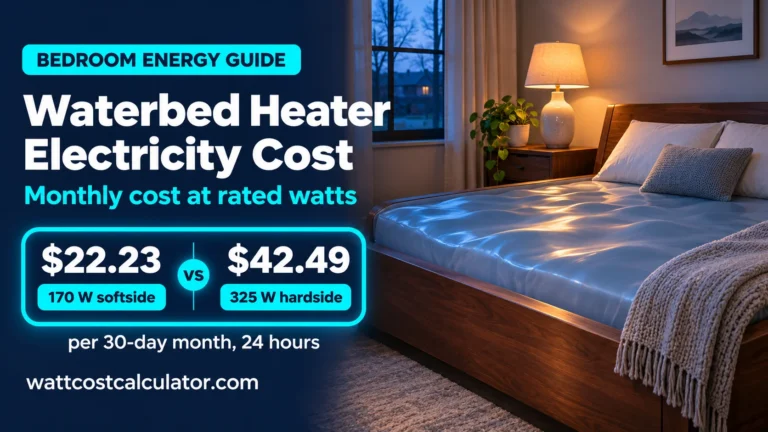
Waterbed Heater Electricity Cost: 170 W vs 325 W Per Month
A waterbed heater costs about $22.23 to $42.49 a month at 18.16¢/kWh if it runs 24 hours at 170 W or 325...
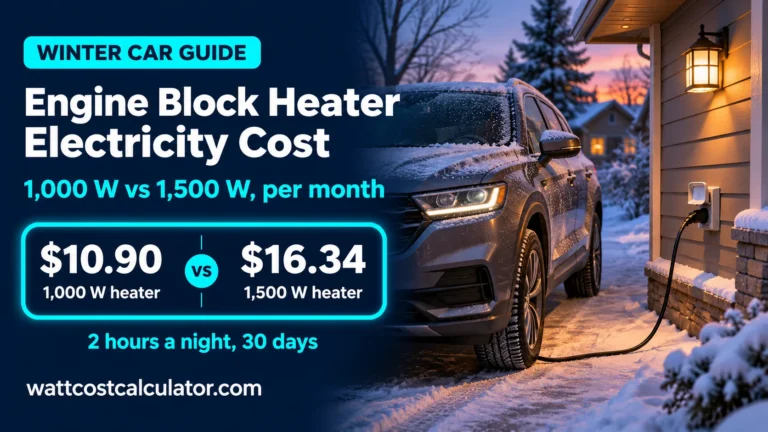
Engine Block Heater Electricity Cost: 1,000 W vs 1,500 W Per Month
An engine block heater costs about $10.90 to $16.34 a month at 18.16¢/kWh when plugged in 2 hours a night at 1,000...

Heated Dog Bed Electricity Cost: Small vs Medium Pad Per Month
A heated dog bed costs about $2.62 to $5.23 a month at 18.16¢/kWh if it runs 24 hours at 20 W to...

Hot Tub Electricity Cost in Winter: 240V vs. 120V Plug-and-Play Spas
Running a full-foam 240V hot tub in freezing winter weather costs roughly $51.76 per 30-day month at 18.16¢/kWh, while an uninsulated 120V...