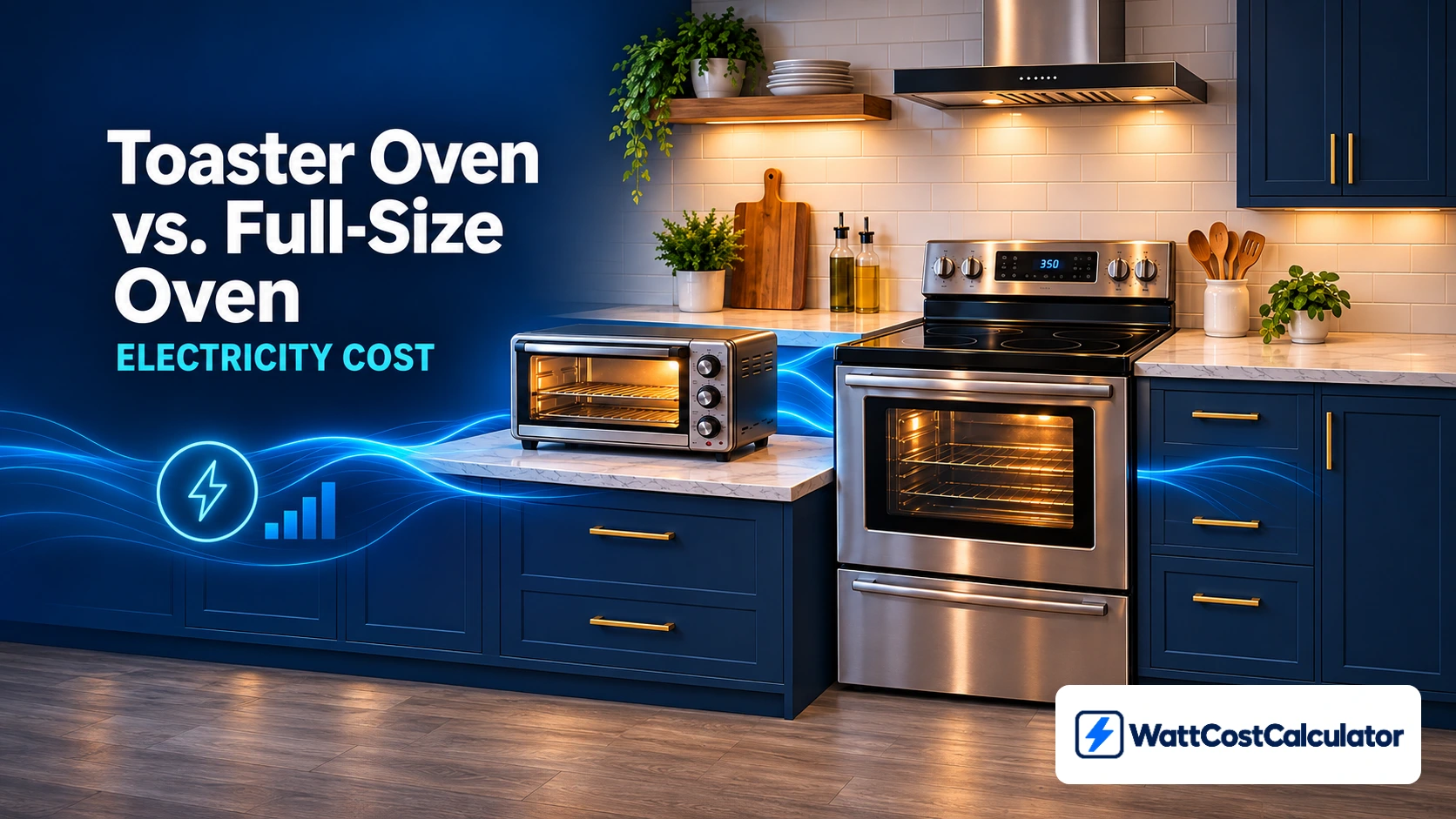
In the scenario below, three 20-minute toaster oven sessions a week use about 78 kWh a year and cost about $14.16 per year. Three 60-minute full-size oven bakes a week use about 312 kWh a year, or about $56.66 per year. The difference is about $42.49 per year at the U.S. average rate. The session energy values are scenario inputs, not test results. Use your appliance’s rated wattage and your own cooking times before relying on the totals.
- Why the cooking method matters more than the oven label
- Inputs used in this guide
- Per-session and annual cost
- The same pattern in four states
- How usage frequency changes the gap
- Preheat time as a separate cost
- Kitchen heat and ventilation
- When each oven makes sense
- How to cut the energy per meal
- Choosing by household size
- Safe use and the energy budget
- Electrical requirements
- Checking your own cooking
- Frequently asked questions
- Sources and method
Why the cooking method matters more than the oven label
An electric oven heats its cavity with resistance elements. A toaster oven does the same job with a smaller cavity and a shorter path for the heat to travel. The energy needed to bring the air and the food to temperature depends on how much air must be heated, how long the element runs, and how much heat escapes when the door opens. A small cavity has less air to heat, so it reaches temperature faster and loses less heat per minute.
Full-size ovens are built for large dishes, multiple racks, and long bakes. Their larger cavity and extra thermal mass make them efficient for big batches, but they take longer to preheat and lose more heat for each opening of the door. A full-size oven cooking a single tray of vegetables uses much more energy per serving than a toaster oven doing the same job.
Inputs used in this guide
The calculation uses two session scenarios. Both assume the cooking time listed, at full element power for the duration. They are planning inputs, not measured results.
– Toaster oven session: 1,500 W for 20 minutes, which is 0.5 kWh per session. – Full-size oven session: 2.0 kWh per session, equal to a 60-minute bake at an average element draw of 2,000 W, including preheat.
Annual cost equals session energy multiplied by sessions per year, multiplied by the rate. The rate is the U.S. average of 18.16 cents per kWh from the U.S. Energy Information Administration’s Electric Power Monthly, Table 5.6.A, for August 2026.
Per-session and annual cost
At 18.16 cents per kWh, a toaster oven session costs about 9.1 cents, and a full-size oven bake costs about 36.3 cents. Three sessions a week over 52 weeks is 156 sessions a year.
| Cooking pattern (scenario) | Energy per session | Cost per session | Annual cost (156 sessions) |
|---|---|---|---|
| Toaster oven, 20 minutes | 0.5 kWh | $0.09 | $14.16 |
| Full-size oven, 60 minutes including preheat | 2.0 kWh | $0.36 | $56.66 |
The per-session figures are rounded from 9.08 cents and 36.32 cents. The annual figures use the unrounded energy values.
The same pattern in four states
Electricity rates change the absolute gap. The table below applies the EIA August 2026 state averages from Table 5.6.A to the three-sessions-a-week scenario.
| Location (EIA August 2026 average) | Toaster oven, per year | Full-size oven, per year | Difference per year |
|---|---|---|---|
| Washington (14.63 cents/kWh) | $11.41 | $45.65 | $34.23 |
| United States (18.16 cents/kWh) | $14.16 | $56.66 | $42.49 |
| New York (28.65 cents/kWh) | $22.35 | $89.39 | $67.04 |
| California (29.75 cents/kWh) | $23.20 | $92.82 | $69.61 |
In California, the full-size oven scenario costs about $70 more per year than the toaster oven scenario under the same cooking pattern.
How usage frequency changes the gap
The gap between the two ovens grows with how often they run. The table below uses the same per-session inputs as the rest of this guide, at the U.S. average rate of 18.16 cents per kWh.
| Usage pattern (scenario) | Toaster oven, per year | Full-size oven, per year | Difference per year |
|---|---|---|---|
| 1 session per week (52 sessions) | $4.72 | $18.89 | $14.16 |
| 3 sessions per week (156 sessions) | $14.16 | $56.66 | $42.49 |
| 1 session per day (365 sessions) | $33.14 | $132.57 | $99.43 |
A household that cooks a full-size oven meal once a day sees a gap of about $99 per year in this scenario. A household that uses the toaster oven for most small meals and the full-size oven once a week sees a much smaller difference.
Preheat time as a separate cost
Preheating a full-size oven takes time and energy before the food goes in. In the scenario, a 10-minute preheat at an average draw of 2,000 W uses about 0.33 kWh, or about 6 cents per session at the U.S. average rate. Across 156 sessions a year, that adds about $9.44 per year. The toaster oven preheats much faster, and its smaller cavity means less energy is spent on the preheat itself. If a recipe does not need preheating, skipping it removes this cost completely. Even for recipes that do, a shorter preheat on a well-insulated oven often gives the same result, so check the oven’s indicator light and the recipe’s own guidance before setting the full time.
Kitchen heat and ventilation
Both ovens put heat into the kitchen, and that heat can make the room warmer and push the air conditioner to run more. In a cooling season, the extra heat from a long full-size oven bake can add a small amount to the household’s cooling load. A toaster oven adds less heat per session. Using the range hood while cooking helps remove the heat and moisture from the room. The electricity used by the range hood is a separate load, and its runtime should be counted when comparing the total cost of a cooking session.
When each oven makes sense
A toaster oven fits well when the meal is small, the dish fits on one tray, or the task is reheating, toasting, or cooking a single item. It is also useful in the summer, because it puts less heat into the kitchen than a full-size oven.
A full-size oven is the better choice for whole roasts, multiple trays, large casseroles, or baking that needs a large, even heat zone. It also makes more sense when the household cooks for many people, because one long bake can replace several small toaster oven sessions. The energy per meal is what matters, not the energy per hour.
How to cut the energy per meal
Batch the cooking. Cook several items in one session. A full-size oven running at a high load for a larger batch often uses less energy per dish than several small sessions.
Use the right size. Match the appliance to the job. A toaster oven for a single portion and a full-size oven for a family meal keeps the energy per serving reasonable.
Avoid unnecessary preheating. Some dishes, such as casseroles or roasts, can go into a cold oven. Check the recipe and preheat only when the recipe requires it.
Keep the door closed. Each time the door opens, heat escapes. Check the food through the window when you can.
Use the timer or the shorter setting. Turn the oven off a few minutes before the food is fully done if the residual heat will finish the job. This is a common practice that reduces the energy used without changing the result for many dishes.
Clean the oven and the seals. A dirty interior or worn door seal lets heat escape. Check the door gasket and keep the interior clean according to the manufacturer’s directions.
Choosing by household size
A single person or a couple who cook small meals can often cover most of their needs with a toaster oven. The appliance heats fast, and the cavity fits a single tray or a small dish. Once a household has three or more regular eaters, or cooks roasts and multi-tray meals often, a full-size oven becomes the more practical tool. The better choice depends on what the household cooks most often, not on the appliance’s wattage alone.
Many homes use both. A toaster oven handles reheating, toast, and small dishes, and the full-size oven handles weekend roasts and baking. That split keeps the energy per meal lower than running the large oven for every small task.
Safe use and the energy budget
Both ovens reach high temperatures, and the heat-resistant surfaces can cause burns. Place the appliance on a stable surface with clear space around it. Keep the cord away from hot surfaces, and do not place the toaster oven under a cabinet or against a wall, where the heat can damage finishes. Check the manufacturer’s clearance guidance before installation.
A safe oven is also an efficient one. A well-maintained door seal, a clean interior, and a working thermostat keep the heat where it belongs. Replacing a damaged seal often costs less than the energy lost through the gap over a year.
Electrical requirements
A toaster oven usually plugs into a standard 120 V outlet on a 15 A or 20 A circuit. Do not share that circuit with a microwave, a kettle, or a space heater, because the combined draw can trip the breaker. A full-size electric oven typically needs a dedicated 240 V circuit with a higher amperage rating. Check the rated amperage on the oven’s label and confirm the circuit with a licensed electrician before you install or upgrade a circuit.
Checking your own cooking
The most useful way to get a real figure is to read the wattage on the appliance label, then record the time it runs for a typical meal. Multiply watts by hours, divide by 1,000 to get kWh, and multiply by your rate. A plug-in energy meter on a toaster oven gives an accurate per-session number quickly. Full-size ovens are harder to meter, because they are often wired directly, so use the label values and a timed log for those.
Keep a short log for two weeks. Write down the appliance, the start and end times, and the dish. Those notes show which meals drive the bill and whether a shorter preheat or a toaster oven substitution would change the monthly total.
Enter the wattage and time for your own appliance into the calculator below. For a toaster oven running 20 minutes at 1,500 W, enter 1,500 W and 0.33 hours.
What would this cost in your home?
Adjust the starting values to match your appliance and electricity plan.
Frequently asked questions
Does a toaster oven always use less electricity than a full-size oven? For the same food, it usually uses less energy because the cavity is smaller and heats faster. For a large batch, a full-size oven can be more efficient per dish, because the heat serves more food at once.
Is it cheaper to use the toaster oven for reheating? In most cases, yes. Reheating a single plate in a toaster oven avoids preheating a large cavity.
Does an air fryer setting change the result? Some toaster ovens include an air-fry setting. Its energy use depends on the element power and the cooking time, so check your appliance’s label and time the cycle.
Sources and method
Session energy equals rated kilowatts multiplied by hours of operation. Annual energy equals session energy multiplied by sessions per year. Cost equals that energy multiplied by the residential rate. Rates are from the EIA Electric Power Monthly, Table 5.6.A for August 2026. Session energy values are scenario inputs for planning. For appliance-specific figures, check the rated wattage on the label. The U.S. Department of Energy Energy Saver site gives general guidance on cooking appliance energy use.
For a related comparison, see our electric oven electricity cost guide and our air fryer electricity cost guide.
Written by Seon (Site Founder & Energy Data Researcher / Home Tech Reviewer). Last checked: November 21, 2026. These are calculated estimates from scenario inputs and average tariffs, not measured results.

Electric Oven vs. Induction Cooktop Electricity Cost: Holiday Cooking & Baking
Cooking a 31-minute weeknight meal on an induction cooktop uses roughly 0.65 kWh ($0.12 at 18.16¢/kWh), while a 4-hour holiday roast in...
Dishwasher Heated Dry vs. Air Dry: Energy Cost and Everyday Trade-Offs
Quick Scenario Summary In the scenario below, a dishwasher that runs one cycle a day with air drying uses about 0.9 kWh...

Air Fryer vs Toaster Oven Electricity Cost: Batch Size and Preheat
A basket air fryer and a countertop toaster oven can both circulate hot air. Which one costs less to cook dinner? The...

Electric Oven Self-Cleaning Cost per Cycle: kWh and Cost Estimate
Estimate electric oven self-cleaning cost per cycle. Compare session kWh, local rates, steam-clean differences, and occasional cleaning budgets.