- Why induction heats pans faster than radiant coils or ovens
- What would this cost in your home?
- Induction vs. radiant cooktop vs. electric oven costs compared
- Understanding oven preheat, duty cycle, and standby clock draw
- How your state’s electricity rate changes monthly cooking bills
- Four practical ways to cut holiday oven and cooktop kWh
- Frequently asked questions
- Sources and calculation method
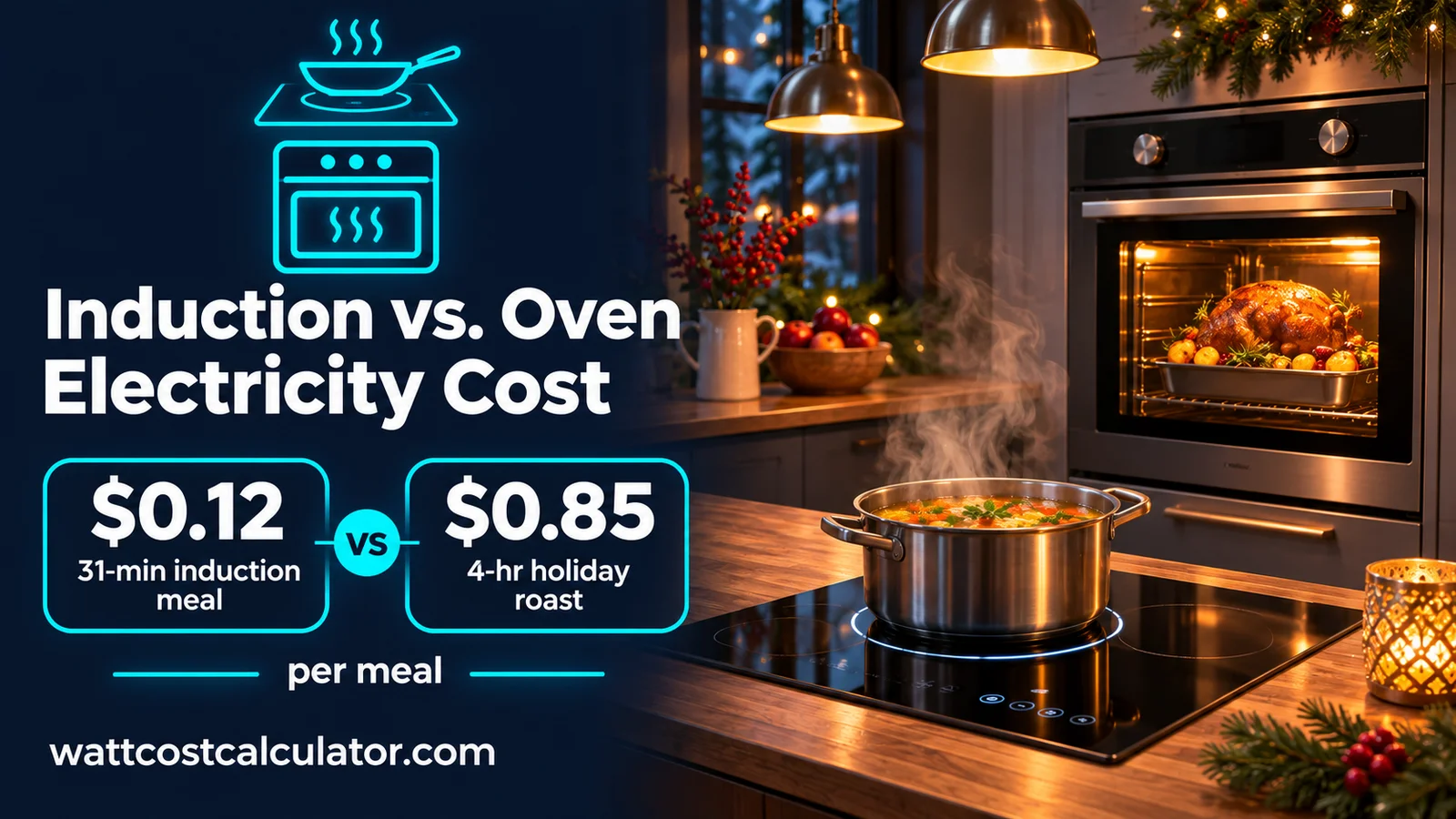
Cooking an everyday 31-minute dinner on an induction cooktop typically uses around 0.65 kWh—costing roughly $0.12 per meal, or $51.16 per year across 418 annual cooking events—at the U.S. Energy Information Administration’s August 2026 residential average of 18.16¢/kWh. By comparison, a 1-hour bake in a full-size electric oven uses about 1.46 kWh ($0.27), and a 4-hour holiday turkey or roast consumes roughly 4.70 kWh ($0.85). These are modeled estimates based on DOE cooking-product duty cycles and stated oven preheat assumptions rather than a guaranteed utility quote.
Why induction heats pans faster than radiant coils or ovens
Traditional electric coil and smooth-top radiant ranges generate heat inside a resistive metal or ribbon element, then transfer that energy through glass or air into the bottom of your pot. Because much of the heat escapes into the surrounding kitchen air and heats the ceramic glass itself, radiant burners stay at high power longer to bring water to a boil or maintain a sear.
An ENERGY STAR certified induction cooktop works differently: an electromagnetic coil induces eddy currents directly inside ferromagnetic cookware, turning the pan itself into the heat source. Because thermal energy goes straight into the metal pot with minimal glass or ambient air heating, boiling water and searing finish faster—and the burner drops to low-wattage simmer cycling sooner. A zone can also run well above its normal output on a “Boost” setting, but its shorter active runtime lowers total kilowatt-hours per meal.
Use the interactive calculator below with your cooking wattage and daily kitchen hours. The preset below models a 1,250-watt average induction session running 0.52 hours (31 minutes), a typical weeknight dinner length chosen for this guide.
What would this cost in your home?
Adjust the starting values to match your appliance and electricity plan.
Rate note: 18.16¢/kWh is the EIA August 2026 U.S. residential average (Table 5.6.A). EIA derives average revenue per kWh from utility sales and revenue data; it is a national benchmark rather than your exact utility plan. Checked November 14, 2026. Fixed monthly account charges are excluded.
Induction vs. radiant cooktop vs. electric oven costs compared
The U.S. Department of Energy (DOE) cooking-products test procedure (10 CFR 430, Appendix I1) uses an annual baseline of 418 cooking cycles per year (~8 meals per week). The session lengths in the table are modeling assumptions for everyday meals and holiday bakes, not DOE averages. The table below compares everyday cooktop meals against weeknight oven bakes, 4-hour holiday roasts, and high-heat self-cleaning cycles at 18.16¢/kWh.
| Cooking method & modeled session | Energy per session | Cost per session (18.16¢) | Annual energy (stated freq.) | Annual cost (18.16¢) |
|---|---|---|---|---|
| Induction cooktop (31-min meal + standby; 418×/yr) | 0.65 kWh | $0.12 | 281.7 kWh | $51.16 |
| Radiant smooth-top / coil (35-min equiv. + standby; 418×/yr) | 0.90 kWh | $0.16 | 386.2 kWh | $70.13 |
| Full-size electric oven (1-hr bake at 350°F; 104×/yr) | 1.46 kWh | $0.27 | 151.8 kWh | $27.57 |
| Holiday roast in electric oven (4-hr bake at 350°F; 6×/yr) | 4.70 kWh | $0.85 | 28.2 kWh | $5.12 |
| Electric oven self-clean cycle (4 hrs at 850°F+; 2×/yr) | 7.50 kWh | $1.36 | 15.0 kWh | $2.72 |
Even during a marathon Thanksgiving dinner—running a 4-hour oven roast ($0.85) alongside two hours of multi-burner induction simmering ($0.45)—total cooking electricity for the entire feast is typically around $1.30. Over a full year, however, choosing an induction cooktop over a conventional radiant electric range saves roughly 105 kWh ($19/year at national average rates, or $31/year in California)—and keeps your kitchen noticeably cooler in summer, reducing air-conditioning load.
Understanding oven preheat, duty cycle, and standby clock draw
A full-size 5.0- to 6.3-cubic-foot electric oven uses a 2,400W to 3,600W bake/broil element, yet it does not pull 3,000W continuously for four hours:
- Initial preheat surge (10 to 14 minutes at ~3,000W): Heating cold steel walls and oven racks from 70°F to 350°F consumes roughly 0.55 to 0.65 kWh before the food even enters the cavity. For small single-tray meals, that preheat overhead is why a compact air fryer or toaster oven can use noticeably less energy than a full-size oven.
- Thermostatic maintenance cycling (~40% to 50% duty cycle): Once at 350°F, an insulated oven cavity only energizes the heating element intermittently to replace heat escaping through the door gasket and vent.
- Continuous clock and smart-Wi-Fi standby (1W to 3W): Modern digital ranges draw roughly 9 to 26 kWh per year just powering the clock display and smart-control board—a meaningful amount next to a single holiday roast.
How your state’s electricity rate changes monthly cooking bills
Because dinner prep routinely falls between 5:00 PM and 8:00 PM—directly overlapping utility evening peak periods—state electric rates alter monthly kitchen bills noticeably. Below is a 30-day comparison of an induction-focused kitchen (35 cooktop meals + 8 oven bakes = 34.43 kWh/month) versus a radiant coil and oven-heavy routine (35 cooktop meals + 12 oven bakes = 49.02 kWh/month) across four EIA Table 5.6.A residential averages.
| Location and EIA average | Induction routine (34.43 kWh/mo) | Radiant & oven-heavy (49.02 kWh/mo) | 30-day kitchen savings |
|---|---|---|---|
| Washington — 14.63¢/kWh | $5.04 | $7.17 | $2.13/mo |
| United States — 18.16¢/kWh | $6.25 | $8.90 | $2.65/mo |
| New York — 28.65¢/kWh | $9.86 | $14.04 | $4.18/mo |
| California — 29.75¢/kWh | $10.24 | $14.58 | $4.34/mo |
You can look up your own state’s residential benchmark in our U.S. electricity rates by state hub or compare full-size oven costs against countertop alternatives in our toaster oven vs. full-size oven electricity guide.
Four practical ways to cut holiday oven and cooktop kWh
- Use the oven light instead of opening the door: Every door opening lets hot air out and forces the heating element back on to recover the temperature, so peek through the window or use the oven light when you can.
- Bake multiple side dishes together on convection mode: Convection fans circulate air evenly across two or three racks, letting you bake stuffing, casseroles, and roasted vegetables simultaneously. Convection can also shorten bake times, so check food early.
- Match induction pan diameter to the zone ring and use lids: Covering a pot while bringing broth or potatoes to a boil traps steam heat inside the pot, which shortens the time the burner has to stay on.
- Save high-heat self-cleaning for off-peak hours (or skip it): A 4-hour 850°F self-clean cycle uses more electricity (7.5 kWh) than a 4-hour holiday roast (4.7 kWh) in the table above. Spot-cleaning with baking soda or steam-clean modes uses far less power.
Frequently asked questions
Does an induction cooktop require a 240V outlet or special wiring?
Built-in 30-inch and 36-inch induction cooktops and slide-in ranges require a standard 240V, 40-amp or 50-amp dedicated kitchen circuit—the exact same receptacle used by conventional electric coil or radiant ranges. Portable single-burner countertop induction units, however, plug into standard 120V/15A kitchen outlets and draw up to 1,800W.
Is convection baking cheaper than regular electric baking?
Possibly, but the difference depends on the recipe. The convection fan adds some power draw, while moving hot air around the food can shorten bake times or allow a lower setting. Check your oven’s manual and cook food by doneness rather than by time alone.
Which uses more electricity: boiling water on induction or in an electric kettle?
Both are highly efficient and cost almost the same—around 0.09 to 0.12 kWh (about $0.02) to boil one liter of cold tap water, depending on losses. Both beat radiant glass-top coils and microwaves for boiling efficiency.
How does holiday cooking compare to post-meal dishwasher cleanup?
A dishwasher cycle with heated dry on uses a different amount of electricity than a cooktop meal, and it depends on the machine and drying option. See our dishwasher heated dry vs. air dry guide for per-cycle figures. To calculate your own kitchen appliances and local utility tariff, enter your wattage in the main electricity cost calculator.
Sources and calculation method
Session energy is calculated as average active watts × cooking hours ÷ 1,000, and electricity cost equals kWh × residential tariff ($/kWh). Annual cooktop figures use the DOE 10 CFR Part 430 Subpart B Appendix I1 baseline of 418 cooking cycles per year, plus representative low-power clock/control standby. Session lengths are modeling assumptions. Fixed utility customer charges and local sales taxes are excluded.
- ENERGY STAR Certified Residential Electric Cooking Products — verified induction, radiant, and coil product listings and annual kWh ratings.
- 10 CFR 430 Subpart B, Appendix I1 (cooking products test procedure) — 418 cooking cycles per year used in the annual energy baseline.
- EIA Electric Power Monthly, Table 5.6.A — August 2026 state and U.S. residential average retail prices.
Last checked: November 14, 2026. This guide presents modeled electricity estimates from DOE/ENERGY STAR test frameworks and EIA average tariffs. Check your utility bill and range nameplate for your exact circuit and rate.
Dishwasher Heated Dry vs. Air Dry: Energy Cost and Everyday Trade-Offs
Quick Scenario Summary In the scenario below, a dishwasher that runs one cycle a day with air drying uses about 0.9 kWh...

Air Fryer vs Toaster Oven Electricity Cost: Batch Size and Preheat
A basket air fryer and a countertop toaster oven can both circulate hot air. Which one costs less to cook dinner? The...

Toaster Oven vs Full-Size Oven: Electricity Cost by Meal
Quick Scenario Summary In the scenario below, three 20-minute toaster oven sessions a week use about 78 kWh a year and cost...

Electric Oven Self-Cleaning Cost per Cycle: kWh and Cost Estimate
Estimate electric oven self-cleaning cost per cycle. Compare session kWh, local rates, steam-clean differences, and occasional cleaning budgets.