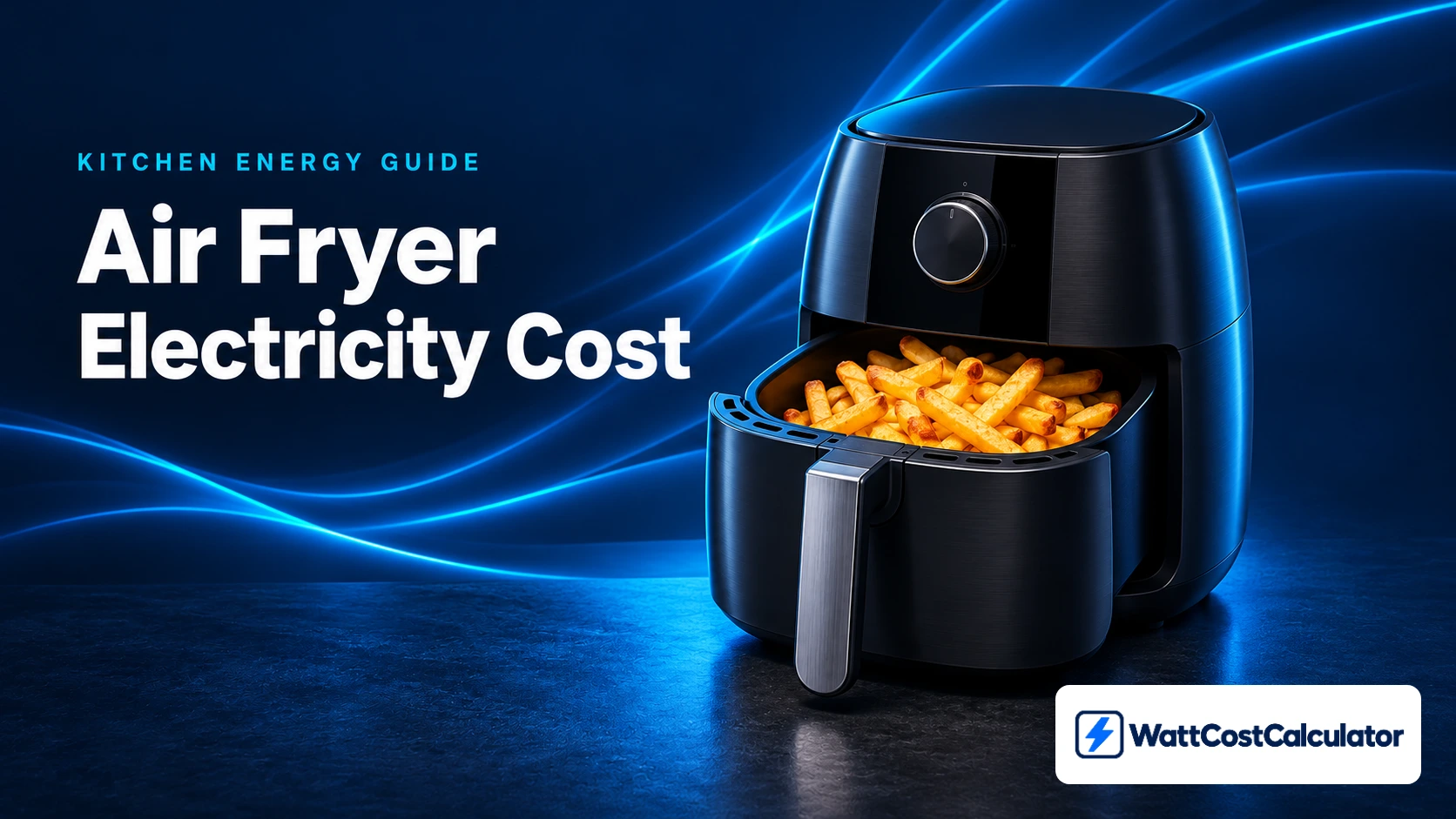
In the scenario below, an air fryer rated at 1,400 W cooking for 20 minutes uses about 0.47 kWh per session, or about 8.5 cents per session. Cooking once a day for a year costs about $30.93, and three sessions a week costs about $13.22 per year. The wattage and cooking time are scenario inputs. Check the label on your own appliance, and time a typical cook to replace them with your own numbers.
- Why an air fryer is efficient for small batches
- Inputs used in this guide
- The same daily cooking in four states
- Air fryer compared with a full-size oven
- Preheating and the cook time
- Cooking in batches
- Choosing a basket size
- Food type and cook time
- A microwave comparison for reheating and small tasks
- Small kitchens and rentals
- Cooking several things at once
- Cleaning and maintenance
- Electrical notes
- Frequently asked questions
- Sources and method
Why an air fryer is efficient for small batches
An air fryer is a small convection oven. A fan moves hot air around a compact basket, so the heat reaches the food quickly and the cavity is small. The result is that the appliance heats a small volume of air, which takes less energy than heating a full-size oven cavity. For a small batch, the energy per portion is often lower than a full oven bake, because the appliance spends its energy on the food and the air around it, not on a large empty box.
The efficiency has limits. A full basket cooks more food per session, and a basket packed tightly may need a longer time, which raises the energy used. Cooking in several small batches uses more energy than one batch at the right size. The best result comes from matching the basket to the portion and cooking once rather than repeatedly.
Inputs used in this guide
The calculation uses one scenario for a typical cooking session.
– Power: 1,400 W, a common rating for an air fryer – Cooking time: 20 minutes per session, including the time the element is on – Energy per session: 1,400 W multiplied by 20 minutes, which is 0.47 kWh
Annual cost equals energy per session, multiplied by the number of sessions a year, multiplied by the rate. The U.S. average rate is 18.16 cents per kWh, from the U.S. Energy Information Administration’s Electric Power Monthly, Table 5.6.A, for August 2026.
| Cooking pattern (scenario) | Cost per session | Annual cost |
|---|---|---|
| One 20-minute session per day (365 sessions) | $0.08 | $30.93 |
| Three 20-minute sessions per week (156 sessions) | $0.08 | $13.22 |
The per-session cost is rounded from 8.47 cents. The annual figures use the unrounded energy values.
The same daily cooking in four states
Electricity rates change the annual totals. The table below applies the EIA August 2026 state averages from Table 5.6.A to one 20-minute session per day.
| Location (EIA August 2026 average) | Rate | Annual cost, one session per day |
|---|---|---|
| Washington | 14.63 cents/kWh | $24.92 |
| United States | 18.16 cents/kWh | $30.93 |
| New York | 28.65 cents/kWh | $48.80 |
| California | 29.75 cents/kWh | $50.67 |
Even in California, a daily 20-minute air fryer session costs about $51 per year in this scenario. The air fryer’s cost is small compared with the time saved for many cooks.
Air fryer compared with a full-size oven
A full-size oven bake of 60 minutes at a planning draw of 2.0 kWh per session costs about 36 cents per session at the U.S. average rate, as in our toaster oven and full-size oven guide. Three such bakes a week come to about $56.66 per year. The air fryer’s 20-minute session uses far less energy for a small portion. The comparison holds only for a similar amount of food. A large batch in an air fryer may need several rounds, and that changes the total.
Preheating and the cook time
Many air fryers preheat for a few minutes before the food goes in. Preheating adds energy and time, so check whether your recipe needs it. Some recipes cook well without a preheat, and skipping it can save a small amount per session. A shorter cook time also saves energy, and checking food early helps avoid overcooking, which wastes energy. If your model has a preheat option, compare the result with and without it on one food, and keep the setting that gives the result you want with the least time.
Shaking the basket or turning the food can help it cook evenly, but each opening of the drawer releases heat. Check the food through the window when the model allows it, and open the drawer only when needed.
Cooking in batches
A basket of food cooks more evenly when it is not overcrowded. Spread the food in a single layer where possible, and leave space for hot air to move. If the batch is too large, cook in two rounds rather than forcing everything into one, because the food may steam rather than crisp, and the cook time may stretch.
Cooking a full basket once can use less energy than two half baskets, because the appliance heats once and the food cooks in a single session. The right size depends on your household, so choose the basket that fits your regular portions.
Choosing a basket size
Basket size is the first decision that affects the energy per portion. A small basket suits one or two people and quick snacks. A large basket suits a family or a batch of food for several meals, but it takes longer to heat and may need a longer cook time. The right size is the one that holds your usual portion in a single layer with room for air to move. A basket that is too small for a usual meal forces several rounds, and a basket that is too large for a small meal heats more air than the food needs.
Check the rated wattage on the label, not the basket size alone. Two baskets of the same volume can have different wattages, and the wattage sets the energy per minute. Use the wattage for the calculation, and the cook time for each food type.
Food type and cook time
Different foods need different cook times, and the cook time sets the energy per session. Frozen snacks often need a short cook at a high setting. Vegetables may need a longer cook at a moderate setting. Meats need a time that ensures they reach a safe internal temperature, and the time depends on the cut and the size. Use a food thermometer for meats, and check the instructions for the food type. Frozen foods often need the same or a slightly longer time than fresh foods of the same size, so add a few minutes and check early.
A practical habit is to write down the cook time for the three foods you cook most often. Those notes give you a realistic session time, which is more useful than a general estimate. Multiply each food’s time by its wattage and your rate to get the cost per session for that food.
A microwave comparison for reheating and small tasks
A microwave is often used for reheating, and it can be more efficient than an air fryer for simple reheating of food that does not need crisping. In the scenario, a 1,000 W microwave running for 3 minutes uses about 0.05 kWh, which costs about 0.9 cents at the U.S. average rate. Over a year of daily use, that is about $3.31. The air fryer uses more energy for the same reheat, but it can restore crispness that a microwave cannot. Choose the appliance that matches the result you need.
Small kitchens and rentals
An air fryer can be a useful appliance in a small kitchen or a rental, because it does not require a full-size oven and it does not heat the whole kitchen. Check the circuit before placing it on a shared outlet, and keep it on a counter with space around it. In a rental, confirm the appliance is allowed under the lease, and place it on a stable surface away from curtains and cabinets.
Cooking several things at once
Some households cook two foods in one session by using a divider or by timing the foods to finish together. A single session with two foods uses the same energy as a single session with one food of the same total weight, so the saving comes from avoiding a second session. Plan the cooking order so that the two foods finish at the same time, and check the internal temperature of the thicker food first. Keep the lighter food on the upper level or the second rack, if your model has one, so that it does not overcook while the thicker food finishes. Shake or turn the lighter food halfway through so that it browns evenly, and avoid stacking pieces, which blocks the hot air and slows the cook.
Cleaning and maintenance
A clean air fryer heats more efficiently and cooks more evenly. Grease buildup on the heating element or the fan can reduce airflow and cause longer cook times. Clean the basket and the drawer after each use, and wipe the interior once a week. Check the fan area for dust or debris according to the manual.
Keep the air intake and exhaust clear. A blocked vent can cause the appliance to overheat, which can trigger a shutoff in the middle of a cook. Empty the drawer of crumbs and grease before each use, since residue can smoke at high heat and affect the next batch.
Electrical notes
An air fryer rated at 1,400 W draws about 11.7 amps at 120 V. A standard 15 A household circuit can carry that load, but the continuous limit is about 12 amps, so the appliance is near the edge of what the circuit can supply for an extended session. Do not share the outlet with a toaster oven, a microwave, or a kettle at the same time. Plug the air fryer into a grounded outlet, and avoid extension cords and power strips, which can overheat under a high load.
Frequently asked questions
Does an air fryer use a lot of electricity? Not for a typical session. In this scenario, one 20-minute session costs under 9 cents at the U.S. average rate.
Is an air fryer cheaper than an oven? For small batches, usually yes. For large batches, the difference depends on how many rounds you need.
Should I preheat? Only if the recipe asks for it. Many recipes cook well without it.
How do I measure my own air fryer? Plug it into a plug-in energy meter during a typical cook, and record the kWh. Multiply by your rate, then by the number of sessions per year.
What would this cost in your home?
Adjust the starting values to match your appliance and electricity plan.
Sources and method
Energy per session equals rated watts multiplied by the cooking time in hours, divided by 1,000. Annual energy equals session energy multiplied by sessions per year. Cost equals that energy multiplied by the residential rate. Rates are from the EIA Electric Power Monthly, Table 5.6.A for August 2026, and the state averages come from the same table. The 1,400 W rating and 20-minute session are scenario inputs. For model-specific figures, check the label on your appliance. The U.S. Department of Energy Energy Saver site gives general guidance on cooking appliance energy use.
For related comparisons, see our toaster oven vs. full-size oven guide and our electric oven vs. induction cooktop guide.
Written by Seon (Site Founder & Energy Data Researcher / Home Tech Reviewer). Last checked: November 22, 2026. These are calculated estimates from scenario inputs and average tariffs, not measured results.

Electric Oven vs. Induction Cooktop Electricity Cost: Holiday Cooking & Baking
Cooking a 31-minute weeknight meal on an induction cooktop uses roughly 0.65 kWh ($0.12 at 18.16¢/kWh), while a 4-hour holiday roast in...
Dishwasher Heated Dry vs. Air Dry: Energy Cost and Everyday Trade-Offs
Quick Scenario Summary In the scenario below, a dishwasher that runs one cycle a day with air drying uses about 0.9 kWh...

Air Fryer vs Toaster Oven Electricity Cost: Batch Size and Preheat
A basket air fryer and a countertop toaster oven can both circulate hot air. Which one costs less to cook dinner? The...

Toaster Oven vs Full-Size Oven: Electricity Cost by Meal
Quick Scenario Summary In the scenario below, three 20-minute toaster oven sessions a week use about 78 kWh a year and cost...