- Why LED holiday strings cut lighting power by up to 90%
- What would this cost in your home?
- LED vs. incandescent display costs by bulb count
- Hidden holiday loads: inflatables and smart timers
- How your state’s electricity rate changes holiday display costs
- Three practical steps to keep holiday displays efficient and safe
- Frequently asked questions
- Sources and calculation method
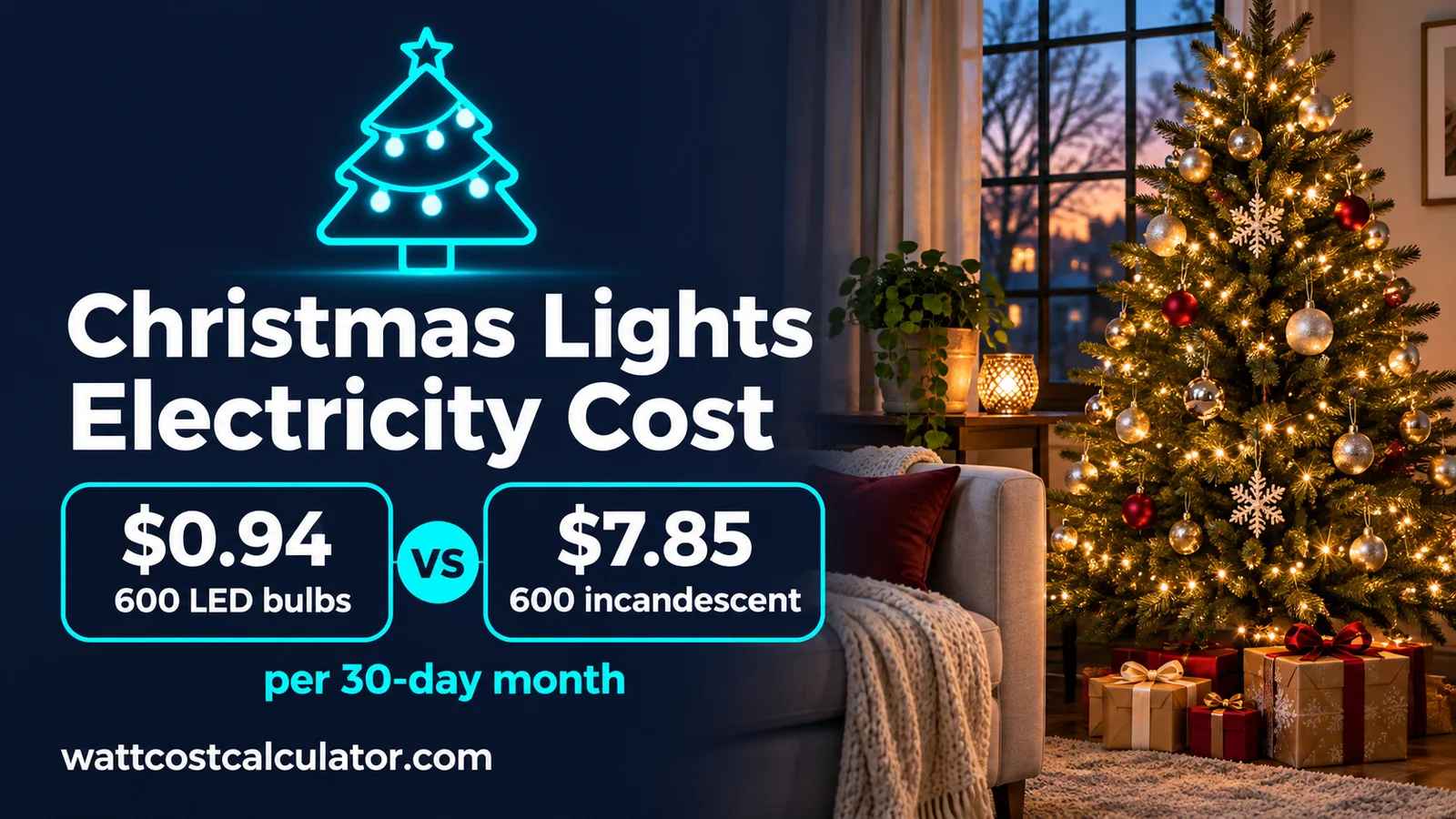
Running a modest 600-bulb indoor and porch holiday display (six 100-count strings) for 6 hours every evening typically costs around $0.26 per day or $7.85 per 30-day month with traditional incandescent mini lights at the U.S. Energy Information Administration’s August 2026 residential average of 18.16¢/kWh. Switching the exact same 600-bulb display to LED light strings drops the modeled cost to just $0.03 per day or $0.94 per 30-day month. For larger 2,000-bulb outdoor roofline displays or classic C9 bulbs, the monthly gap widens to more than $20 to $37 per month.
Why LED holiday strings cut lighting power by up to 90%
Traditional incandescent Christmas lights generate illumination by heating a thin tungsten filament until it glows, converting most of the electrical energy into wasted heat rather than visible light. A standard 100-bulb incandescent mini string typically draws about 40 watts (roughly 0.4W per bulb), while larger outdoor C9 incandescent bulbs draw 7 watts per bulb—meaning a single 100-bulb C9 roofline run pulls 700 watts, almost as much as a small space heater.
By contrast, ENERGY STAR certified decorative light strings use semiconductor light-emitting diodes (LEDs) that consume up to 92% less energy than conventional incandescent strands. According to ENERGY STAR, the electricity needed to power a single 7-watt incandescent bulb is enough to illuminate 140 LEDs—two 24-foot light strings. Because LEDs run cool and use far fewer watts per strand, you can also daisy-chain far more strings end-to-end without blowing the tiny replaceable plug fuses described in the U.S. Department of Energy’s holiday lights guide.
Use the interactive calculator below with your total display wattage and nightly timer hours. In the preset example below, a 600-bulb LED display averages 28.8 watts running 6 hours per night.
What would this cost in your home?
Adjust the starting values to match your appliance and electricity plan.
Rate note: 18.16¢/kWh is the EIA August 2026 U.S. residential average (Table 5.6.A). EIA derives average revenue per kWh from utility sales and revenue data; it is a national benchmark rather than a quote for your exact utility tariff. Checked November 14, 2026. Fixed monthly account fees are excluded.
LED vs. incandescent display costs by bulb count
Holiday electricity bills depend on three variables: bulb technology, total bulb count, and nightly timer duration. The table below compares four common residential setups running 6 hours per night (5:00 PM to 11:00 PM) across a 30-day month and a full 45-day Thanksgiving-to-New-Year’s season at 18.16¢/kWh.
| Display setup (6 hours/night) | Total watts | 30-day energy | 30-day cost | 45-day season cost |
|---|---|---|---|---|
| 600 Mini LEDs (6 strings × 4.8 W) | 28.8 W | 5.18 kWh | $0.94 | $1.41 |
| 600 Incandescent Minis (6 strings × 40 W) | 240 W | 43.20 kWh | $7.85 | $11.77 |
| 2,000 Mini LEDs (20 strings × 4.8 W) | 96 W | 17.28 kWh | $3.14 | $4.71 |
| 2,000 Incandescent Minis (20 strings × 40 W) | 800 W | 144.00 kWh | $26.15 | $39.23 |
| 100 C9 LED Roofline Bulbs (0.6 W/bulb) | 60 W | 10.80 kWh | $1.96 | $2.94 |
| 100 C9 Incandescent Roofline Bulbs (7 W/bulb) | 700 W | 126.00 kWh | $22.88 | $34.32 |
If your home runs a classic 2,000-bulb incandescent outdoor display plus 100 C9 roofline bulbs, total lighting draw hits 1,500 watts—the exact same load as running a portable electric space heater for six hours every evening. Swapping that combined setup to LEDs drops total draw to 156 watts, cutting a $73.55 seasonal lighting bill down to roughly $7.65.
Hidden holiday loads: inflatables and smart timers
Bulb strands are only part of a modern yard display. Three overlooked accessories often add more kilowatt-hours than the LED strings themselves:
- Lawn inflatable blowers (35W to 95W per inflatable): Unlike LEDs, inflatable yard decorations rely on a continuous shaded-pole or DC blower fan plus internal lights. Running two 65W inflatables for 10 hours a day adds 1.30 kWh daily ($7.08 per 30-day month at 18.16¢/kWh)—more than seven times the electricity of 600 LED tree lights.
- All-night operation vs. 6-hour timers: Leaving a 2,000-bulb incandescent display plugged in for 12 hours overnight instead of 6 hours doubles your 30-day bill from $26.15 to $52.30. A mechanical or photocell dusk-to-midnight timer pays for itself in the first week.
- Wi-Fi smart plugs (0.8W to 1.2W standby): Outdoor smart outlets make scheduling effortless and draw roughly 0.02 kWh per day on standby—around 12 cents per month—which is negligible when automating higher-wattage displays.
How your state’s electricity rate changes holiday display costs
Because many households run holiday lights between 5:00 PM and 9:00 PM—directly overlapping evening utility Time-of-Use (TOU) peak hours—state tariff differences matter even more in November and December. Below is how a 2,000-bulb outdoor mini display (144.00 kWh/month incandescent vs. 17.28 kWh/month LED) compares across four EIA Table 5.6.A residential averages.
| Location and EIA average | 2,000 Incandescent (144.00 kWh/mo) | 2,000 LED (17.28 kWh/mo) | 30-day LED savings |
|---|---|---|---|
| Washington — 14.63¢/kWh | $21.07 | $2.53 | $18.54/mo |
| United States — 18.16¢/kWh | $26.15 | $3.14 | $23.01/mo |
| New York — 28.65¢/kWh | $41.26 | $4.95 | $36.31/mo |
| California — 29.75¢/kWh | $42.84 | $5.14 | $37.70/mo |
In high-rate states like New York and California, replacing a 2,000-bulb incandescent setup with LEDs saves $36 to $38 in a single 30-day month—often recouping the purchase price of new LED strands in one or two holiday seasons. You can check your exact state benchmark in our U.S. electricity rates by state hub or compare winter home energy loads in our bathroom floor heating electricity guide.
Three practical steps to keep holiday displays efficient and safe
- Check the string’s max-connect wattage and plug fuse: Never exceed the manufacturer’s end-to-end connection limit—typically 3 strings for incandescent minis versus 20 to 40+ strings for LEDs. Overloading thin 22-gauge incandescent wires trips the small 3-amp or 5-amp fuse inside the male plug.
- Use an outdoor-rated dusk-to-midnight timer: Setting lights to turn on at 5:00 PM and shut off at 11:00 PM cuts runtime by 50% compared to leaving lights glowing until sunrise, while preventing inflatable blower motors from running unnecessarily overnight.
- Verify outdoor GFCI protection: Always plug exterior holiday displays and inflatables into a weather-resistant GFCI-protected outdoor receptacle rather than running indoor extension cords through cracked windows or doors.
Frequently asked questions
How many strings of LED Christmas lights can I plug together safely?
Most 100-count LED light strings draw only 4.8 to 7 watts (roughly 0.04 to 0.06 amps), allowing you to connect 25 to 40+ identical strings end-to-end depending on the manufacturer’s 210-watt plug-fuse rating. By contrast, 40-watt incandescent strings usually max out at 3 to 5 strings end-to-end. Always follow the specific limit printed on the white tag near the plug.
Do twinkling or chasing LED lights use less electricity than steady-on lights?
Slightly less, because individual diode channels cycle off briefly during chase patterns. However, because a 100-bulb LED string uses less than 5 watts even at 100% steady brightness, the monthly dollar difference between steady-on and twinkling LED modes is usually only a few pennies.
Do outdoor holiday lights add a lot of heat to my living room?
Only incandescent strings produce noticeable heat—which is why dry indoor Christmas trees with incandescent bulbs require careful watering and fire-safety precautions. LED strands run cool to the touch, eliminating heat buildup on indoor trees and greenery.
How does holiday lighting compare to everyday home-office power loads?
A 600-bulb LED display (28.8W for 6 hours/day, about 5.2 kWh a month) uses less than half the electricity of a dual-monitor work desk running 8 hours a day, which that guide puts at about 0.432 kWh per day, or roughly 13 kWh a month. To calculate your exact display and local tariff, plug your total watts into the main electricity cost calculator.
Sources and calculation method
Daily energy is calculated as watts × hours ÷ 1,000, and electricity cost equals total kWh × residential rate ($/kWh). String wattage scenarios model representative 100-count mini and C9 bulb specifications under a 6-hour nightly schedule for 30-day and 45-day periods. Fixed monthly utility account fees, local taxes, and time-of-use peak surcharges are excluded.
- ENERGY STAR Certified Decorative Light Strings — efficiency criteria (up to 92% energy savings vs. incandescent, ≤0.2W per bulb).
- U.S. Department of Energy (DOE): How Do Holiday Lights Work? — series-parallel wiring, plug fuse safety, and LED vs. incandescent circuit behavior.
- EIA Electric Power Monthly, Table 5.6.A — August 2026 state and U.S. residential average retail prices.
Last checked: November 14, 2026. This guide presents modeled electricity estimates from ENERGY STAR product guidelines, DOE circuit principles, and EIA average tariffs. Check your light-string tag and utility bill for your exact wattage and rate.

Cat Water Fountain Electricity Cost: Monthly Cost by Pump Wattage
A cat water fountain costs about $0.13 to $0.39 a month at 18.16¢/kWh if its pump runs 24 hours at 1 to...
CPAP Machine Electricity Cost: Heated Humidifier & Heated Tube Impact
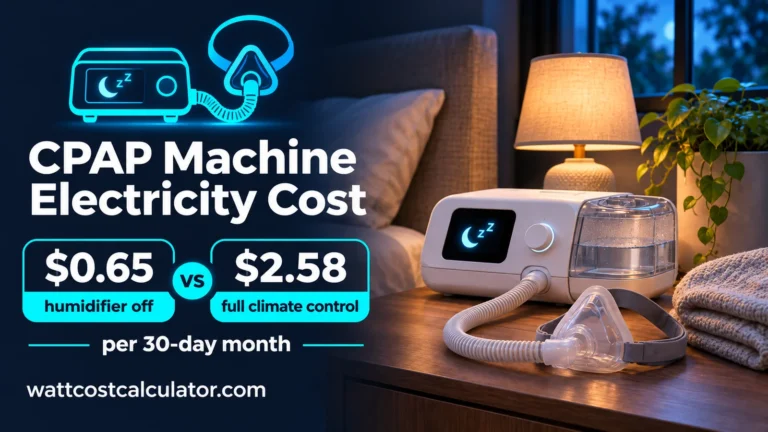
Running a CPAP machine for 8 hours a night costs roughly $0.65 per 30-day month ($7.95/year) with humidification off, or $2.58 per...
Robot Vacuum & Auto-Empty Wash Dock Electricity Cost: Charging vs. Hot-Air Drying
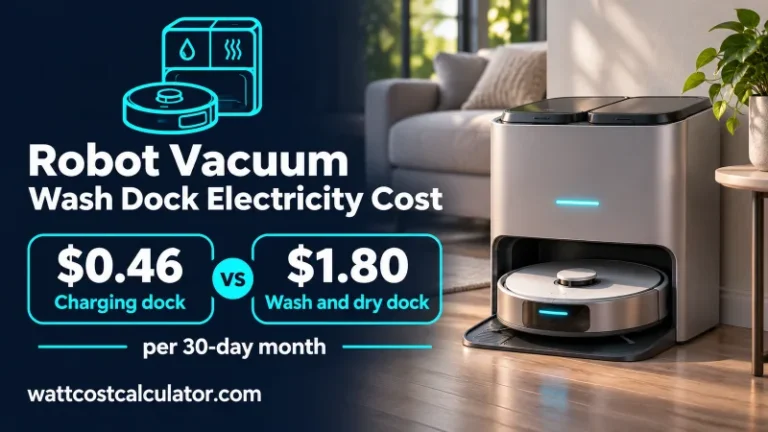
A basic charging-only robot vacuum costs roughly $0.46 per 30-day month ($5.62/year) at 18.16¢/kWh, while an all-in-one mop-washing and hot-air drying station...
Home Printer Electricity Cost: HP OfficeJet Pro 9125e vs. Brother HL-L2405W
A lightly used HP OfficeJet Pro 9125e costs about $0.32 a month in electricity, while a Brother HL-L2405W left in its 4-watt...