
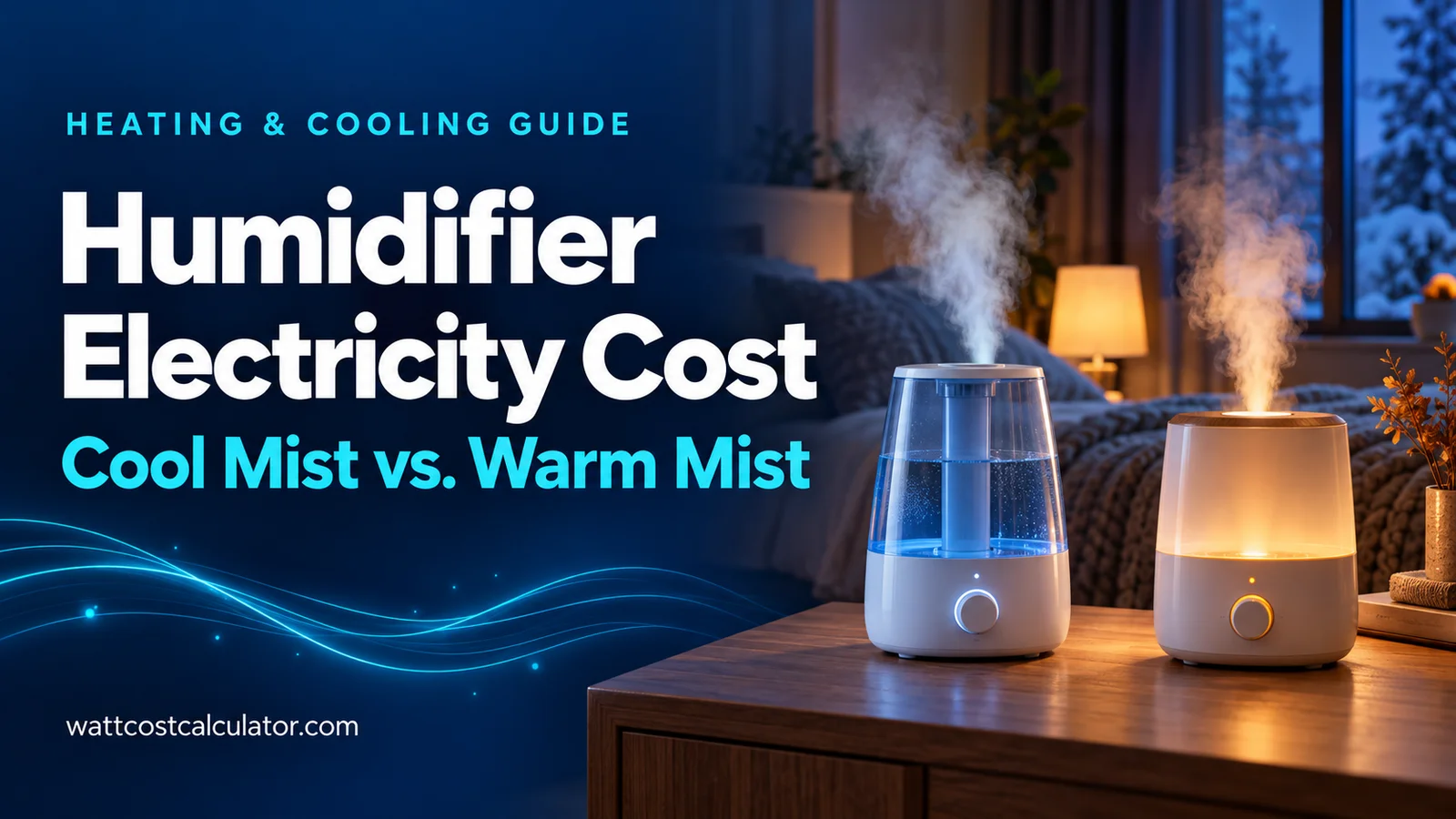
- Why cool mist and warm mist draw different power
- Calculate your humidifier electricity cost
- What would this cost in your home?
- Eight-hour night: watts matter, but so does runtime
- Water and filters can change the cheaper choice
- Measure one ordinary night before changing equipment
- Do not run longer just because the electricity is cheap
- Our take: compare the room outcome, then the bill
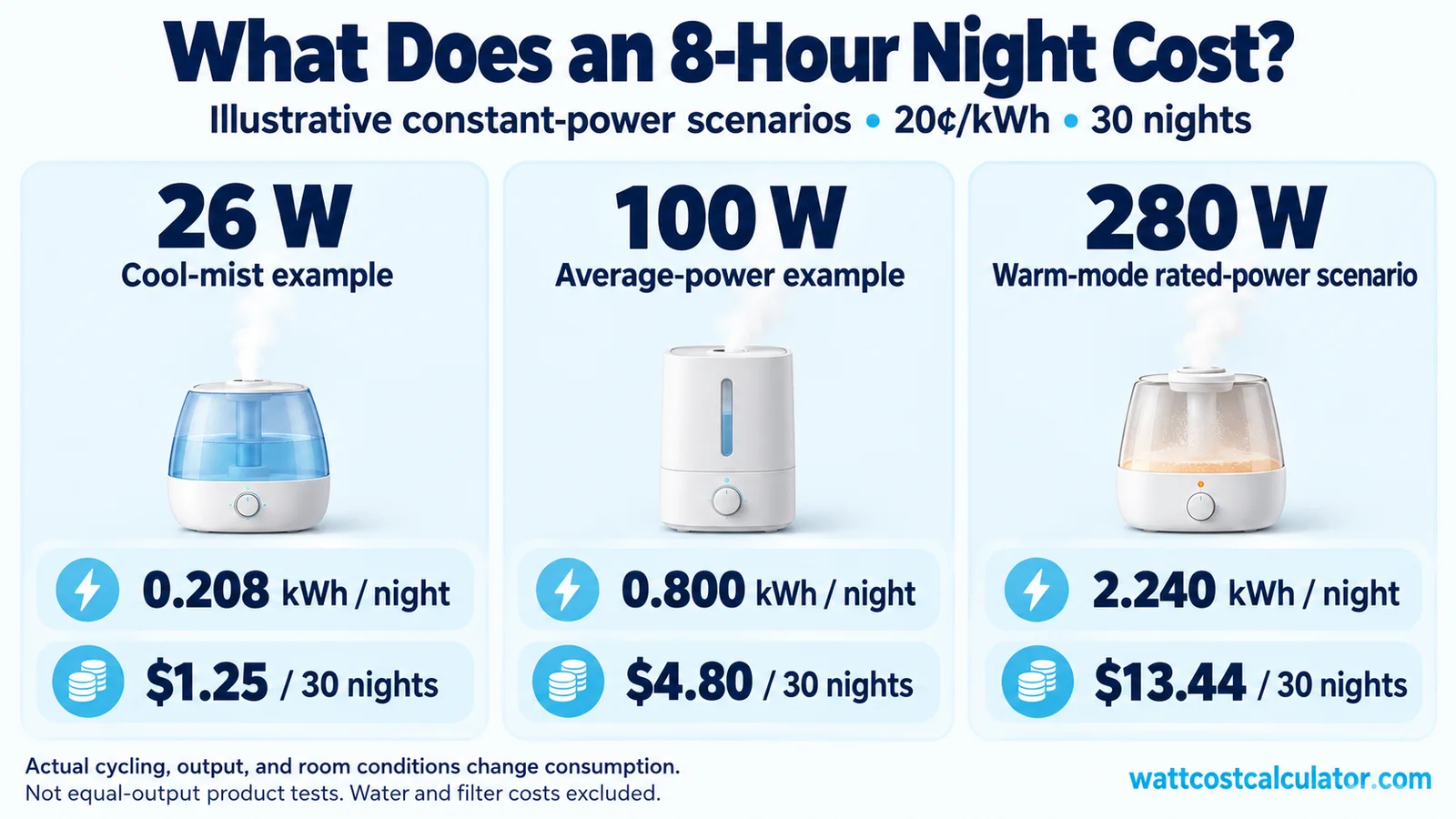
A humidifier’s electricity cost can be pennies per night or several dollars per month, depending on whether it uses a heating element and how often it actually runs. At an illustrative 20¢/kWh, a constant 26-watt load for eight hours costs about 4 cents per night, or $1.25 for 30 nights. A constant 280-watt load over the same hours costs about 45 cents per night, or $13.44 for 30 nights. Those are calculation scenarios, not measurements of two machines delivering identical humidity.
The useful buying question is not simply “Which humidifier has fewer watts?” It is: What does it cost to maintain the humidity my room needs, including electricity, water, and replacement materials? This guide focuses on portable room humidifiers, rather than furnace-mounted whole-house systems. The comparison uses published specifications and the usage assumptions shown below.
Why cool mist and warm mist draw different power
Ultrasonic models use vibration to produce mist. Evaporative models use a fan and a wet wick or filter. Steam vaporizers heat water; some hybrid ultrasonic models also offer a heated warm-mist mode. These designs do not all have the same operating load, water output, or maintenance requirements. The EPA’s humidifier guide explains the main operating types and their care requirements.
For concrete nameplate examples, Levoit lists the Classic 300S ultrasonic cool-mist model at 26 W and the LV600S warm/cool hybrid at 280 W. These are manufacturer ratings checked on November 9, 2026, not our measured averages. In particular, the hybrid’s 280 W rating does not mean it draws 280 W in cool mode, at every setting, or throughout an automatic overnight session.
We use those ratings to make the scale of the calculation tangible. They are not an efficiency ranking: the models have different outputs and room specifications. A low-watt model that cannot maintain the desired humidity is not an equivalent substitute for a larger unit.
Calculate your humidifier electricity cost
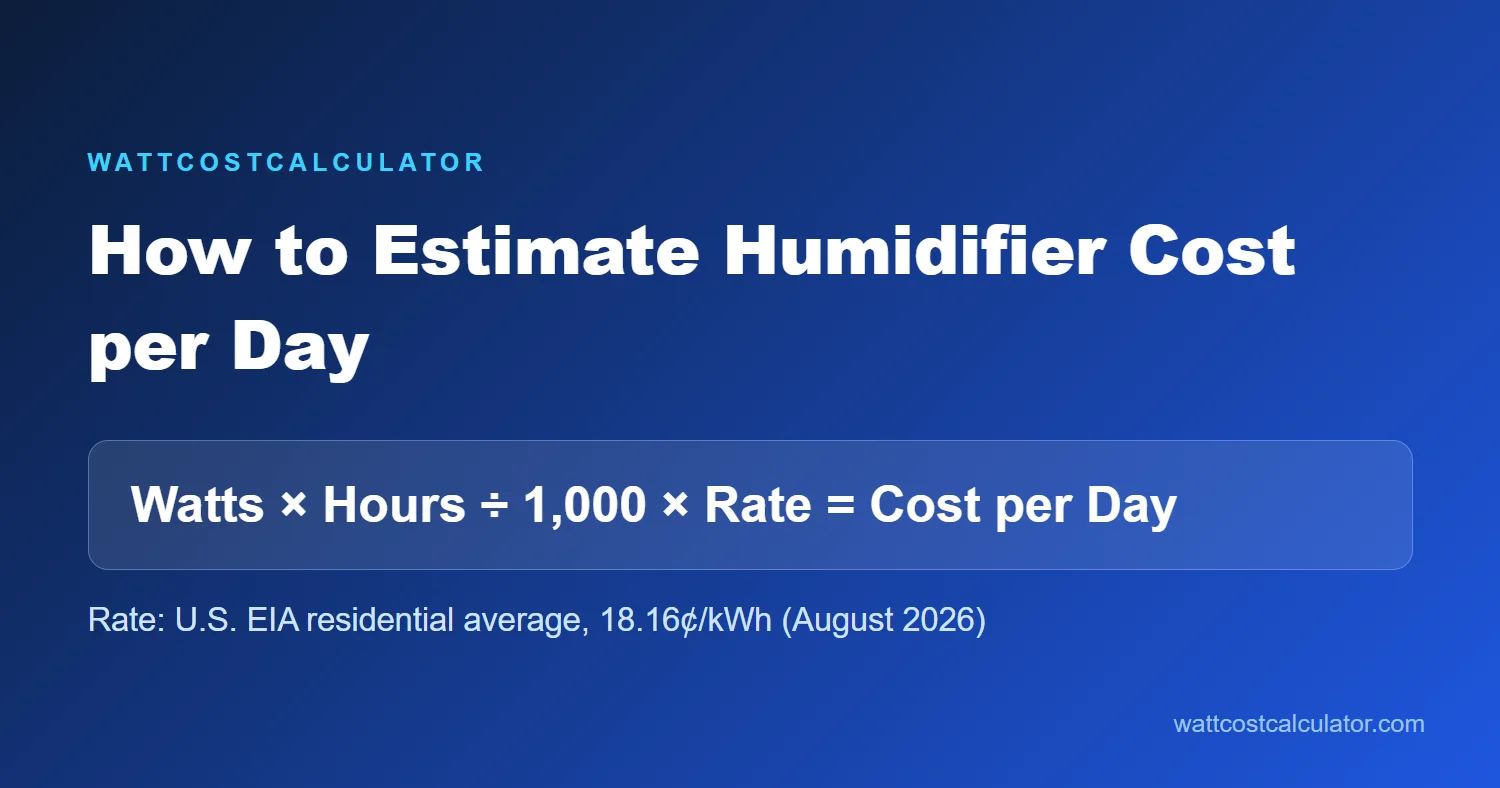
Use watts ÷ 1,000 × hours × price per kWh. In the calculator, the price is entered in cents, so 20 means $0.20/kWh. Replace the 26 W example with your measured average or a clearly identified rated-power scenario. The results project daily use over 30 days and 365 days; a winter-only humidifier should not be budgeted as a full year unless you really use it year-round.
What would this cost in your home?
Adjust the starting values to match your appliance and electricity plan.
Find the variable electricity price on your bill with our U.S. electricity bill guide. A flat monthly customer fee is not an extra charge caused by running the humidifier. On a time-of-use plan, calculate each price period separately using our TOU rate guide.
Eight-hour night: watts matter, but so does runtime
The table holds operating time and electricity price constant. The 100 W row is an invented average-power example, not a typical specification or a claim about a particular design.
| Constant or average input | Energy in 8 hours | Cost per night | 30 nights at 20¢/kWh |
|---|---|---|---|
| 26 W | 0.208 kWh | $0.0416 | $1.25 |
| 100 W | 0.800 kWh | $0.1600 | $4.80 |
| 280 W | 2.240 kWh | $0.4480 | $13.44 |
If the 280 W load runs for only four hours within an eight-hour overnight window, its active energy is 1.12 kWh, costing $0.224 per night or $6.72 for 30 nights, before any standby consumption. Do not enter eight hours and then halve the watts again if you have already accounted for that same cycling.
There are two valid ways to estimate a cycling unit: use its operating watts with actual active hours, or use its measured average watts over the entire observation window. If a meter records 0.90 kWh over nine hours, the whole-window average is 100 W. Use 100 W × 9 hours; do not apply another duty-cycle discount.
Water and filters can change the cheaper choice
At low electrical loads, supplies deserve attention. A purely hypothetical 0.4 gallon of purchased water per night at $1 per gallon adds $12 over 30 nights. That is much more than the 26 W electricity example. It is not a market price or a recommended consumption level: use your actual water quantity and local cost. A hypothetical $15 replacement wick lasting three months adds another $5 per month of that use period.
Our buying preference is to compare the full seasonal cost and maintenance routine before replacing a working unit for lower wattage alone. Electricity, suitable water, filters or cartridges, and purchase price belong in that comparison. Check the manual for the water and replacement materials your model requires. Do not switch to unsuitable water merely to improve the cost estimate.
As another conditional example, the difference between the two constant-power endpoints above is $12.19 per 30 nights. That saving exists only if both loads really run for the assumed hours and provide an acceptable result. It is not a promised saving from buying the lower-rated product.
Measure one ordinary night before changing equipment
- Record the room conditions. Note starting humidity, target setting, doors, and approximate room temperature. Compare nights with similar conditions.
- Measure cumulative kWh. If the manufacturer’s instructions permit it, use a suitably rated plug-in energy meter in a dry, safe position. Follow both devices’ electrical and placement instructions.
- Record time and water use. An eight-hour timer does not guarantee eight hours of active humidification. Note empty-tank shutdowns, automatic cycling, and how much water was actually used.
- Price the full session. Multiply measured kWh by your applicable rate, then add water and replacement-material costs separately.
- Repeat when conditions change. A colder, leakier, or larger room can require a different operating pattern. One night is a useful snapshot, not a season-long guarantee.
The plug reading covers the humidifier, not the whole home’s heating bill. Warm-mist equipment adds heat locally, while evaporation and changing room conditions interact with heating demand. We have not modeled those effects, so the electricity table should not be presented as a net whole-house energy saving.
Do not run longer just because the electricity is cheap
Use a hygrometer and respond to the room. The EPA advises keeping indoor relative humidity at or below 50%, reducing output or use if condensation or dampness develops, and keeping steam equipment away from children because hot water and steam can burn. Its care guidance includes daily emptying, drying, and refilling of portable tanks, frequent cleaning, and low-mineral water to limit mineral dispersal. Follow the product’s care instructions as well.
A humidifier adds moisture; a dehumidifier removes it. If windows are wet or the room is already humid, adding moisture to achieve a timer target makes little sense. For winter comfort costs beyond humidity, compare our space-heater running costs and electric blanket versus space heater guide.
Our take: compare the room outcome, then the bill
For an existing humidifier, measure a normal session before making a replacement decision. For a new one, start with suitable output, a cleaning routine you can sustain, and the correct water requirements; then estimate electricity with realistic cycling. A low electricity figure is useful only when the unit meets the room’s needs without over-humidifying.
Try your own watts, overnight hours, and electricity rate in the calculator above, or use our Appliance Electricity Cost Calculator to compare other winter devices.
Sources and method
Sources checked November 9, 2026: Levoit Classic 300S specifications, Levoit LV600S specifications, and EPA, Use and Care of Home Humidifiers. All dollar figures are our calculations at an illustrative 20¢/kWh, rather than a claimed current U.S. average. The images illustrate the topic and scenarios; they are not photographs of our testing.
Disclaimer: The figures on this page use statewide or standardized averages and the inputs shown. They are for general information only, not a utility quote, a bill, or financial advice. Check your own electricity bill and the official EIA or manufacturer sources for current figures.

Waterbed Heater Electricity Cost: 170 W vs 325 W Per Month
A waterbed heater costs about $22.23 to $42.49 a month at 18.16¢/kWh if it runs 24 hours at 170 W or 325...

Infrared Sauna Electricity Cost: Cost Per 1-Hour Session by Model
An infrared sauna costs about $0.25 to $0.49 per one-hour session at 18.16¢/kWh, depending on model. Here is the cost per session...
Engine Block Heater Electricity Cost: 1,000 W vs 1,500 W Per Month
An engine block heater costs about $10.90 to $16.34 a month at 18.16¢/kWh when plugged in 2 hours a night at 1,000...

Heated Dog Bed Electricity Cost: Small vs Medium Pad Per Month
A heated dog bed costs about $2.62 to $5.23 a month at 18.16¢/kWh if it runs 24 hours at 20 W to...