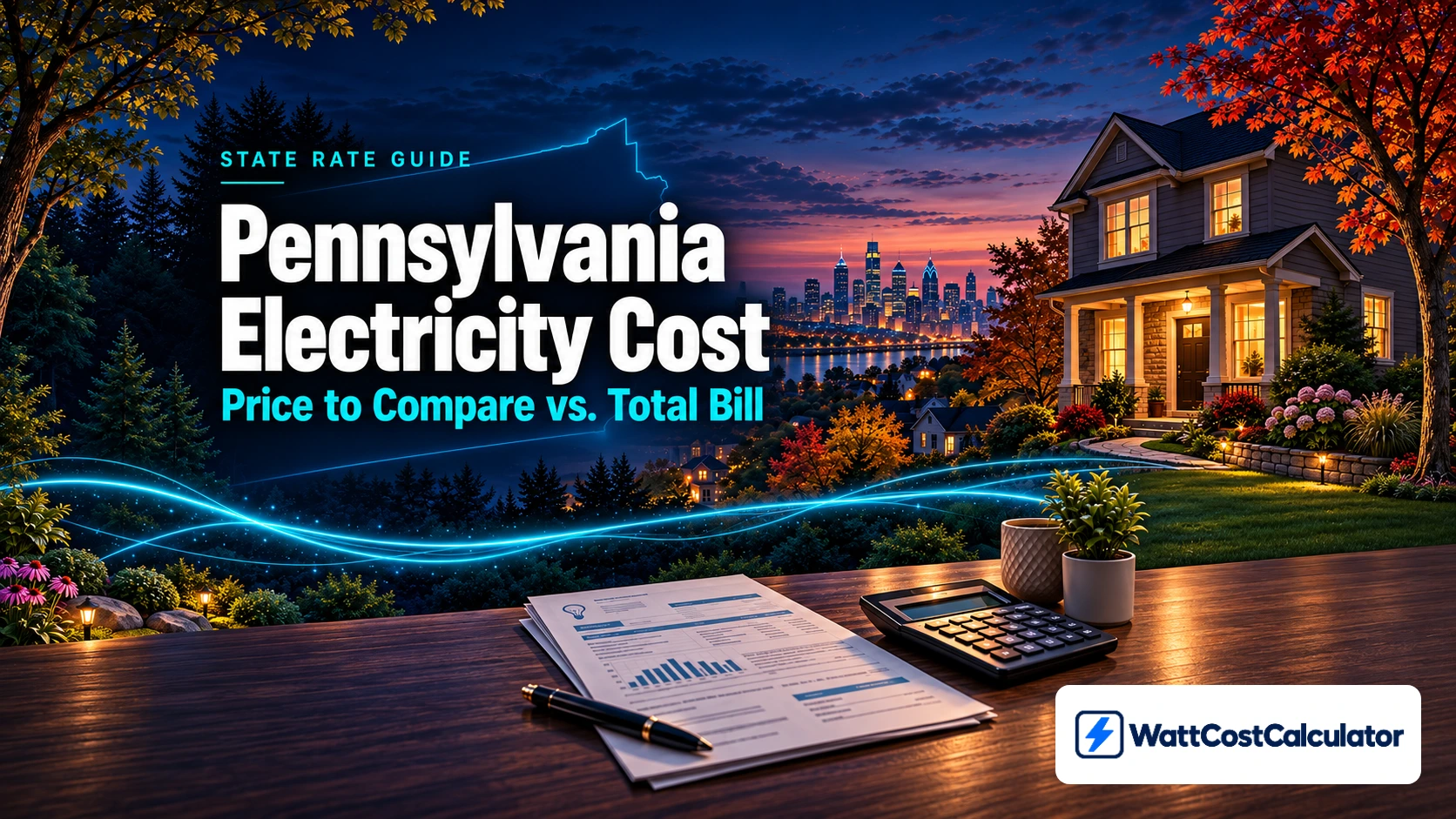
Pennsylvania’s average residential rate is 21.77 cents per kWh, from EIA Table 5.6.A for August 2026. That is about 3.6 cents above the U.S. average of 18.16 cents. For a reference home that uses 1,000 kWh a month, the energy charge alone is about $217.70 per month, compared with about $181.60 at the U.S. average. The gap is about $433 per year. Pennsylvania bills also include delivery and other charges, and the shopping choice a household makes changes the energy part of the bill.
- Price to compare and the total bill
- Rates compared with the U.S. average
- A reference home at 1,000 kWh per month
- Heating and cooling in Pennsylvania
- Electric heat and the winter bill
- Appliance scenarios at Pennsylvania’s rate
- What delivery charges cover
- Time-of-use and peak-hour plans
- Water heating and the electric bill
- Solar and net metering in Pennsylvania
- Keeping records for a fair comparison
- Comparing offers
- Practical steps for lowering the bill
- Frequently asked questions
- Sources and method
Price to compare and the total bill
Pennsylvania households can buy electricity from a retail supplier or stay with the default service from the local utility. The default service price is set periodically and is published as a price to compare, which is the per-kWh energy price a customer would pay for default service. A retail offer is compared with that price. The price to compare covers the generation part of the bill. It does not include the delivery charge, which is set by the local utility and paid no matter which supplier a household chooses.
A household comparing offers should look at the total estimated bill, not the energy rate alone. Add the delivery charges, any fixed monthly charges, and any taxes that apply. The total shows whether an offer saves money in practice. Check the terms of each offer, including the contract length, any introductory rate, and what happens at the end of the term.
Rates compared with the U.S. average
The table below uses the EIA August 2026 residential figures from Table 5.6.A.
| Location (EIA August 2026 average) | Rate | Difference from U.S. average |
|---|---|---|
| Pennsylvania | 21.77 cents/kWh | about 3.61 cents higher |
| United States | 18.16 cents/kWh | reference |
At the same usage, a higher energy rate adds to the bill every month. For a household that uses 1,000 kWh a month, the difference is about $36 per month at the state average.
A reference home at 1,000 kWh per month
To compare Pennsylvania with the national benchmark on the same basis, this guide uses a reference home that uses 1,000 kWh per month. It is a planning value, not the average for Pennsylvania.
| Reference home (1,000 kWh per month) | Energy charge, monthly | Energy charge, annual |
|---|---|---|
| Pennsylvania (21.77 cents/kWh) | $217.70 | $2,612.40 |
| United States (18.16 cents/kWh) | $181.60 | $2,179.20 |
The energy charge is only one part of the total. Delivery, fixed charges, and taxes are added on top, and they are not in the EIA energy rate.
Heating and cooling in Pennsylvania
Pennsylvania has hot summers and cold winters, and both seasons can raise the bill. Cooling is a major summer load in many homes, and electric heat or a heat pump can drive the winter bill. The seasonal swing can be large, so a household should compare the same month in each year, not a summer month against a spring one.
As a scenario, a 1,200 W window air conditioner running 8 hours a day for 31 days uses about 297.6 kWh. At Pennsylvania’s average rate, that is about $64.79 for the month. At the U.S. average rate, the same unit costs about $54.04. The per-unit difference is modest, but a whole-house system running for longer hours multiplies it.
Electric heat and the winter bill
A home with electric resistance heat or electric baseboards can see a large winter bill, because the heating load is high on cold days. A heat pump uses less electricity per unit of heat in mild weather, but its efficiency drops as the temperature falls, so a cold snap can still raise the bill. Insulation, air sealing, and a thermostat set back during the night are the most reliable ways to reduce the heating load.
Check the heating system’s rated capacity and its efficiency, and consider a programmable thermostat with a schedule that matches the household’s routine.
Appliance scenarios at Pennsylvania’s rate
The table below applies Pennsylvania’s rate to three common household loads. The scenarios use planning values, not measurements of any specific product.
| Scenario (annual energy) | Pennsylvania (21.77 cents/kWh) | United States (18.16 cents/kWh) |
|---|---|---|
| Refrigerator at 493 kWh per year | $107.33 per year | $89.53 per year |
| Electric vehicle charging, 300 kWh per month | $783.72 per year | $653.76 per year |
The refrigerator row uses the published average of 493 kWh per year for ENERGY STAR refrigerators in one analysis, as a planning value. The EV row uses the reference of 300 kWh per month from our EV charging guide. A household with an EV sees the rate difference grow over a year.
What delivery charges cover
The delivery part of a Pennsylvania bill pays for the poles, wires, transformers, and meters that bring power to the home, and for maintaining and repairing that system. It is set by the local utility and reviewed by the state’s regulator, so it is the same for a household whichever supplier it chooses. Delivery charges can make up a large share of the bill, especially for a household that uses little electricity, because part of the delivery charge is fixed.
When comparing offers, do not subtract anything from the bill. Add the delivery charges to each offer’s energy price, so that the totals are fair. A supplier offer that looks cheap on the energy line may not be cheaper once the delivery line is included.
Time-of-use and peak-hour plans
Some Pennsylvania offers include time-of-use pricing, with a higher rate during the late afternoon and evening and a lower rate overnight. A household that can shift flexible loads, such as a dishwasher, a washer, an EV charger, or a pool pump, to off-peak hours can lower its bill on that plan. A household that uses most of its power during the peak window may pay more than the flat-rate average.
Read the peak and off-peak hours on each offer, and check which days the peak applies. Set the schedules on appliances that can run on a timer, and keep the high-use tasks out of the peak window when possible.
Water heating and the electric bill
Electric water heaters are a common load in Pennsylvania homes. A storage water heater uses energy to keep a tank of water hot, and its standby losses continue all day. The water heater’s share of the bill depends on the size of the tank, the set point, the household’s hot water use, and the heater’s efficiency. Insulating the tank and the first few feet of hot water pipe can cut standby losses. Lowering the set point a few degrees, while keeping it at a safe and comfortable level, also reduces the load.
A heat pump water heater uses less electricity to produce the same hot water, because it moves heat rather than generating it directly. Compare its rated efficiency with a standard electric tank before deciding, and check the installation requirements for space and airflow.
Solar and net metering in Pennsylvania
Pennsylvania households can install rooftop solar, and the value of the energy a system exports depends on the program terms and the utility’s rules. The rules have changed over time, so check the current terms before you sign a contract. The energy a household uses directly from its own panels does not appear on the grid bill, which lowers the bill by the energy it replaces. The credit for exported energy depends on the program and can differ from the retail rate.
Ask the installer and the utility to show the expected savings using the current rate and the household’s own usage. Compare the result with the energy charge on the bill, and check the payback period under realistic assumptions.
Keeping records for a fair comparison
Keep a log of the monthly kilowatt-hours, the energy price, the delivery charges, and any fixed charges for the last twelve months. The log shows the total cost of the current arrangement, and it gives a basis for comparing a new offer. A year of records also shows the seasonal pattern clearly, so that a comparison is made across the same months.
Record the date of each contract, the length of any fixed term, the renewal terms, and the name of the supplier and the utility on each bill. A reminder set a month before the end of a contract gives time to compare offers without rushing.
Comparing offers
When comparing a retail offer with the default service, use the same usage in both calculations. Enter the offer’s energy rate, add the delivery and fixed charges that apply, and compare the total with the default service total. Read the fine print for any variable rate, a credit that expires, or a fee that applies at the end of the contract. A low introductory rate can rise after the first term, so calculate the cost for the full contract, not only the first bill.
The state’s official comparison tool lists offers and the default price. Use it to check the price to compare for your utility’s territory before you choose a plan.
Practical steps for lowering the bill
Set the thermostat for the season. A few degrees of setback in winter and summer, when the house is empty, reduces the heating and cooling load.
Seal and insulate. Air leaks and poor insulation make both heating and cooling work harder. Check attic insulation, door seals, and window treatments.
Maintain the system. A clean filter and a clean coil help the system run efficiently. Schedule service on the manufacturer’s interval.
Compare offers before renewal. Check the offers when the contract ends, and compare them with the default service total.
Use the benchmark carefully. The state average is a starting point. Your own bill, usage, and plan decide the actual cost.
Frequently asked questions
Is electricity more expensive in Pennsylvania than the U.S. average? On the EIA August 2026 residential average, yes. Pennsylvania’s average is 21.77 cents per kWh, compared with 18.16 cents for the U.S.
Why is the price to compare different from my bill? The bill includes delivery and other charges, and the price to compare covers only the generation part of the price.
Should I switch suppliers? It depends on the total estimated cost for your usage and the terms of the offer. Compare the total, not the headline rate.
Can I calculate my bill myself? Yes, for the energy part. Multiply kilowatt-hours by the rate, then add the delivery, fixed, and tax lines from your bill.
What would this cost in your home?
Adjust the starting values to match your appliance and electricity plan.
Sources and method
Monthly cost equals kilowatt-hours multiplied by the residential rate in dollars per kWh. The Pennsylvania and U.S. rates come from the EIA Electric Power Monthly, Table 5.6.A for August 2026. The reference home of 1,000 kWh per month and the scenario loads are planning values, not measurements. The refrigerator row uses a published average as a planning input. Figures exclude delivery, fixed charges, and taxes. The U.S. Department of Energy Energy Saver site gives general guidance on home energy use.
For the national benchmark, see our U.S. electricity rates by state hub.
Written by Seon (Site Founder & Energy Data Researcher / Home Tech Reviewer). Last checked: November 22, 2026. These are calculated estimates from EIA average rates and planning scenarios, not measured results.
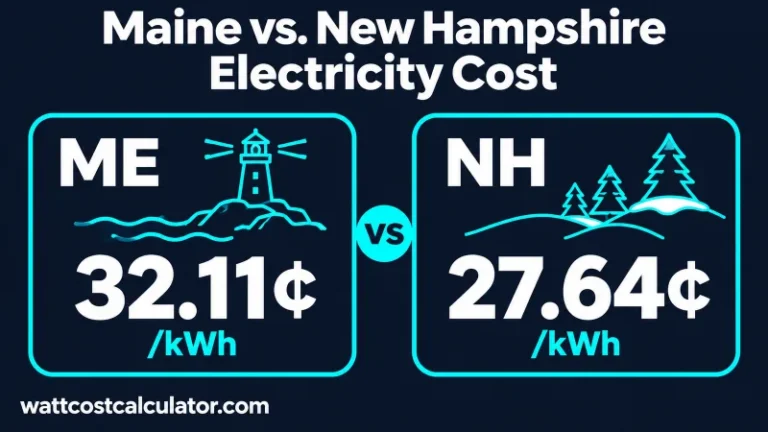
Maine vs. New Hampshire Electricity Cost: Winter Heat Pump & Delivery Bills
Residential electricity in Maine averaged 32.11¢/kWh in August 2026 (EIA), compared with 27.64¢/kWh in New Hampshire—making a 700 kWh monthly bill $31.29...

2026 US State-by-State Electricity Cost Master Guide
Compare electricity prices across U.S. states using EIA data: the five most expensive and cheapest states, plus California, Texas, Florida and New...
U.S. Electricity Rates by State (2026 Comparison Hub)
Compare residential electricity prices in all 50 states and DC, using EIA August 2026 data with August 2025 for comparison, and jump...
Illinois vs Ohio Electricity Cost: Supply Rates and the Total Bill
Table of ContentsHideWhat the same usage costs at state averagesPrice to Compare: a supply benchmark, not the entire billWhy a lower supplier...