

Texas’s average residential rate is 15.91 cents per kWh, from EIA Table 5.6.A for August 2026, which is below the U.S. average of 18.16 cents. For a reference home that uses 1,000 kWh a month, that is about $159.10 per month, compared with about $181.60 at the U.S. average. The gap is about $270 per year. Texas’s rate is lower on average, but the bill still depends on cooling hours, the home’s insulation, and the plan a household chooses.
- What the state average does and does not include
- Rates compared with the U.S. average
- A reference home at 1,000 kWh per month
- Cooling is the largest load in most Texas homes
- How to read a Texas bill
- Seasonal load pattern
- Appliance scenarios at each rate
- Heat, winter, and the shoulder seasons
- Solar and rate plans
- Choosing a plan
- Time-of-use plans and peak hours
- Practical steps for lowering a Texas bill
- Frequently asked questions
- Sources and method
What the state average does and does not include
The state average is calculated from utility sales and revenue across the state. It is a benchmark, not a bill. It does not include fixed monthly charges, delivery fees in some plans, taxes, or the plan-specific charges that a household may pay. A Texas household chooses from many retail plans, and those plans can have very different prices, contract terms, and fixed fees. The average rate can be far from the rate on your own plan, so use it as a starting point and compare it with your bill.
The average is also a blend across the state. A home in one part of the state may see a higher or lower rate than the average, depending on its provider and its plan. Check the energy charge on your bill, divide it by the kilowatt-hours used, and compare the result with the benchmark.
Rates compared with the U.S. average
The table below uses the EIA August 2026 residential figures from Table 5.6.A.
| Location (EIA August 2026 average) | Rate | Difference from U.S. average |
|---|---|---|
| Texas | 15.91 cents/kWh | about 2.25 cents lower |
| United States | 18.16 cents/kWh | reference |
At the same usage, a lower rate saves a little each month, and the saving grows with the number of kilowatt-hours a home uses. A high-use home in Texas sees a larger dollar saving than a low-use home, all else equal.
A reference home at 1,000 kWh per month
To compare Texas with the national benchmark on the same basis, this guide uses a reference home that uses 1,000 kWh per month. It is a planning value, not the average for Texas.
| Reference home (1,000 kWh per month) | Monthly cost | Annual cost |
|---|---|---|
| Texas (15.91 cents/kWh) | $159.10 | $1,909.20 |
| United States (18.16 cents/kWh) | $181.60 | $2,179.20 |
The difference is about $22.50 per month, or about $270 per year, for this reference home at the state average. Actual savings depend on your plan and your usage.
Cooling is the largest load in most Texas homes
Summer cooling drives the Texas bill. Hot afternoons and long stretches of high temperatures mean that an air conditioner may run for many hours a day from late spring through early autumn. The cooling load depends on the outdoor temperature, the home’s insulation and windows, the thermostat setting, and the efficiency of the system.
As a scenario, a 1,200 W window air conditioner running 8 hours a day for 31 days uses about 297.6 kWh. At Texas’s average rate, that costs about $47.35 for the month. At the U.S. average rate, the same unit costs about $54.04. The per-unit difference is modest, but a whole-house system running longer hours multiplies it.
How to read a Texas bill
A Texas electricity bill often has several parts: the energy charge, which is the kilowatt-hours used multiplied by the plan’s rate; a fixed monthly charge, which is paid even when usage is low; and taxes and fees. Some plans add a delivery charge that is set by the local transmission and distribution utility. The EIA average is closest to the energy charge alone, so compare the energy charge on your bill with the benchmark, rather than the total.
Check the billing period, because a 30-day month and a 33-day month can show different kilowatt-hours, and a bill that covers a heat wave can look much higher than the months around it. Keep the bill pages for the year, so you can compare a hot month with a hot month from the year before. A simple habit is to note the thermostat setting and the number of hot days in each billing period, so that a change in the bill can be traced to a cause.
Seasonal load pattern
Cooling dominates the Texas summer load, while the winter heating load is usually smaller in most parts of the state. A home with central air can see its bill rise sharply from a mild spring month to a hot summer month, even on the same rate. The seasonal swing matters for budgeting. Set aside the difference between a mild month and a hot month, or use a levelized billing plan if your provider offers one, so that the summer bill does not come as a surprise.
Winter heat in Texas often comes from a heat pump or electric resistance heat, and a heat pump in mild weather usually needs less energy per degree of warmth than resistance heat. The heating load depends on the home’s insulation and the outdoor temperature, and the energy use can be lower than the summer cooling load in many areas.
Appliance scenarios at each rate
The table below applies the Texas and U.S. rates to three common household loads. The scenarios use planning values for each appliance, and they are not measurements of any specific product.
| Scenario (annual energy) | Texas (15.91 cents/kWh) | United States (18.16 cents/kWh) |
|---|---|---|
| Refrigerator at 493 kWh per year | $78.44 per year | $89.53 per year |
| Electric vehicle charging, 300 kWh per month | $572.76 per year | $653.76 per year |
| Pool pump, 1 kW for 8 hours a day, 30 days | $38.18 per month | $43.58 per month |
The refrigerator row uses the published average of 493 kWh per year for ENERGY STAR refrigerators in one analysis, as a planning value. The EV row uses the reference of 300 kWh per month, and the pool row uses a 1 kW pump running 8 hours a day. A household with an EV or a pool sees the rate difference add up over a year.
Heat, winter, and the shoulder seasons
Texas winters are generally milder than its summers, but cold snaps happen, and the heating load can rise sharply for a few days. A home with electric resistance heat can see a short spike in the bill during those days. A programmable thermostat set a few degrees lower overnight, with a warm layer of bedding and clothing, can reduce the spike without a large change in comfort.
The shoulder seasons, spring and autumn, often have the lowest bills. Those months are a good time to check the system, replace the filter, and seal any leaks before the next summer.
Solar and rate plans
Texas has a competitive retail market, and rooftop solar options are available from many providers. The terms of a solar plan, including the buyback rate, the contract length, and any fees, vary by provider. A solar system’s value depends on how much of its output the household uses directly, and on the credit for any exported energy. Read the contract carefully, and compare the expected savings with the benchmark rate in this guide, not only the headline price of the plan.
Choosing a plan
Texas is known for retail plans with different structures. Some plans have a fixed rate for the contract term, some have a variable rate that changes with the wholesale market, and some offer time-of-use pricing with peak and off-peak windows. Each structure carries different risks. A fixed rate gives a predictable bill, while a variable rate may fall or rise with market conditions. A time-of-use plan can save money for a household that shifts flexible loads, but it can cost more for a household that runs cooling during the peak window.
Read the plan’s energy charge, any fixed monthly fee, the contract length, the early-termination terms, and any credit that depends on usage. Compare the total estimated bill for your usage, not the headline rate alone. Write down the plan name, the rate, the contract end date, and any renewal terms in one place, so that the renewal decision is not made in a hurry. The state’s official comparison tools can help with that comparison.
Time-of-use plans and peak hours
Many Texas plans set their highest prices in the late afternoon and evening, when demand is high. A household on a time-of-use plan should check the peak window and the off-peak window, then schedule flexible loads outside the peak. A dishwasher, a washer, an EV charger, or a pool pump can often run in the off-peak window without a change in comfort.
Cooling is harder to shift, because the house warms during the day. A thermostat set a few degrees higher during the peak window, with a pre-cool before the window opens, can reduce the peak load while keeping the house comfortable.
Practical steps for lowering a Texas bill
Raise the thermostat when the house is empty. A few degrees of setback during the workday can reduce the cooling load, and a programmable or smart thermostat can automate it.
Seal and insulate. Air leaks and poor insulation let cool air escape, so the system runs longer. Check attic insulation, door seals, and window treatments.
Shade the windows. Blinds, shades, and exterior shading reduce the heat that enters the house. A shaded west window can make a noticeable difference in the afternoon.
Maintain the system. A clean filter and a clean outdoor coil help the system run efficiently. Schedule service on the manufacturer’s recommended interval.
Compare plans before renewal. A plan that was cheap when you signed may not be the best choice at renewal. Check the offers before the contract ends.
Frequently asked questions
Is electricity cheaper in Texas than the U.S. average? On the EIA August 2026 residential average, yes. Texas’s average is 15.91 cents per kWh, compared with the U.S. average of 18.16 cents.
Does the state average tell me my bill? No. Your bill depends on your plan, your usage, fixed charges, and taxes. Use the average as a benchmark.
Why does cooling matter so much? Cooling is often the largest seasonal load, and in a hot climate it can run for many hours a day, which makes efficiency and setback habits important.
Can I use the calculator for my own home? Yes. Enter the wattage and hours of your largest loads, and use your plan’s energy rate from the bill.
What would this cost in your home?
Adjust the starting values to match your appliance and electricity plan.
Sources and method
Monthly cost equals kilowatt-hours multiplied by the residential rate in dollars per kWh. The Texas and U.S. rates come from the EIA Electric Power Monthly, Table 5.6.A for August 2026. The reference home of 1,000 kWh per month and the 1,200 W window air conditioner running 8 hours a day for 31 days are planning scenarios, not measurements. Figures exclude fixed monthly charges, taxes, and plan-specific fees. The U.S. Department of Energy Energy Saver site gives general guidance on cooling and home energy use.
For the national benchmark, see our U.S. electricity rates by state hub.
Written by Seon (Site Founder & Energy Data Researcher / Home Tech Reviewer). Last checked: November 22, 2026. These are calculated estimates from EIA average rates and planning scenarios, not measured results.
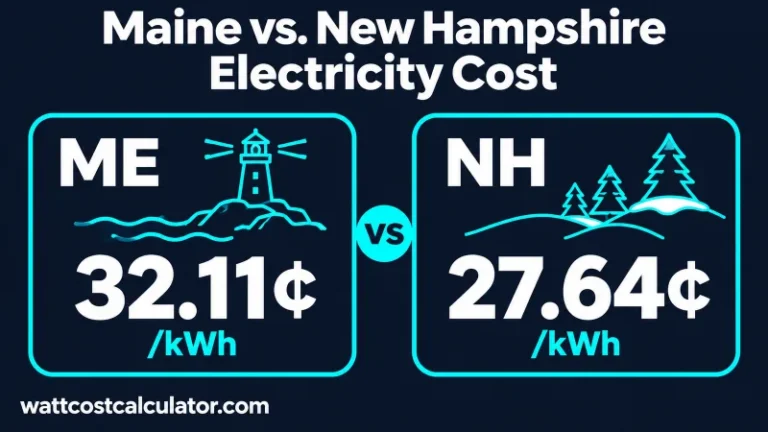
Maine vs. New Hampshire Electricity Cost: Winter Heat Pump & Delivery Bills
Residential electricity in Maine averaged 32.11¢/kWh in August 2026 (EIA), compared with 27.64¢/kWh in New Hampshire—making a 700 kWh monthly bill $31.29...

2026 US State-by-State Electricity Cost Master Guide
Compare electricity prices across U.S. states using EIA data: the five most expensive and cheapest states, plus California, Texas, Florida and New...

U.S. Electricity Rates by State (2026 Comparison Hub)
Compare residential electricity prices in all 50 states and DC, using EIA August 2026 data with August 2025 for comparison, and jump...

Illinois vs Ohio Electricity Cost: Supply Rates and the Total Bill
Table of ContentsHideWhat the same usage costs at state averagesPrice to Compare: a supply benchmark, not the entire billWhy a lower supplier...