
- Calculate the energy you actually pay for
- Separate the motor from hot water
- What would this cost in your home?
- Cold vs. heated water: a transparent example
- Why the water heater changes the answer
- A useful physics check, not a substitute for measurement
- Read a label without counting water heating twice
- How to build a more useful household estimate
- Keep washing cost separate from drying cost
- Frequently asked questions
Washing machine electricity cost has two parts: energy used by the washer and energy used to heat its water. In our illustrative example, a cold load using 0.20 kWh costs $0.04 at 20¢/kWh. Adding 0.80 kWh of electric water heating raises that load to $0.20. These are teaching inputs, not measured averages or a current national electricity rate.
The important question is not just “how many watts is my washer?” It is which energy use your number includes. A meter at the washer outlet can miss a separate water heater, while an annual label estimate may already include water-heating assumptions. Counting the same energy twice is just as misleading as leaving it out.
Calculate the energy you actually pay for
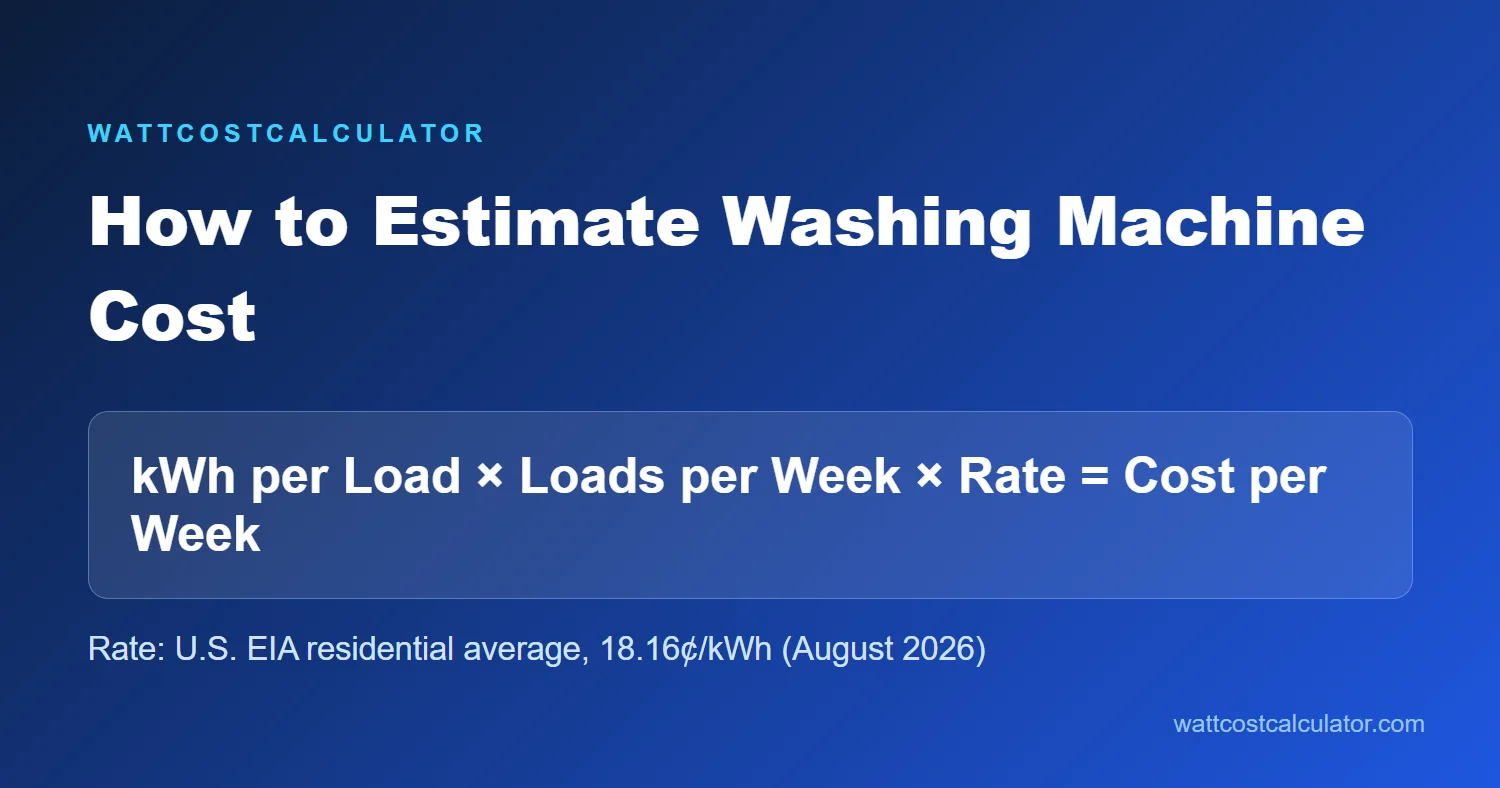
Use cost per load = electric kWh per load × electricity price in dollars/kWh. Add separately billed fuel costs only when applicable. For an average month, multiply per-load cost by loads/week × 52 ÷ 12.
The calculator starts with our 0.20-kWh cold-load example and five loads per week. Change energy per load to 1.00 to reproduce the electric hot-water example below. Enter the combined electricity only if your input includes both the washer and its electric water heating. The tool cannot infer your water heater type.
Separate the motor from hot water
If a meter reports 0.15 kWh for both wash cycles but the warm cycle requires another 0.40 kWh at an electric water heater, compare 0.15 with 0.55 kWh for whole-home electricity. At 20¢/kWh, the difference is 8¢ per load. With gas water heating, track that portion as fuel cost separately. These inputs illustrate the accounting boundary.
What would this cost in your home?
Adjust the starting values to match your appliance and electricity plan.
Cold vs. heated water: a transparent example
To isolate water heating, assume both loads use 0.20 kWh for the washer itself, including any energy captured in that example’s washer-side measurement. The heated-water case adds 0.80 kWh from a separate electric resistance water heater. We hold load count and electricity price constant. Actual cycles can differ in motor time, fill volume and internal heating, so this is not a prediction for a particular model.
| Illustrative case | Electricity/load | Cost/load | Average month* | Annual* |
|---|---|---|---|---|
| Cold load, no added water heating | 0.20 kWh | $0.04 | $0.87 | $10.40 |
| Same washer + 0.80 kWh external electric water heating | 1.00 kWh | $0.20 | $4.33 | $52.00 |
| Difference attributable to modeled water heating | 0.80 kWh | $0.16 | $3.47 | $41.60 |
*Five loads/week, 52 weeks/year and 20¢/kWh. Average month = annual ÷ 12. Each result is rounded independently, so displayed monthly totals may not subtract exactly. Excludes water/sewer bills, detergent, drying, fixed utility charges and standby energy outside the inputs.
At 10¢/kWh, the same 0.80-kWh difference is $20.80/year. At 40¢, it is $83.20/year. Changing the rate changes the dollars, not the modeled energy saved. Use your own applicable rate rather than assuming a high-price state’s headline average applies to your home.
Why the water heater changes the answer
- Electric resistance water heater: include electricity attributable to the hot water delivered for the wash. Distribution and storage losses can complicate allocation.
- Heat pump water heater: do not reuse a resistance-heater kWh estimate unchanged. Electricity depends on operating mode, conditions and any resistance backup.
- Gas water heater: the water-heating fuel belongs on the gas side of the calculation. The washer’s electricity may look similar even when total household energy cost changes.
- Internal washer heater: heater use is already captured by a complete washer-side electricity measurement. Do not add the same internal heating again as an external allowance.
Cold, tap-cold, warm and hot settings are not universal temperature specifications. Check your machine’s manual: temperature control, incoming supply temperature and special cycles can change what happens during a load.
A useful physics check, not a substitute for measurement
For water alone, approximate heat needed in kWh as liters × temperature rise in °C × 0.001163. Heating 20 liters by 30°C needs about 0.70 kWh of heat. This is an illustrative quantity of heated water, not a claim about a washer’s total water use.
That is thermal energy, not automatically billed electricity. A real system’s fuel, efficiency, heat-pump performance and losses matter. It also does not establish the amount of hot water your cycle draws. Our table’s 0.80-kWh allowance is an independent scenario assumption, not a result calculated from this physics example.
Read a label without counting water heating twice
ENERGY STAR’s washer guide recommends checking the yellow EnergyGuide label and explains that its IMEF efficiency metric considers more than washer motor electricity, including water heating and moisture removal. Different metrics serve different purposes; IMEF is not a ready-to-enter per-load kWh measurement.
Read the exact label’s assumptions and the manufacturer’s documentation before adding any external water-heating estimate to annual kWh. If you convert an annual estimate into per-load energy, use the load count underlying that estimate, not an unrelated number of loads. Compare similar capacities and test assumptions.
How to build a more useful household estimate
- Choose a repeatable load. Record cycle, temperature setting, laundry quantity, extra rinses and any sanitize or steam options.
- Measure complete cycles when suitable. Record kWh rather than multiplying the highest nameplate wattage by the entire elapsed cycle. Use only equipment compatible with the appliance and its instructions; do not open wiring or improvise a meter connection.
- Identify the missing energy. Check whether hot water comes from elsewhere. A washer-outlet reading alone does not measure that separate heater.
- Track several comparable loads. Document the range rather than presenting one reading as every household’s normal use.
- Apply your billing rate. Our electric bill guide separates variable charges from fixed fees. For TOU plans, allocate washer and electric water-heater use to the relevant periods rather than automatically assigning both to the washer’s start time.
Keep washing cost separate from drying cost
More spin extraction can affect the energy needed for later drying, but a washer-only comparison does not capture the whole laundry task. Compare equivalent cleaning and final dryness before claiming one routine is cheaper. See the electric dryer cost guide for a separate per-load budget.
For appropriate routine loads, consider cold water and a detergent suited to it. Follow garment care labels and your washer’s cleaning and hygiene instructions; energy savings are not a reason to override a required process. Run loads within the manufacturer’s capacity limits.
Frequently asked questions
Does a longer Eco cycle always cost more?
No. Elapsed time does not tell you integrated kWh. A longer program can change heating, agitation and pauses. Compare complete-cycle energy under similar conditions.
Can I use the rated watts times one hour?
That gives a constant-power scenario, not necessarily a measured cycle. Motors, pumps and heaters can turn on and off. Per-cycle kWh is usually the more useful input for this budget.
Does cold washing eliminate every water-heating cost?
Do not assume so. Check the exact setting and machine behavior. The cold example here explicitly assumes no added water-heating energy; it does not describe every washer or program.
Try your own load cost above, then use our full electricity cost calculator for other household devices. For shifting use across time periods, read our TOU guide.
Reviewed October 21, 2026 by Seon. Reference: ENERGY STAR Clothes Washers guide, linked above. The cost scenarios use the usage assumptions and example rate shown above.
Related reading: To combine washer and dryer costs in one load, see our wash-and-dry cost per load guide.
Disclaimer: The figures on this page use statewide or standardized averages and the inputs shown. They are for general information only, not a utility quote, a bill, or financial advice. Check your own electricity bill and the official EIA or manufacturer sources for current figures.
At 18.16¢/kWh, a 0.20 kWh cold-water load costs about 4 cents, while a 1.00 kWh load costs about 18 cents. Most of the difference between cold and warm washing comes from heating the water, not from the washer itself.
All-in-One Washer Dryer Combo Electricity Cost: Heat Pump vs. Vented Units
A 120V heat-pump all-in-one washer dryer combo uses roughly 0.9 to 1.3 kWh per complete wash-and-dry load, costing $0.16 to $0.24 at...

Top-Load vs Front-Load Washer Electricity Cost: Hot Water and Spin
Quick Scenario Summary In the scenario below, a top-load washer using 0.65 kWh per cold-water load costs about $30.69 per year at...
Sensor Dry vs Timed Dry: Dryer Electricity Use per Load
Sensor dry can reduce the cost of overdrying, but the savings depend on how much electricity the two complete cycles actually use....
Heated Drying Rack vs Electric Dryer: Electricity Cost per Load
A heated drying rack can draw far less power at any moment than a full-size electric dryer, but a low wattage number...