
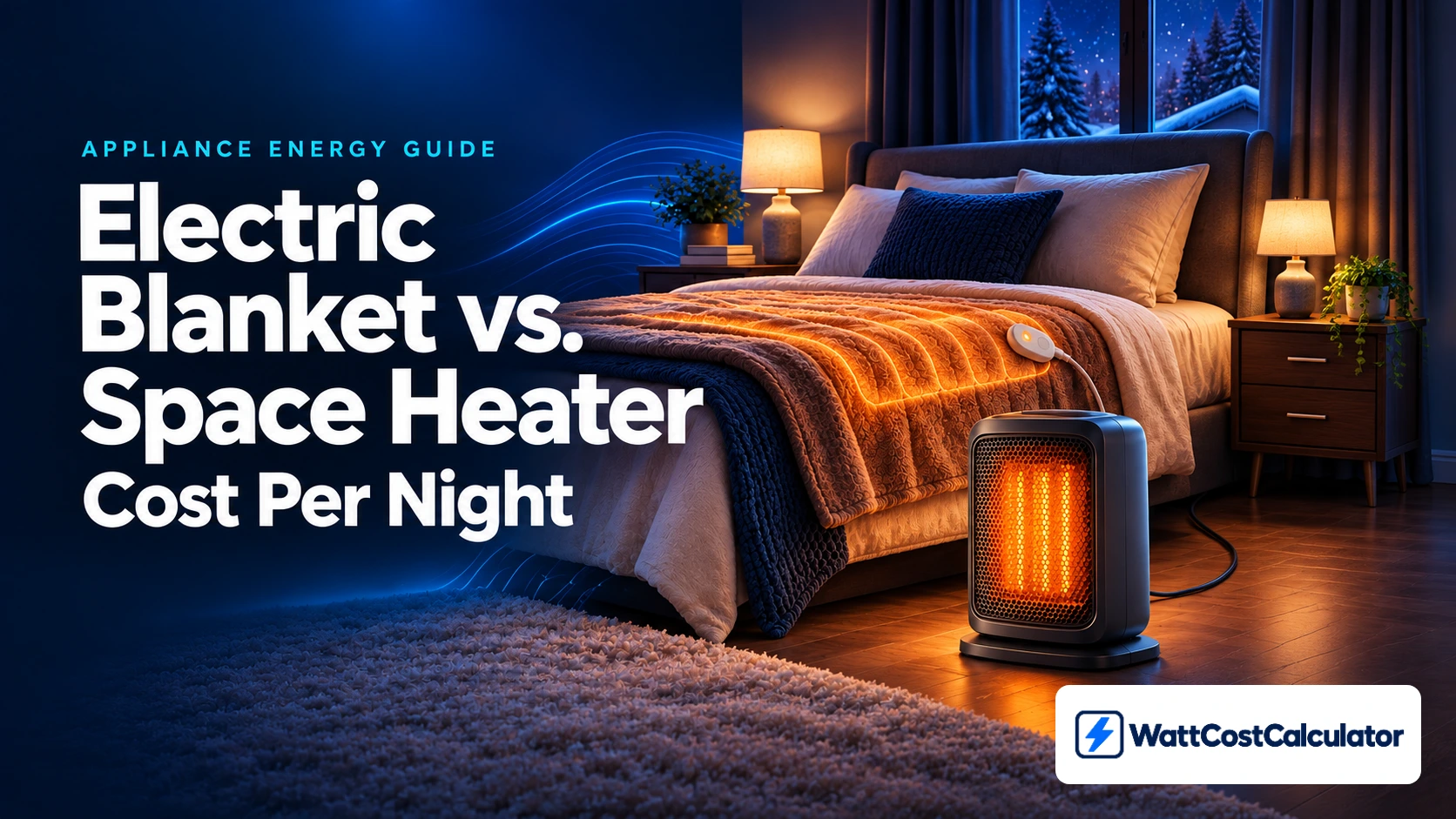
In the scenario below, a 100 W electric blanket run for 8 hours a night costs about 14.5 cents per night, or about $4.36 per 30-day month. A 1,500 W space heater run for 4 hours a day costs about $1.09 per day, or about $32.69 per month. Over a 150-night winter season, the blanket costs about $21.79 and the heater about $163.44 at the U.S. average rate. The wattage and runtime values are scenario inputs. Check the labels on your own blanket and heater before relying on the totals.
- Why the two devices differ so much
- Inputs used in this guide
- The same scenario in four states
- When each is the better choice
- Controls on electric blankets
- Room temperature and the comfort range
- Choosing a heater size
- Season planning
- Maintenance and storage
- Safety first
- Practical ways to lower the bill
- Frequently asked questions
- Sources and method
Why the two devices differ so much
An electric blanket warms a person directly. It places a low-power heating element close to the body and holds the warmth in the bed. The heat stays where it is needed, and the room air warms only a little. A space heater warms the air in a room. Most of its heat leaves the room through walls, windows, and doors, and the person in the room feels only part of the heat. That is why the same comfort can take far less energy from a blanket than from a heater.
The heat output of an electric blanket is low, and most models include a thermostat or a timer that holds a set temperature. A space heater runs at much higher power and often cycles on and off to hold a room temperature. The total energy depends on how long each device runs, and on the room’s heat loss when a heater is used.
Inputs used in this guide
The calculation uses two planning scenarios. They describe a typical winter setup, not measured results for any specific product.
– Electric blanket: 100 W, running 8 hours a night, which is 0.8 kWh per night. – Space heater: 1,500 W, running 4 hours a day, which is 6.0 kWh per day.
Monthly cost equals kilowatt-hours per day, multiplied by 30, multiplied by the rate. The U.S. average rate is 18.16 cents per kWh, from the U.S. Energy Information Administration’s Electric Power Monthly, Table 5.6.A, for August 2026.
| Device (scenario) | Energy per night or day | Cost per night or day | Cost per 30 days | Cost per 150-night season |
|---|---|---|---|---|
| Electric blanket, 100 W, 8 hours a night | 0.8 kWh | $0.15 | $4.36 | $21.79 |
| Space heater, 1,500 W, 4 hours a day | 6.0 kWh | $1.09 | $32.69 | $163.44 |
The space heater uses about 7.5 times the energy of the blanket in this scenario. The gap comes from the power rating and the room heating, not from the hours alone.
The same scenario in four states
Electricity prices change the monthly bill. The table below applies each state’s EIA August 2026 average to the 30-day scenario.
| Location (EIA August 2026 average) | Electric blanket, per 30 days | Space heater, per 30 days |
|---|---|---|
| Washington (14.63 cents/kWh) | $3.51 | $26.33 |
| United States (18.16 cents/kWh) | $4.36 | $32.69 |
| New York (28.65 cents/kWh) | $6.88 | $51.57 |
| California (29.75 cents/kWh) | $7.14 | $53.55 |
In California, the space heater scenario costs about $46 more per month than the blanket scenario. That gap is one reason many households use a blanket or a warm pad for sleep and a heater only when a room must be heated.
When each is the better choice
An electric blanket suits a person who wants to stay warm in bed. It works well with a cool bedroom, and it does not require heating the whole room. A space heater suits a room where people spend many hours, such as a home office, a living room, or a workshop. It can warm the room quickly, and it is useful when several people share the space.
For a bedroom, a blanket and a moderate room temperature often give more comfort per kilowatt-hour than a heater. For a daytime room, a heater may be the practical tool, but it should be used with a timer or a thermostat, and kept away from furniture and bedding.
Controls on electric blankets
Most electric blankets offer several heat settings, and some include a dual control that lets two people choose different temperatures. Many also include an automatic shutoff after a set number of hours, which prevents the blanket from running all night if the user falls asleep without turning it off. An auto-off feature can cut the hours in the scenario, and it is one of the simplest ways to reduce energy use without losing comfort.
A timer is a separate feature. It starts the blanket before bedtime so the bed is warm when you lie down, then turns it off. Use the timer for the warm-up period rather than the whole night, if your comfort allows it. A blanket that is warm at the start of the night and cools slowly through the night may be enough for many sleepers.
Room temperature and the comfort range
The room temperature changes how much heat a bed loses, and that changes how hard the blanket must work. A cool bedroom at a comfortable temperature with a blanket is often more efficient than a warm room with no blanket, because the blanket supplies the warmth the body needs at the surface. Find the lowest room temperature that keeps you comfortable with the blanket on, then adjust the blanket setting to suit.
For a heater, the same principle applies. Each degree of added room temperature increases the energy the heater needs to hold it. A setting a few degrees lower, with a warm layer of clothing and bedding, can reduce the run time without a noticeable drop in comfort.
Choosing a heater size
A space heater is sized by its power output, and the right size depends on the room. A small room needs less output than a large one, and a room with poor insulation needs more output to hold the same temperature. A heater that is too large for the room will cycle on and off quickly, which may be less efficient than a smaller unit that runs steadily. A heater that is too small will run continuously and struggle to reach the set point. Measure the room, check the insulation, and choose a heater whose output matches the space, rather than buying the highest wattage available.
Season planning
Winter use is seasonal, so the total for a heating season matters as much as the monthly figure. In the scenario, the blanket runs 150 nights, for a total of about $21.79 at the U.S. average rate. The heater runs 4 hours a day for the same 150 days, for a total of about $163.44. If the heater is used for only half of the season, the total halves, and if the blanket is used for the whole season, the total stays about the same. A simple plan is to estimate the number of nights the blanket is used and the number of days the heater is needed, then multiply by the per-night and per-day figures in this guide. Write the season total on the calendar at the start of winter, and compare it with the bill at the end of each month.
Maintenance and storage
Store an electric blanket flat or loosely folded, not tightly rolled, because a sharp fold can stress the wires inside. Keep it away from pets that chew cords, and avoid storing it under heavy items. Keep the controller dry, and unplug the blanket before washing if the label says the blanket must be unplugged. Never wash a blanket unless the manufacturer says it is safe to do so, and follow its drying and care instructions exactly. Check the blanket every season for a worn cord, a hot spot, or a control that no longer holds its setting.
For a space heater, clean the air intake and keep the area around the heater clear of dust, lint, and debris. Check the cord and the plug for damage at the start of each season. A heater that runs with a blocked intake can overheat and cycle more often.
Safety first
Electric blankets and space heaters both need careful use. Check the blanket’s cord and controller for damage, and do not fold or tuck the blanket in a way that bunches the element. Follow the manufacturer’s rules on use with pets and on the number of hours. Replace a blanket that shows damage, a hot control, or a worn cord.
A space heater draws 1,500 W, which is about 12.5 amps on a 120 V circuit. A standard 15 A household circuit can carry that load, but the continuous limit is about 12 amps, so the heater is at the edge of what the circuit can supply continuously. Plug the heater directly into a wall outlet, not into an extension cord or a power strip. Keep it at least three feet from bedding, curtains, and furniture, and turn it off when you leave the room.
Practical ways to lower the bill
Use the blanket for sleep and the heater only when needed. Warming a bed takes less energy than warming a room.
Set the blanket’s thermostat or timer. Preheat the bed, then lower the setting or turn the blanket off once you are asleep, if the manufacturer allows it.
Set the heater’s thermostat. A lower setting means the heater runs less often. A thermostat-controlled heater avoids running at full power when the room is already warm.
Close the room. Shut the door and cover drafty windows so that the heat stays in the room you are heating.
Use a timer. A timer limits the hours the heater runs in a room that is empty for part of the day.
Frequently asked questions
Is an electric blanket cheaper to run than a space heater? Yes, in this scenario. The blanket uses about 13 percent of the energy of the heater in this scenario, because it heats a person rather than a room.
Can I run both? Many people do. A blanket for sleep and a heater for the living room is a common combination. Check the total load on the circuit before using both at the same time.
Does a heated pad or mattress pad cost more to run? It depends on the wattage and the hours. A pad at a low wattage runs at a cost similar to a blanket.
How do I measure my own devices? Plug each device into a plug-in energy meter for a week. Record the kWh, divide by the number of nights or days, and multiply by 30 for the monthly figure.
What would this cost in your home?
Adjust the starting values to match your appliance and electricity plan.
Sources and method
Energy equals rated watts multiplied by hours, divided by 1,000. Monthly cost equals the daily energy multiplied by 30 days and the residential rate. Rates are from the EIA Electric Power Monthly, Table 5.6.A for August 2026, and the state averages come from the same table. The blanket and heater wattage and runtime values are scenario inputs. For model-specific figures, check the label on each product. The U.S. Department of Energy Energy Saver site gives general guidance on heating and home energy use.
For a related comparison, see our electric blanket vs. space heater cost guide and our space heater electricity cost guide.
Written by Seon (Site Founder & Energy Data Researcher / Home Tech Reviewer). Last checked: November 22, 2026. These are calculated estimates from scenario inputs and average tariffs, not measured results.
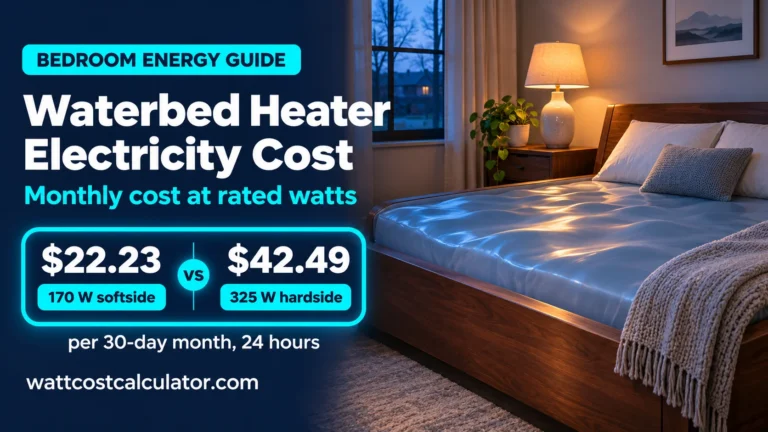
Waterbed Heater Electricity Cost: 170 W vs 325 W Per Month
A waterbed heater costs about $22.23 to $42.49 a month at 18.16¢/kWh if it runs 24 hours at 170 W or 325...

Infrared Sauna Electricity Cost: Cost Per 1-Hour Session by Model
An infrared sauna costs about $0.25 to $0.49 per one-hour session at 18.16¢/kWh, depending on model. Here is the cost per session...
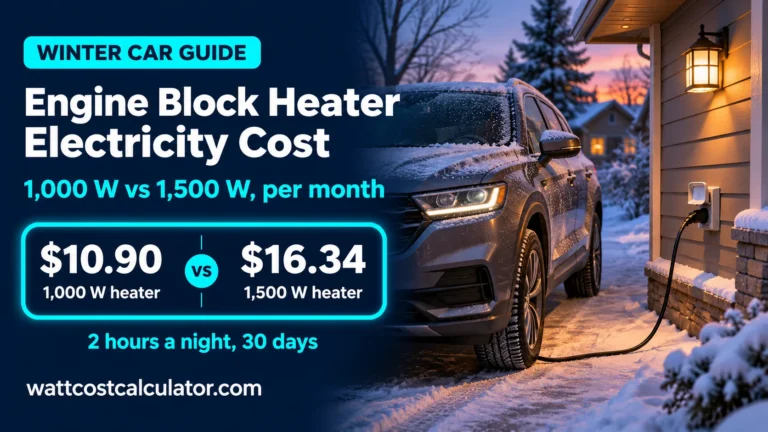
Engine Block Heater Electricity Cost: 1,000 W vs 1,500 W Per Month
An engine block heater costs about $10.90 to $16.34 a month at 18.16¢/kWh when plugged in 2 hours a night at 1,000...

Heated Dog Bed Electricity Cost: Small vs Medium Pad Per Month
A heated dog bed costs about $2.62 to $5.23 a month at 18.16¢/kWh if it runs 24 hours at 20 W to...