
- What the EnergyGuide number tells you
- Turn annual kWh into your own electricity cost
- Why a hot garage deserves a separate check
- Does a chest freezer save more than an upright?
- Estimate the ENERGY STAR reference with your rate
- Measure over several normal compressor cycles
- What would this cost in your home?
- Frequently asked questions
- Sources and assumptions
- How to measure your own freezer
Chest freezer electricity cost starts with the annual kWh on its EnergyGuide label. ENERGY STAR says a certified chest freezer uses about 215 kWh per year on average. At the latest EIA U.S. residential average available for this article, 18.16 cents per kWh (August 2026), that example works out to about $39.04 per year, or $3.25 per average month. Your freezer, electricity plan, and installation conditions can produce a different result.
The practical catch is location: a label helps compare models under standardized conditions, while a freezer in a hot garage experiences the temperatures and ventilation of your actual home. Use the label to shop; use your own rate and, when possible, measured kWh to estimate your bill.
What the EnergyGuide number tells you
The yellow EnergyGuide label reports a model’s estimated annual electricity use and helps compare similar products. The Federal Trade Commission says its annual cost estimate is based on typical use and a national average energy price; your cost depends on your use and local price. That dollar figure is useful for comparing models on the same label basis, but it is not a promise about your utility bill.
ENERGY STAR’s current freezer guidance gives about 215 kWh per year for a certified chest freezer. That is a broad reference point, not a guarantee for every capacity or model. Check the exact freezer’s EnergyGuide label or listing, including capacity and defrost type, before using a number in a purchase comparison.
Turn annual kWh into your own electricity cost
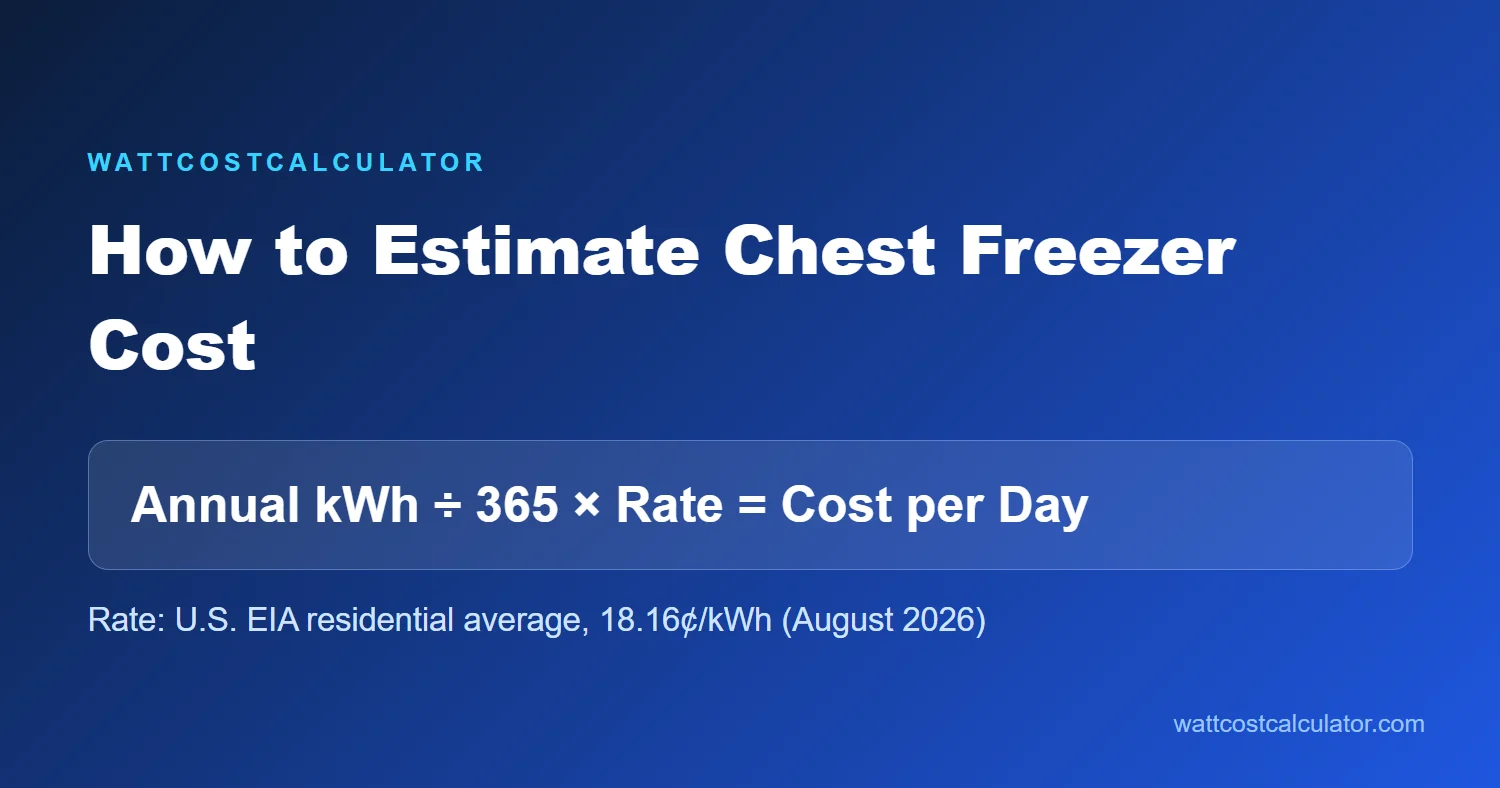
Annual energy cost = annual kWh × your electricity price per kWh. If your bill shows cents, divide by 100 before multiplying. To estimate an average month, divide the annual result by 12. This is an energy-charge estimate; fixed service fees and taxes generally do not disappear when you unplug one appliance.
Here is a sensitivity check at 18.16¢/kWh. The 215 kWh figure comes from ENERGY STAR; 100 and 350 kWh are illustrative inputs to show how the arithmetic changes, not a claimed market range or measurements.
| Annual energy use | Estimated cost per year | Average per month |
|---|---|---|
| 100 kWh (illustrative) | $18.16 | $1.51 |
| 215 kWh (ENERGY STAR reference) | $39.04 | $3.25 |
| 350 kWh (illustrative) | $63.56 | $5.30 |
The multiplication is simple, but the input matters. Use the current label for the specific model, or record the freezer’s accumulated kWh over a representative period with a properly rated energy meter. A short reading during one weather pattern may not represent a full year, so note the dates and conditions rather than treating a few days as an annual measurement.
Why a hot garage deserves a separate check
ENERGY STAR advises keeping a freezer indoors unless you live in a mild climate. It notes that extreme temperatures can stress the compressor and shorten the freezer’s life. It does not publish a universal “garage penalty” in kWh, so we would not add an invented percentage to the EnergyGuide estimate.
Before installing a chest freezer in a garage, check the exact model’s manual for its permitted room-temperature range and clearance requirements. A unit marketed as garage-ready may be designed for a wider range, but its own installation instructions still govern. Keep air able to circulate around the appliance, check that the lid seals tightly, and avoid placing it next to a heat source. ENERGY STAR recommends an interior temperature of 0°F; DOE guidance gives a typical setting range of -5°F to 0°F. Follow your model’s instructions and food-safety guidance rather than setting it colder just to chase a number.
For a real-world cost check, read the meter’s cumulative kWh after the freezer has been in its normal location for a representative week or longer, and record the indoor/garage conditions. Multiply measured kWh by the applicable variable rate. A warmer season may differ from winter, so compare periods if the garage sees large temperature swings.
Does a chest freezer save more than an upright?
ENERGY STAR says chest freezers are usually more efficient because opening the top lid lets less cold air escape than opening a front door. That is one factor, not the whole buying decision. Chest models need floor space and can make small items harder to organize; an upright may be easier to access. Compare EnergyGuide kWh for similar capacity, then weigh that difference against purchase price, usable storage, and the chance you will actually keep the appliance organized and closed.
Our practical view: do not buy extra freezer capacity solely for a small projected electricity saving. First estimate the food you expect to store and whether bulk purchases or reduced food waste justify the space and cost. If you already own a freezer, measuring it can answer whether replacing it is worth investigating; a label comparison alone cannot calculate your payback without the new unit’s price and your use.
Estimate the ENERGY STAR reference with your rate
Use 215 kWh per year as the starting example below, then replace it with your model’s label value and your own electricity rate. The U.S. average is only a comparison point. EIA reported a August 2026 residential average of 18.16¢/kWh; your bill’s marginal energy rate may differ.
Measure over several normal compressor cycles
A freezer’s nameplate watts describe operating power, while the compressor does not necessarily run all day. Use a suitable meter to record several days that include normal door openings and defrost, if applicable. Divide measured kWh by days and multiply by 365 for a rough annual projection, then consider how garage temperature changes by season.
What would this cost in your home?
Adjust the starting values to match your appliance and electricity plan.
The estimate prices the annual kWh you enter. It does not include fixed fees, taxes, demand charges, or any seasonal change in usage. For help finding an appropriate variable rate, see our guide to reading a U.S. electric bill. For the different annual-use questions that come with a refrigerator, read our refrigerator electricity cost guide, or use the full appliance electricity cost calculator with your own values.
Frequently asked questions
Is the EnergyGuide yearly cost what I will pay?
No. It is an estimate based on standardized information and a national average energy price. Your exact model use, local electricity rate, temperature, and habits affect the actual cost.
Will a chest freezer in a hot garage use more electricity?
Ambient conditions can affect operation, but there is no single reliable percentage for every freezer and garage. Check the manufacturer’s allowed temperature range and compare measured kWh in your own location. Extreme temperatures can also affect compressor life.
What temperature should I set?
ENERGY STAR recommends 0°F, while DOE guidance describes -5°F to 0°F as a typical range. Check your owner’s manual and use a freezer thermometer if the appliance does not show its actual interior temperature.
Is a chest freezer always more efficient than an upright?
ENERGY STAR says chest models are usually more efficient because less cold air escapes when the top lid opens. Compare the annual kWh labels for models with similar capacity and features; efficiency varies by product.
Related reading: A chest freezer runs continuously; compare that usage pattern with the per-load calculation in our dishwasher cost guide.
Sources and assumptions
- ENERGY STAR: Freezers — certified chest-freezer reference use, EnergyGuide shopping advice, temperature and placement tips.
- Federal Trade Commission: How to Use the EnergyGuide Label — estimated use and cost, and why actual costs vary with local energy prices and use.
- U.S. Department of Energy: Purchasing Energy-Efficient Residential Freezers — freezer selection and operating guidance.
- U.S. Energy Information Administration: August 2026 electricity prices — national residential average of 18.16¢/kWh.
Reviewed October 29, 2026. Cost examples use the displayed assumptions. EnergyGuide and ENERGY STAR figures are comparison references; actual freezer consumption depends on the exact model, setting, ambient temperature, placement, and use.
Disclaimer: The figures on this page use statewide or standardized averages and the inputs shown. They are for general information only, not a utility quote, a bill, or financial advice. Check your own electricity bill and the official EIA or manufacturer sources for current figures.
A chest freezer that uses about 215 kWh a year costs about $39 at 18.16¢/kWh, and one that uses 350 kWh costs about $64. That difference is why the annual energy rating on the label is worth checking before you buy.
How to measure your own freezer
Plug the freezer into a plug-in watt meter and leave it running for at least 24 hours with the lid closed. Read the daily kWh, multiply by 365 for the annual figure, and compare it with the EnergyGuide label. Measure again in a warm month, because the freezer works harder in hot rooms.

Electric Oven vs. Induction Cooktop Electricity Cost: Holiday Cooking & Baking
Cooking a 31-minute weeknight meal on an induction cooktop uses roughly 0.65 kWh ($0.12 at 18.16¢/kWh), while a 4-hour holiday roast in...

Dishwasher Heated Dry vs. Air Dry: Energy Cost and Everyday Trade-Offs
Quick Scenario Summary In the scenario below, a dishwasher that runs one cycle a day with air drying uses about 0.9 kWh...

Air Fryer vs Toaster Oven Electricity Cost: Batch Size and Preheat
A basket air fryer and a countertop toaster oven can both circulate hot air. Which one costs less to cook dinner? The...

Toaster Oven vs Full-Size Oven: Electricity Cost by Meal
Quick Scenario Summary In the scenario below, three 20-minute toaster oven sessions a week use about 78 kWh a year and cost...