
- Quick comparison: annual kWh matters more than heater wattage
- Try the annual-use calculator with your own rate
- Include installed cost in the payback
- What would this cost in your home?
- Two current 50-gallon models to make the comparison concrete
- Why the heat-pump model uses less electricity
- What can make your real bill different?
- Is a heat-pump water heater worth it?
- Frequently asked questions
- Sources and calculation notes
Heat pump water heater cost depends on the model, hot-water use, your electricity rate, and how the unit is set up. Using standardized annual-use figures from the U.S. Department of Energy and the latest EIA residential average available for this example, a heat-pump model comes to about $14.89 per month for water heating, compared with $52.01 for a less-efficient electric storage model. That is a controlled test comparison, not a promise about every home.
For all 50 states, see our 2026 U.S. Electricity Rates by State Hub.
Below, we show how those estimates are calculated, what can change them in real life, and how to estimate costs with your own rate.
Quick comparison: annual kWh matters more than heater wattage
DOE’s Federal Energy Management Program (FEMP) compares water heaters under a test method based on producing 20,075 gallons of hot water per year. Its guidance lists annual use of 3,437 kWh for a less-efficient electric storage water heater and 984 kWh for an ENERGY STAR heat-pump water heater. These figures let us compare tested energy use without pretending that a heater runs at its full rated power all day.
| DOE test example | Annual electricity | Annual cost at 18.16¢/kWh | Average monthly cost |
|---|---|---|---|
| Less-efficient electric storage tank | 3,437 kWh | $624.16 | $52.01 |
| ENERGY STAR heat-pump water heater | 984 kWh | $178.69 | $14.89 |
| Difference in this test comparison | 2,453 kWh less | $445.46 less | $37.12 less |
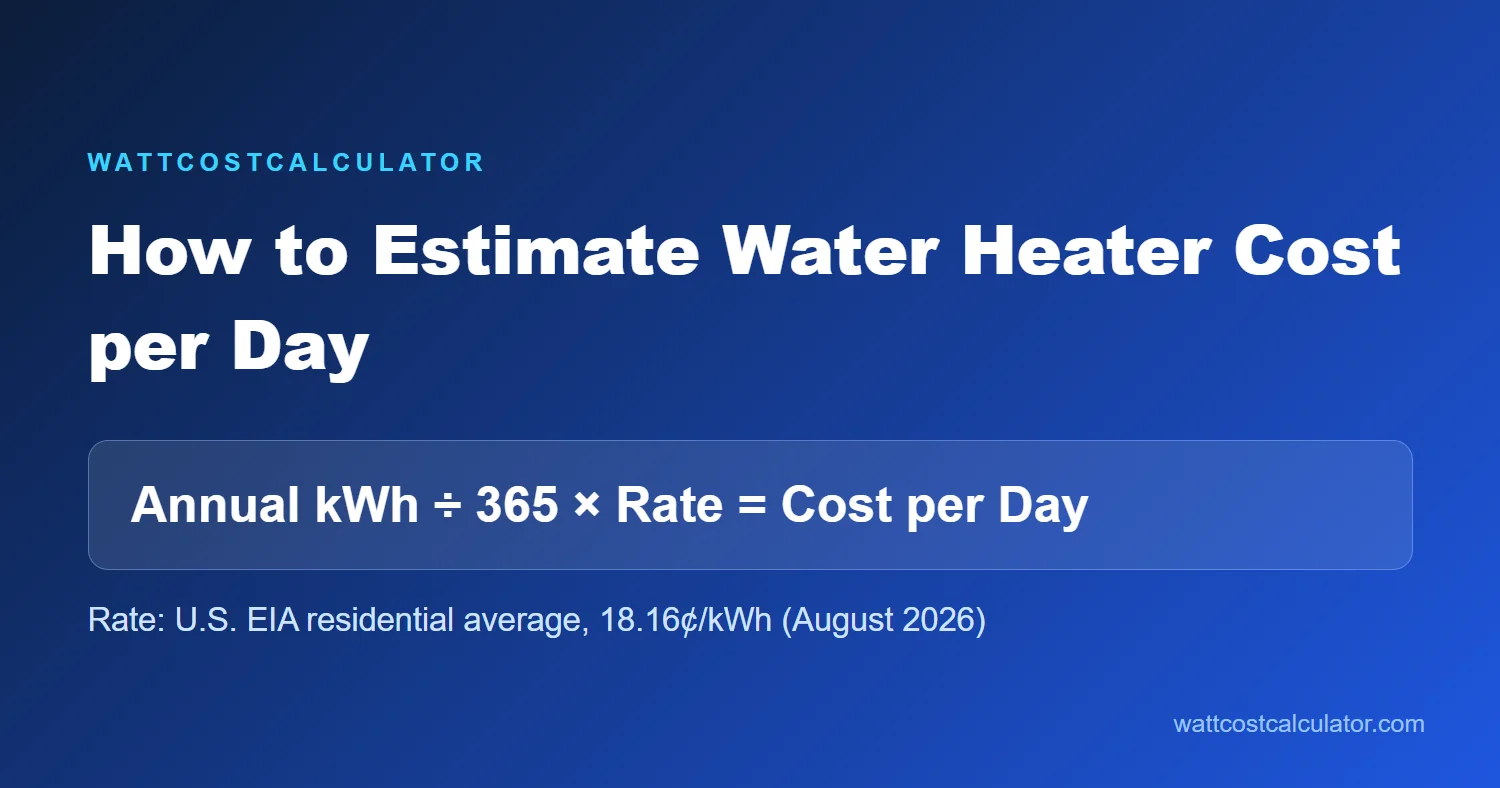
The electricity rate is EIA’s reported U.S. residential average of 18.16 cents per kWh for August 2026. EIA describes the figure as average revenue per kWh, a useful national benchmark rather than your utility’s exact tariff. Your bill may include a different energy rate, delivery charges, fixed fees, taxes, or time-of-use prices.
Try the annual-use calculator with your own rate
The example starts with the DOE reference for a standard electric storage heater. Change the annual kWh to the number on your EnergyGuide label or utility monitoring report, then enter your electricity rate in cents per kWh. To estimate the heat-pump example, enter 984 kWh.
Include installed cost in the payback
If a heat-pump model costs $1,200 more after incentives and saves an estimated $80 a year on energy, the simple payback is 15 years. Maintenance, changes in rates, local climate and the effect on conditioned rooms can change the result. Compare quotes and use your household’s hot-water usage before relying on a standardized label.
What would this cost in your home?
Adjust the starting values to match your appliance and electricity plan.
For a model-specific estimate, use the annual kWh from the EnergyGuide label when available. The label’s annual-cost estimate may use a different electricity price, so comparing annual kWh is often more useful than comparing the printed dollars alone.
Two current 50-gallon models to make the comparison concrete
For a shopping reference, compare the Rheem Performance Standard Electric XE50T06ST45U1 with the Rheem Performance Platinum ProTerra XE50T10HS45U1. The ProTerra line is a hybrid heat-pump family, so compare each model’s annual kWh on its EnergyGuide label rather than retail popularity claims. Both are marketed as 50-gallon tanks, though the listed storage volume is 45 gallons. The figures below are manufacturer and ENERGY STAR specifications, not a claim that either unit was tested in a home.
| Model | Type | Listed storage | UEF | First-hour rating | Practical distinction |
|---|---|---|---|---|---|
| XE50T06ST45U1 | Resistance electric | 45 gal | 0.93 | 61 gal | Conventional tank; 240 V, 4,500 W elements |
| XE50T10HS45U1 | Hybrid heat pump | 45 gal | 3.88 | 67 gal | ENERGY STAR certified; requires suitable space, airflow and condensate planning |
UEF is a standardized efficiency metric, not a promise of a particular bill. The DOE/FEMP annual-kWh comparison below uses its own standardized product-class examples and should not be mistaken for a direct annual-use test of these two model numbers. Before buying, compare current EnergyGuide labels, household first-hour demand, the installation quote, and local rebates. A two-person home with modest hot-water use may value different features than a four-person home with back-to-back showers.
Sources for these model specifications: Rheem Performance standard-electric product page, Rheem ProTerra model page, ENERGY STAR certification record, and Home Depot 50-gallon Rheem listings.
Why the heat-pump model uses less electricity
A standard electric tank heats water directly with resistance elements and stores it for later use. A heat-pump water heater moves heat from the surrounding air into its tank, using electricity to run a compressor and fan. That means its performance can change with installation location, air temperature, operating mode, and hot-water demand. ENERGY STAR’s current criteria list a minimum Uniform Energy Factor (UEF) of 3.30 for qualifying integrated heat-pump water heaters in the applicable product class; UEF is a standardized efficiency metric, not a direct estimate of your monthly bill.
In the FEMP comparison above, the heat-pump model uses about 71% fewer kWh than the less-efficient resistance-tank reference (1 − 984 ÷ 3,437). That percentage follows from those specific annual test values. It should not be applied automatically to every pair of products or household.
What can make your real bill different?
- Hot-water demand: More showers, laundry, dishwashing, and higher household occupancy generally mean more water to heat.
- Incoming water temperature: Colder groundwater requires more heat to reach the same delivery temperature, so location and season matter.
- Room conditions and mode: A heat-pump unit can use backup resistance heat in some operating conditions or high-demand modes. DOE notes that efficiency mode can take longer to recover and may provide less hot water during heavy demand.
- Rate structure: A flat national average cannot reflect your local supply and delivery charges or time-of-use schedule. See our guide to reading supply and delivery charges on a U.S. electric bill.
- Installation: Space, airflow, condensate drainage, sound, and the unit’s rated operating-temperature range can affect whether a heat-pump model fits your home. Check the model documentation and installer’s assessment.
Is a heat-pump water heater worth it?
Start with the annual kWh difference for two specific models, multiply it by your actual electricity rate, and compare the estimated yearly savings with the installed price difference. The calculation here suggests about $449 per year in electricity savings at the national-average rate for the DOE test pair. It does not include purchase price, installation, repairs, rebates, financing, or possible changes in space-conditioning costs, so it cannot by itself answer the payback question.
If you are replacing a failed heater, compare models before choosing a technology and confirm that the available space, household demand, and electrical/plumbing setup suit the product. For a final decision, ask installers for itemized quotes and compare the exact model numbers and annual kWh figures.
Frequently asked questions
Does a heat-pump water heater cost about $15 a month to run?
About $15 per month is the arithmetic result for the DOE reference of 984 kWh/year at 18.16¢/kWh. Your usage, rate, installation conditions, and operating mode may produce a different bill.
Does a higher UEF always mean a lower bill?
A higher UEF indicates better standardized efficiency under the relevant test method. Your bill still depends on the amount of hot water used and the local price of electricity, so check annual kWh and use your own rate for a cost estimate.
Can I estimate cost from the heater’s wattage?
Wattage describes the power draw while a heating element or compressor is operating. Since a water heater cycles and its operating pattern changes with demand and conditions, annual kWh or measured consumption is usually a better starting point for estimating the yearly bill.
Related reading: Electric water-heating costs also show up in washing-machine hot-water use and dishwasher electricity cost.
Sources and calculation notes
- U.S. Department of Energy FEMP: Purchasing Energy-Efficient Residential Water Heaters (annual-use test basis and example kWh values).
- ENERGY STAR: Residential Water Heater Key Product Criteria (UEF definition and product criteria).
- U.S. Energy Information Administration: Electric Power Monthly (August 2026 residential average price).
Calculation: annual cost = annual kWh × $0.1816; average monthly cost = annual cost ÷ 12. Values are rounded to cents. These estimates cover energy charges only and do not include fixed fees, taxes, or other bill components.
Want to check a different appliance or your own electric rate? Use the Appliance Electricity Cost Calculator on our homepage to estimate your costs.
Disclaimer: The figures on this page use statewide or standardized averages and the inputs shown. They are for general information only, not a utility quote, a bill, or financial advice. Check your own electricity bill and the official EIA or manufacturer sources for current figures.

Waterbed Heater Electricity Cost: 170 W vs 325 W Per Month
A waterbed heater costs about $22.23 to $42.49 a month at 18.16¢/kWh if it runs 24 hours at 170 W or 325...

Infrared Sauna Electricity Cost: Cost Per 1-Hour Session by Model
An infrared sauna costs about $0.25 to $0.49 per one-hour session at 18.16¢/kWh, depending on model. Here is the cost per session...
Engine Block Heater Electricity Cost: 1,000 W vs 1,500 W Per Month
An engine block heater costs about $10.90 to $16.34 a month at 18.16¢/kWh when plugged in 2 hours a night at 1,000...

Heated Dog Bed Electricity Cost: Small vs Medium Pad Per Month
A heated dog bed costs about $2.62 to $5.23 a month at 18.16¢/kWh if it runs 24 hours at 20 W to...