
- Quick estimate: home charging cost per 100 miles
- Calculate your monthly and annual home-charging cost
- Avoid adding charging loss twice
- What would this cost in your home?
- Worked examples at the August 2026 U.S. average rate
- Where to find the right kWh/100 miles number
- How your utility plan changes the estimate
- Home charging versus gasoline: compare equivalent miles
- Why your actual result may differ
- Sources and calculation notes
For a useful first estimate, multiply your EV’s EPA-rated energy use in kWh per 100 miles by your home electricity price. At the August 2026 U.S. residential average of 18.16¢/kWh, a car using 30 kWh per 100 miles costs about $5.45 per 100 miles to charge at home. Your own result depends on the vehicle’s label, your utility rate, and how and when you charge.
This guide turns that label number into a home-charging estimate you can adjust. It also explains why the vehicle’s EPA kWh/100 miles figure is especially useful for a cost estimate: EPA’s test accounts for electricity measured from the outlet, including charging-system losses.
Quick estimate: home charging cost per 100 miles
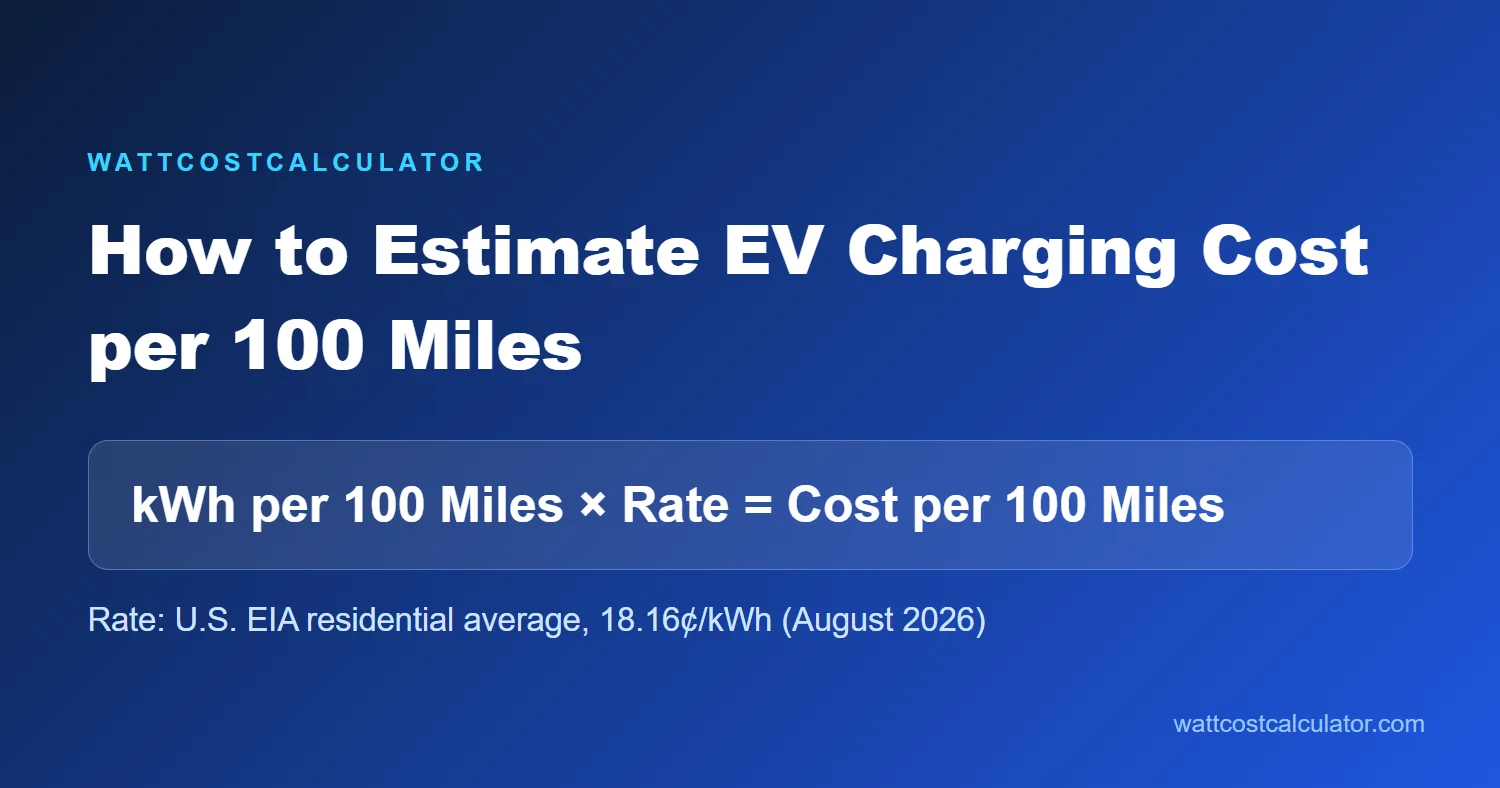
Cost per 100 miles = vehicle energy use (kWh/100 miles) × electricity price ($/kWh)
For example: 30 kWh/100 miles × $0.1816/kWh = $5.448, or about $5.45 per 100 miles. To use a rate shown in cents, divide it by 100 first: 18.16¢/kWh = $0.1816/kWh.
Calculate your monthly and annual home-charging cost
Start with the energy figure on your vehicle’s EPA label or FuelEconomy.gov listing. Then estimate your monthly distance and use the price per kWh from your bill or utility plan.
- Monthly energy: (kWh per 100 miles ÷ 100) × miles driven per month.
- Monthly energy cost: monthly kWh × your electricity price in dollars per kWh.
- Annual estimate: monthly cost × 12, if your mileage and rate stay similar.
Enter the exact EPA kWh per 100 miles for your vehicle, your monthly driving distance, and the home electricity rate from your bill:
Avoid adding charging loss twice
The EPA label’s kWh per 100 miles is a charging-energy benchmark. If you use that number, do not add a second assumed charging-loss percentage. If your car instead reports battery energy per mile, estimate wall energy separately. For example, 27 kWh delivered to the battery at 90% charging efficiency requires 30 kWh from the wall.
What would this cost in your home?
Adjust the starting values to match your appliance and electricity plan.
Example result: 1,000 miles at 30 kWh/100 miles uses an estimated 300 kWh. At 18.16¢/kWh, that is about $54.48 per month, or $653.76 per year at 12,000 miles.
Worked examples at the August 2026 U.S. average rate
The U.S. Energy Information Administration reported an average residential price of 18.16¢ per kWh for August 2026. The examples below use that published reference price and assume 1,000 miles each month. They are scenarios, not quotes for a particular car or utility.
| Example efficiency | Cost per 100 miles | Energy at 1,000 mi/month | Monthly energy cost | Annual cost at 12,000 mi |
|---|---|---|---|---|
| 25 kWh/100 mi | $4.54 | 250 kWh | $45.40 | $544.80 |
| 30 kWh/100 mi | $5.45 | 300 kWh | $54.48 | $653.76 |
| 35 kWh/100 mi | $6.36 | 350 kWh | $63.56 | $762.72 |
These efficiency values are rounded examples chosen to show how the calculation changes; check your own model and trim’s EPA figure. Driving conditions, temperature, speed, tires, climate controls, and cargo can change real-world efficiency. The EIA national average is a comparison point, not your marginal price: your bill may include a different energy rate, delivery charges, a time-of-use (TOU) schedule, tiers, or other line items.
Where to find the right kWh/100 miles number
Look up the exact model year, make, model, drivetrain, and wheel configuration on the EPA label or FuelEconomy.gov. Use the electricity-consumption figure in kWh per 100 miles, not MPGe by itself. A vehicle’s city/highway mix and trim can affect its rated consumption, so a nearby model is only a rough stand-in.
EPA explains that its EV electricity-use testing measures energy from the wall outlet and includes losses in the charging equipment and the vehicle’s onboard charger. That makes the EPA kWh/100-mile figure appropriate for estimating what you buy from the utility. Do not add a generic charging-loss percentage to that same EPA figure; doing so would count those losses twice. If you instead use energy delivered to the battery from a vehicle display or app, that may use a different measurement boundary, so label the source and don’t treat it as interchangeable with the EPA wall-outlet figure.
How your utility plan changes the estimate
For a quick estimate, use the per-kWh price that applies to the extra electricity you expect to use. The average price on a bill can be a useful starting point, but dividing the whole bill by total kWh may mix fixed fees and non-energy charges into the rate. See our guide on which electricity rate to use from a U.S. electric bill.
If your utility offers a TOU plan, check the official rate sheet for the hours, seasons, weekends, and eligibility rules. Charging overnight is cheaper only when your plan actually assigns a lower price to those hours and your vehicle can be scheduled then. Compare the rates for the charging periods you use; don’t assume one national “off-peak” price.
Also check whether your bill has tiered pricing or a separate EV rate. Home charging can move some of your usage into a higher tier or may qualify for a dedicated plan, depending on the utility and service address. Keep one-time installation costs and any monthly plan fee separate from the per-mile energy calculation so you can see what each amount represents.
Home charging versus gasoline: compare equivalent miles
To compare energy costs fairly, compare both vehicles over the same distance. For an EV, multiply EPA kWh/100 miles by the applicable price per kWh. For a gasoline car, divide 100 miles by its fuel economy in miles per gallon, then multiply by the local price per gallon.
This is an energy-cost comparison, not total ownership cost. It excludes vehicle purchase price, financing, maintenance, insurance, public fast charging, charging-equipment installation, and any fixed utility fees. Public charging also has different prices and can’t be estimated with your home rate unless you actually pay that rate.
Why your actual result may differ
- Your rate: Your utility, plan, season, and charging hour matter more than a national average.
- Your vehicle: EPA consumption varies by model, trim, drivetrain, and wheels.
- Your miles: Monthly driving distance scales the estimate directly.
- Your charging mix: Home, workplace, and public charging can have different prices.
- Your driving: Weather, speed, elevation, and cabin heating or cooling change energy use.
For the best personal estimate, start with the exact EPA label figure and the rate from your utility’s current plan. After a month, compare the estimate with your bill or charging records and update the inputs. If your utility changes the price or you switch plans, recalculate.
Related reading: Home charging depends on the plan: our time-of-use guide and Texas electricity bill guide explain two common rate complications.
Sources and calculation notes
- U.S. EPA: Fuel Economy and EV Range Testing — explains EV efficiency testing and energy measured from the outlet.
- U.S. Department of Energy, Alternative Fuels Data Center: Charging Electric Vehicles at Home — describes home-charging costs and the effect of local electricity rates.
- U.S. Energy Information Administration: Average Price of Electricity to Ultimate Customers — August 2026 residential reference price, 18.16¢/kWh.
- FuelEconomy.gov — official EPA/DOE fuel-economy and vehicle energy-use lookup.
Updated October 2026. Cost examples use the EIA August 2026 U.S. residential average as a dated reference and rounded illustrative vehicle-efficiency scenarios. Your actual bill and exact vehicle rating will differ.
Disclaimer: The figures on this page use statewide or standardized averages and the inputs shown. They are for general information only, not a utility quote, a bill, or financial advice. Check your own electricity bill and the official EIA or manufacturer sources for current figures.
Maine vs. New Hampshire Electricity Cost: Winter Heat Pump & Delivery Bills
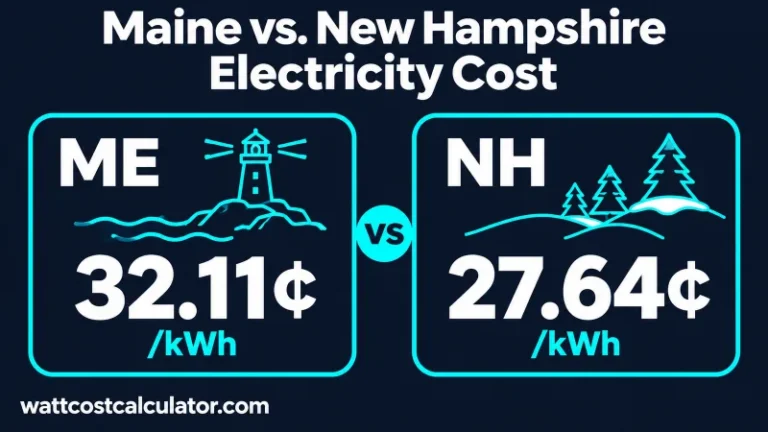
Residential electricity in Maine averaged 32.11¢/kWh in August 2026 (EIA), compared with 27.64¢/kWh in New Hampshire—making a 700 kWh monthly bill $31.29...

2026 US State-by-State Electricity Cost Master Guide
Compare electricity prices across U.S. states using EIA data: the five most expensive and cheapest states, plus California, Texas, Florida and New...

U.S. Electricity Rates by State (2026 Comparison Hub)
Compare residential electricity prices in all 50 states and DC, using EIA August 2026 data with August 2025 for comparison, and jump...

Illinois vs Ohio Electricity Cost: Supply Rates and the Total Bill
A supplier advertises electricity for 10 cents per kilowatt-hour. Should a 1,000-kWh month cost $100? The supply portion might be about that...