- Check the label before comparing watts
- Quick cost comparison: iron vs. steamer
- How to calculate electricity cost per session
- What changes the real-world result?
- Estimate your own weekly ironing budget
- Separate heat-up from thermostat cycling
- Iron or steamer session budget
- A fair comparison starts with the same basket
- Ways to avoid paying for unused heat
- Frequently asked questions
- Estimate the cost with your own inputs
- What would this cost in your home?
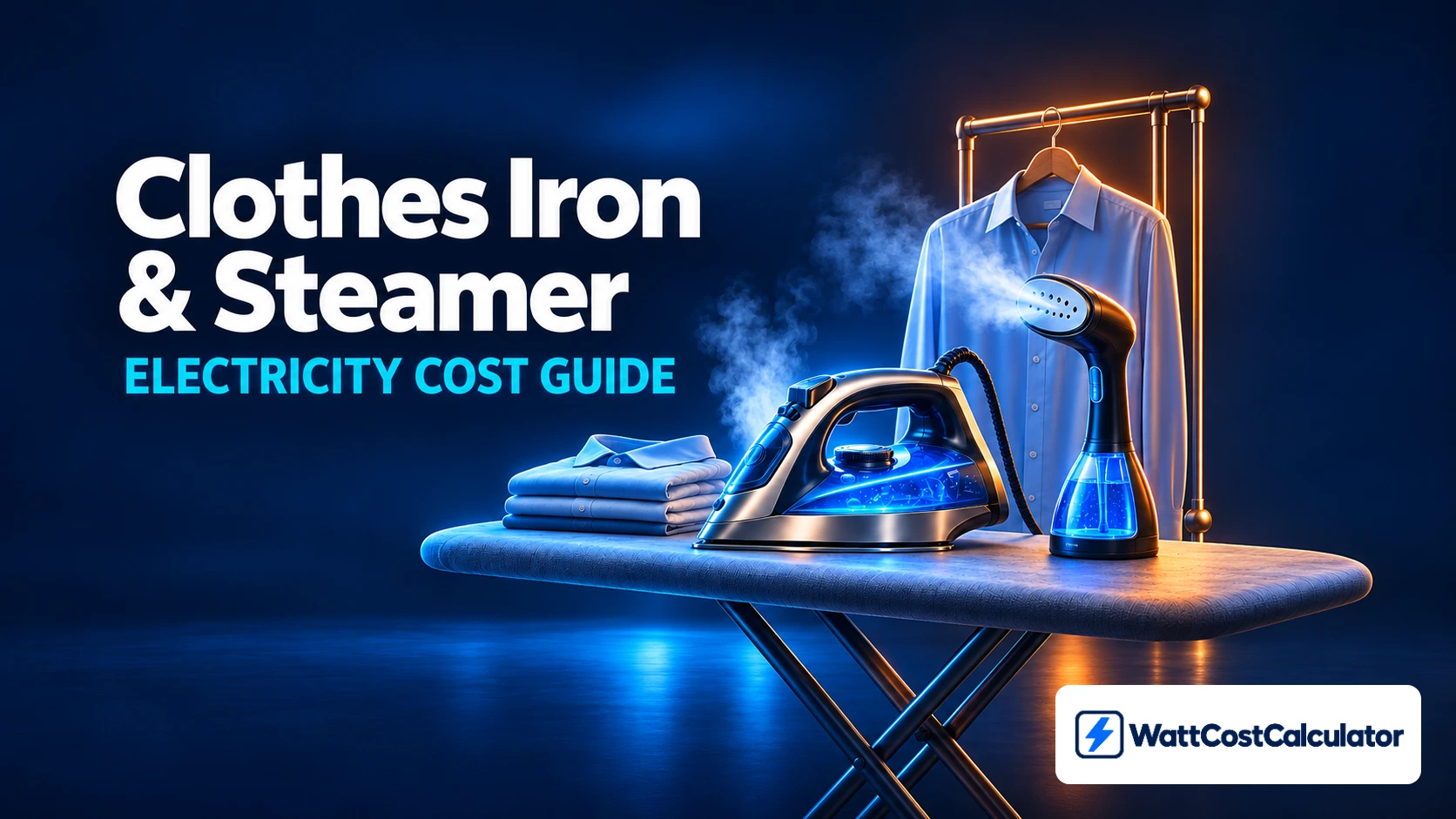
Clothes iron electricity cost can be modest per session despite a high power rating. At an illustrative 1,500 watts, 30 minutes of continuous heating uses 0.75 kWh. At the U.S. residential average of 18.16¢/kWh reported for August 2026, that is about 14¢ for one session. Your iron’s label, time spent heating, thermostat cycling, and electricity rate change the result.
For a quick shirt refresh, the deciding factor is often how long you spend getting the finish you want. A steamer that takes longer on a stubborn crease can use more energy than an iron with a higher power rating.
Check the label before comparing watts
Two documented examples show why a universal 1,500-W assumption will not fit every device. Rowenta’s support page for reference DW5280U1 lists 1,725 W. Conair’s Turbo ExtremeSteam GS59X specifications list a 1,875-W steam generator. These manufacturer ratings describe power, not measured energy for finishing a shirt.
At constant rated power for five minutes, those inputs give about 0.144 and 0.156 kWh—roughly 2.61¢ and 2.84¢ at 18.16¢/kWh. The small gap can be outweighed by warm-up time, a refill or several extra minutes of work. I would choose for the garment and finish first, then compare the complete session.
Quick cost comparison: iron vs. steamer
For an easy comparison, assume each device is rated at 1,500 W and uses that full input for the stated time. The rate is 18.16¢/kWh, EIA’s U.S. residential average for August 2026. Because many thermostatic appliances cycle their heating element, this constant-power model can overstate actual energy use during a complete session.
| Illustrative use | Energy per session | Cost per session | Sessions | Annual estimate |
|---|---|---|---|---|
| Iron, 30 minutes | 0.75 kWh | $0.14 | 1 per week | 39 kWh; $7.08 |
| Garment steamer, 20 minutes | 0.50 kWh | $0.09 | 1 per week | 26 kWh; $4.72 |
Table inputs: 1,500 W constant power, 52 sessions/year and 18.16¢/kWh. The two rows use different session lengths.
The example does not show that one appliance is inherently more efficient. The steamer’s lower annual total comes from the assumed shorter weekly use. If both run for the same time at the same actual average wattage, their modeled electricity use is the same.
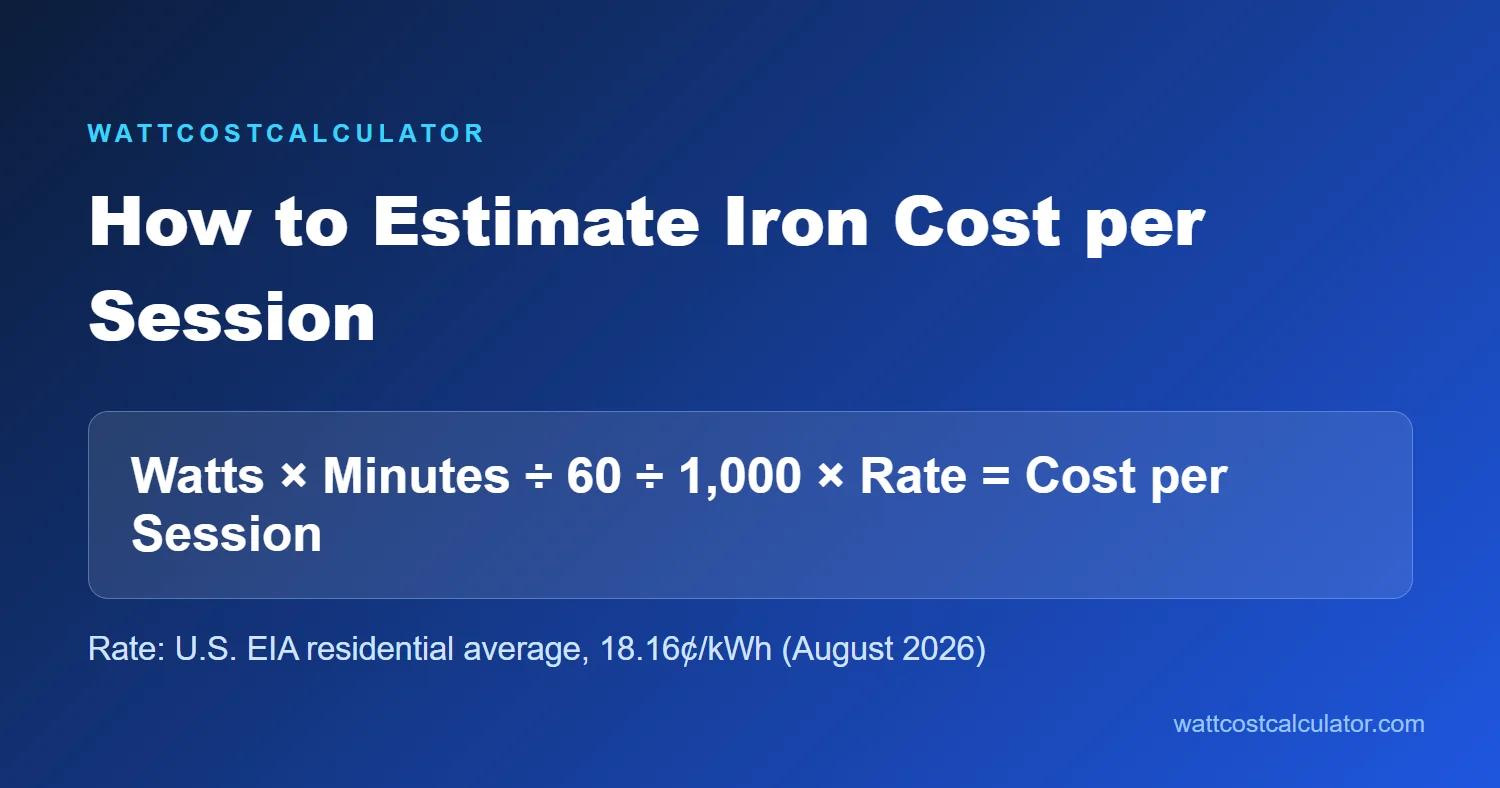
How to calculate electricity cost per session
- Find the input rating in watts on the appliance label or manual.
- Estimate the time the heating element is actually drawing power, in hours.
- Calculate kWh: watts × hours ÷ 1,000.
- Calculate cost: kWh × your electricity rate in dollars per kWh.
For example, 1,500 W × 0.5 hour ÷ 1,000 = 0.75 kWh. At 18.16¢/kWh ($0.1816), 0.75 × $0.1816 = $0.1362, or about 14¢.
Use the input wattage, not the voltage or maximum outlet rating. The number printed on an appliance is generally a rated or maximum input; it does not tell you that the heater stays on continuously. Thermostats may cycle off after the soleplate or water reaches temperature. A plug-in energy meter that records kWh over the full session can give a more representative reading, provided the meter is explicitly rated for the appliance’s electrical load and used according to its instructions.
What changes the real-world result?
- Warm-up and thermostat cycling: the element may draw strongly at first, then switch on and off. Elapsed time is not always full-power time.
- Steam setting: generating steam can require additional heating, and the exact behavior varies by model and setting.
- Session length: several garments in one session may use less energy than repeatedly heating the appliance for very short sessions, but measure your routine before assuming a saving.
- Your marginal rate: an EIA national average is useful for an example, not a substitute for the variable per-kWh charges on your bill. Time-of-use plans can change the applicable rate by hour.
Estimate your own weekly ironing budget
Start with a 30-minute, 1,500-W session once a week. At 100% duty this is the table’s 0.75 kWh; at an assumed 50% duty it becomes 0.375 kWh. Change the duty cycle to explore sensitivity, not because an iron or steamer is guaranteed to use a particular percentage. A full-session kWh reading is the better check.
Separate heat-up from thermostat cycling
A 1,500 W iron running its heating element continuously for 30 minutes uses 0.75 kWh. If the element is energized for only 15 minutes in that session, the heating portion is 0.375 kWh. A steamer may draw differently after warmup, so compare complete sessions that produce a similar finish.
Iron or steamer session budget
Duty cycle means assumed element on-time over the whole session, including warm-up.
Rate reference: EIA August 2026 residential averages, released October 23; checked and reflected November 9, 2026. Examples are editable assumptions. Estimates cover entered electricity only. Method & limitations.Rate reference updated October 29, 2026: EIA August 2026 U.S. residential average, 18.16¢/kWh, released October 23. Table totals and calculator default were recalculated from the prior July reference.
A fair comparison starts with the same basket
Comparing an iron on five cotton shirts with a steamer on one lightweight blouse measures different tasks. Choose the same items, the same acceptable finish and the same starting condition. Record elapsed time from switch-on until the last garment is finished, including warm-up and pauses. A kWh reading over that whole period captures thermostat cycling better than watching the power display for a few seconds.
My decision rule is simple: for a crisp collar or crease, judge whether the chosen tool produces that result before comparing its energy cost. For an occasional refresh, convenience may be worth more than a few cents per session. Neither conclusion requires claiming that every iron or every steamer wins.
Ways to avoid paying for unused heat
- Group garments into one session if that fits your routine, so you do not repeatedly warm the appliance for a single item.
- Use the lowest setting suitable for the garment and follow its care label and the appliance manual.
- Switch the appliance off and unplug it when finished, following the manufacturer’s safety instructions. Never leave a hot iron or steamer unattended.
- For a reliable budget, compare a few similar sessions with a properly rated energy meter rather than treating rated watts as measured average power.
Short household sessions are often inexpensive in energy terms, even when the appliance has a high wattage rating. The useful comparison is kWh per session multiplied by your rate, not watts alone.
Frequently asked questions
Does a 1,500-W iron use 1.5 kWh every hour?
Only if it draws 1,500 W continuously for that hour. A thermostat can switch the heating element off and on, so a full-session kWh reading may be lower than rated watts multiplied by elapsed time.
Is a steamer always cheaper to run than an iron?
No. Cost depends on actual energy per session and how often and how long you use it. The example above assigns the steamer a shorter session, so it is a usage comparison rather than a controlled appliance test.
How much does ironing cost at a different electricity rate?
For the 0.75-kWh example session, the cost is about 9¢ at 12¢/kWh, 14¢ at 18.16¢/kWh, and 23¢ at 30¢/kWh. Replace these sample rates with the applicable variable rate on your bill.
Can I use a smart plug to measure an iron?
Only use monitoring equipment whose electrical rating and instructions explicitly permit the appliance load. Do not leave an iron or steamer operating unattended to collect a reading.
Try your own numbers in the mini calculator above, or use the full Appliance Electricity Cost Calculator for another device. For the rest of the laundry budget, compare our electric dryer cost guide, heat-pump vs. standard dryer comparison, and washing machine energy guide.
Reviewed October 29, 2026 by Seon. The table is a worked usage comparison; product ratings above come from manufacturer documentation. EIA rate source.
Related reading: For the full household laundry bill beyond ironing, see our wash-and-dry cost per load guide.
Estimate the cost with your own inputs
The 0.75 kWh starting point matches the article’s 1,500 W iron scenario for 30 minutes of continuous heating. Change the session energy to reflect thermostat cycling or your steamer’s actual use.
What would this cost in your home?
Adjust the starting values to match your appliance and electricity plan.
Disclaimer: The figures on this page use statewide or standardized averages and the inputs shown. They are for general information only, not a utility quote, a bill, or financial advice. Check your own electricity bill and the official EIA or manufacturer sources for current figures.
All-in-One Washer Dryer Combo Electricity Cost: Heat Pump vs. Vented Units
A 120V heat-pump all-in-one washer dryer combo uses roughly 0.9 to 1.3 kWh per complete wash-and-dry load, costing $0.16 to $0.24 at...
Top-Load vs Front-Load Washer Electricity Cost: Hot Water and Spin
Quick Scenario Summary In the scenario below, a top-load washer using 0.65 kWh per cold-water load costs about $30.69 per year at...
Sensor Dry vs Timed Dry: Dryer Electricity Use per Load
Sensor dry can reduce the cost of overdrying, but the savings depend on how much electricity the two complete cycles actually use....
Heated Drying Rack vs Electric Dryer: Electricity Cost per Load
A heated drying rack can draw far less power at any moment than a full-size electric dryer, but a low wattage number...