
- The label trap: 1,200 W cooking power is not 1,200 W from the outlet
- Microwave electricity cost formula
- Cost by cooking time
- Calculate your own daily, monthly, and yearly estimate
- Cooking plus standby electricity
- A useful kitchen check: one serving versus several batches
- Does the clock or display use electricity all day?
- Microwave versus oven for a small reheat
- What can change your actual cost?
- Sources and calculation notes
- Estimate the cost with your own inputs
- What would this cost in your home?
Microwave electricity cost is usually modest for a short reheat. As an example, a microwave drawing 1,200 watts from the outlet for five minutes uses about 0.10 kWh. At the U.S. residential average of 18.16¢/kWh reported for August 2026, that is about 1.8 cents per session, or roughly 54 cents a month if you do it once every day.
The first number to check is electrical input, not the cooking wattage on the box. That distinction can change an estimate more than trimming a few seconds from a reheat.
The label trap: 1,200 W cooking power is not 1,200 W from the outlet
Panasonic’s NN-SN686S manufacturer specification sheet lists 1,200 W cooking power and 1,480 W power consumption. This is a documented model example, not a meter reading. At a constant 1,480 W for five minutes, the calculation is 0.123 kWh, or about 2.24¢ at 18.16¢/kWh. Using its cooking-output figure instead would give 1.82¢.
That difference is only a fraction of a cent for one reheat, but it explains why the input label belongs in an electricity calculator. Check the exact model suffix and manual; the 1,200-W input table below remains a separate, adjustable scenario.
Microwave electricity cost formula
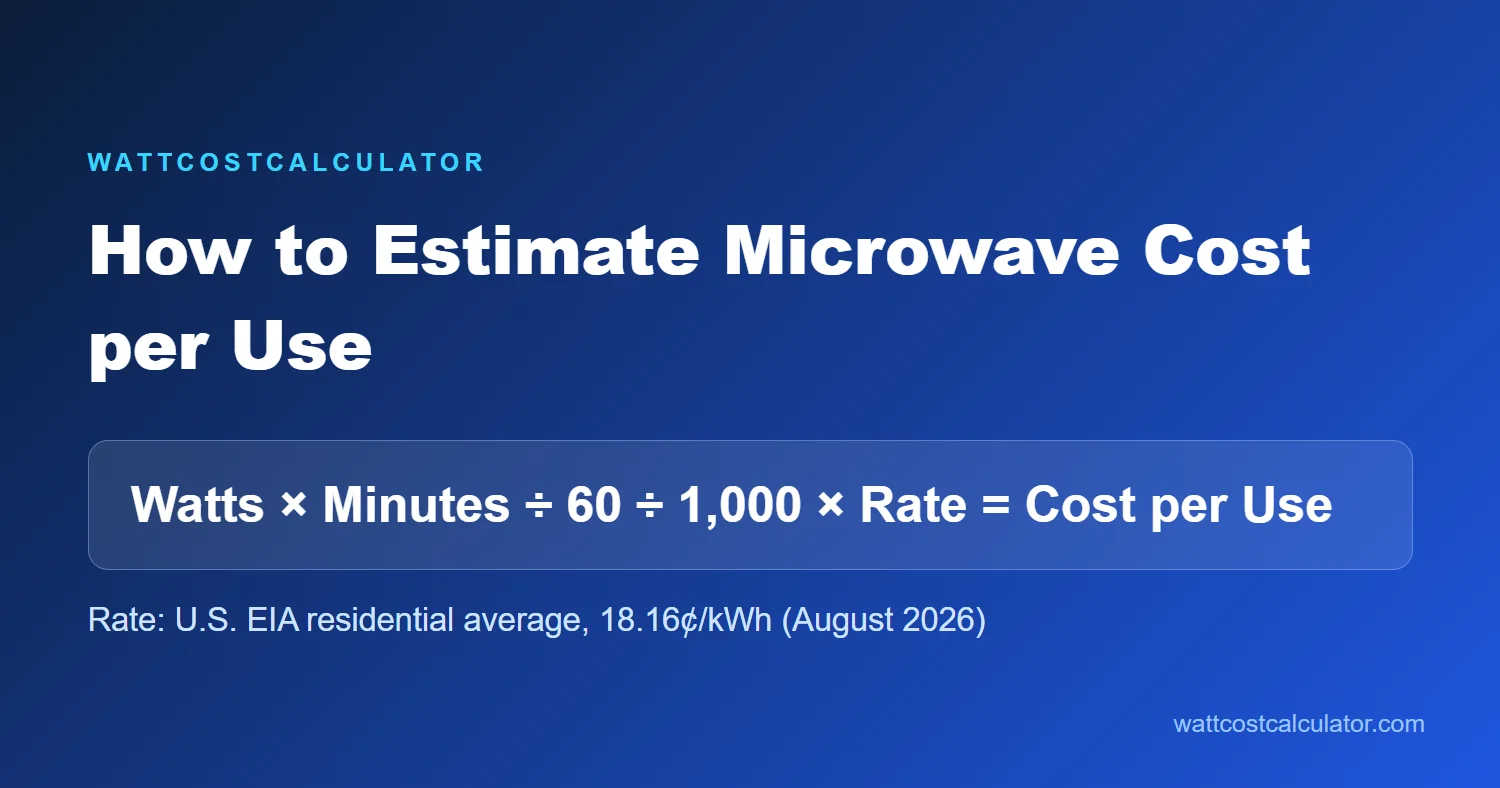
Energy (kWh) = electrical input watts ÷ 1,000 × minutes ÷ 60
Cost = energy (kWh) × electricity price in dollars per kWh
For the example above: 1,200 ÷ 1,000 × 5 ÷ 60 = 0.10 kWh. Then 0.10 × $0.1816 = $0.01816. The cost rounds to about 2¢ on a bill, though the unrounded estimate is 1.8¢.
Cost by cooking time
The table assumes an illustrative 1,200 W electrical input that stays at full power throughout the timed interval, and the EIA’s August 2026 U.S. residential average of 18.16¢/kWh. Dollar totals use unrounded kWh.
| Run time | Estimated energy | Cost per session | 30 sessions | 365 sessions |
|---|---|---|---|---|
| 1 minute | 0.020 kWh | 0.36¢ | $0.11 | $1.33 |
| 3 minutes | 0.060 kWh | 1.09¢ | $0.33 | $3.98 |
| 5 minutes | 0.100 kWh | 1.82¢ | $0.54 | $6.63 |
| 10 minutes | 0.200 kWh | 3.63¢ | $1.09 | $13.26 |
A quick reheating session is inexpensive in this scenario. Repeated long cooking cycles add up in direct proportion to the minutes and wattage. For a different rate, multiply the kWh in the table by the per-kWh price on your own plan. For example, the five-minute scenario costs 1.2¢ at 12¢/kWh and 3¢ at 30¢/kWh.
Calculate your own daily, monthly, and yearly estimate
Check the appliance’s rating label or owner’s manual for electrical input or input watts. A marketing description may instead give cooking output power. Those are different numbers: using output watts as though they were the electricity drawn from the outlet can understate the estimate. If the label is unclear, use the manual or measure a representative cycle with a suitable plug-in energy meter; do not open the microwave casing.
Enter electrical input watts and cooking minutes directly—no conversion to decimal hours is needed. Standby watts are a separate input; the 1-W starting value is an editable assumption. The tool avoids counting standby during cooking.
Cooking plus standby electricity
Use electrical input watts. Standby applies only outside cooking time.
Rate reference: EIA August 2026 residential averages, released October 23; checked and reflected November 9, 2026. Examples are editable assumptions. Estimates cover entered electricity only. Method & limitations.Rate reference: EIA August 2026 U.S. residential average, 18.16¢/kWh; released October 23 and checked November 9, 2026. Lower-power settings and automatic programs can change the average draw.
A useful kitchen check: one serving versus several batches
For a weekday lunch, record one complete reheat, including any extra time after stirring. For a family meal, record every batch. Four separate two-minute runs are eight minutes of use, even if the recipe describes only one serving.
On a suitably rated energy meter, reset the kWh total immediately before a normal session and read it afterward. Keep food and quantity comparable, follow the microwave and meter instructions, and never run the oven empty to collect data. We would compare complete-session kWh before drawing conclusions from a low-power setting: a longer cooking time can offset lower instantaneous power.
Does the clock or display use electricity all day?
Yes, the display and controls can draw electricity between meals. Budget that separately from cooking. For scale, a hypothetical 1 W idle load over 8,760 hours is 8.76 kWh/year, or $1.59 at 18.16¢/kWh. This is a sensitivity example; a low-power meter reading or manufacturer standby specification gives a better figure for your model.
That distinction matters because the display is on for far more hours than the oven actively cooks, but its standby draw is small. To find your own annual standby use, measure the plugged-in unit over a representative period with an energy meter that can resolve low wattage, then multiply measured kWh by your rate. Avoid assuming the microwave’s cooking wattage continues while idle. If you choose to unplug it, consider whether you rely on its clock, convenience, or settings, and follow the product manual.
Microwave versus oven for a small reheat
A microwave can be a practical option for reheating a single serving because it avoids heating a full oven cavity. The U.S. Department of Energy has also advised using a microwave, toaster, or countertop grill instead of an oven when appropriate to avoid excess kitchen heat. The exact energy difference depends on the food, portion, preheat time, appliance, and cooking method.
For a fair home comparison, meter each complete method for the same portion and result. Include oven preheating, all microwave or oven run time, and multiple batches. Then multiply each measured kWh by the same applicable rate. Do not compare the microwave’s output-watt label with an oven’s input rating as if they were directly comparable energy totals.
What can change your actual cost?
- Electrical input: use the appliance’s input rating or measured session kWh, not an assumed wattage.
- Cooking time: use the time the appliance is actively heating, and include separate preheating if you compare another appliance.
- Power setting: lower settings may cycle the heating system, so rated watts multiplied by timer minutes can overestimate consumption.
- Electricity rate: use the rate that applies during the cooking time. A time-of-use plan may vary by hour; see our guide to time-of-use electricity rates.
- Standby: a clock and controls can add a small always-on load that a cooking-only estimate leaves out.
Your electric bill may combine energy supply, delivery, fixed fees, taxes, or tiered prices. For an appliance estimate, use the variable price for extra kWh where possible. Our electric bill guide explains how to identify the rate that fits a calculation. The EIA’s national average is a useful dated benchmark, not the price every household pays.
Related reading: Compare short cooking sessions with our air fryer cost guide and per-cycle kitchen use with our dishwasher cost guide.
Sources and calculation notes
- U.S. Energy Information Administration, Electricity Monthly Update — August 2026 residential average price of 18.16¢/kWh, released October 23, 2026.
- U.S. Department of Energy, energy-saving tips — suggests choosing a microwave or countertop appliance instead of an oven where appropriate.
- Whirlpool: What Microwave Wattage Do You Need? — explains where to find the microwave’s wattage on its serial-number plate.
Updated October 29, 2026: added the Panasonic input/output specification example and session-check method.
Estimate the cost with your own inputs
The 0.10 kWh starting point represents the five-minute, 1,200 W outlet-input example. Use the energy for one complete microwave session; standby use is separate.
For a microwave, I would pay more attention to how long you actually cook than to the wattage on the box. In this example, heating a frozen pizza slice for 2.5 minutes at full power uses about 0.066 kWh, or roughly 1.2 cents per reheat. Standby power is small, but it runs all year, so it is worth keeping in mind.
What would this cost in your home?
Adjust the starting values to match your appliance and electricity plan.
Disclaimer: The figures on this page use statewide or standardized averages and the inputs shown. They are for general information only, not a utility quote, a bill, or financial advice. Check your own electricity bill and the official EIA or manufacturer sources for current figures.

Electric Oven vs. Induction Cooktop Electricity Cost: Holiday Cooking & Baking
Cooking a 31-minute weeknight meal on an induction cooktop uses roughly 0.65 kWh ($0.12 at 18.16¢/kWh), while a 4-hour holiday roast in...

Dishwasher Heated Dry vs. Air Dry: Energy Cost and Everyday Trade-Offs
Quick Scenario Summary In the scenario below, a dishwasher that runs one cycle a day with air drying uses about 0.9 kWh...

Air Fryer vs Toaster Oven Electricity Cost: Batch Size and Preheat
A basket air fryer and a countertop toaster oven can both circulate hot air. Which one costs less to cook dinner? The...

Toaster Oven vs Full-Size Oven: Electricity Cost by Meal
Quick Scenario Summary In the scenario below, three 20-minute toaster oven sessions a week use about 78 kWh a year and cost...