
- What uses electricity in a gas furnace?
- Fan AUTO vs. ON: the bill difference
- A winter-day fan budget
- Find your own answer without guessing
- Try the extra fan cost in the mini calculator
- Compare fan AUTO and extra circulation
- The missing specification: circulation speed
- When might ON be worth considering?
- Sources and calculation notes
- Compare fan-only hours, not the entire day twice
- Estimate the cost with your own inputs
- What would this cost in your home?
Gas furnace electricity cost can be easy to miss: a gas furnace burns gas for heat, but it still needs electricity for its blower, controls, and other components. That is why a thermostat’s fan setting can change your electric bill even when the heat source is gas. The useful question is not simply “How many watts does a gas furnace use?” It is how long does the blower run at each speed?
Quick answer: With fan AUTO, the blower generally runs during a heating or cooling call and briefly afterward. With fan ON, it also circulates air between calls. The extra electricity is the fan-only power multiplied by those additional hours. Some systems use a lower circulation speed, so do not assume the heating wattage applies all day.
What uses electricity in a gas furnace?
The main recurring electric load is the air-circulating blower. An inducer fan, ignition system, circuit board, and other controls can also use electricity, depending on the equipment and operating phase. The gas consumed by the burners is a separate cost on a gas bill. The U.S. Department of Energy describes the furnace fan as an electrically powered device that circulates air through ductwork, and its energy analysis treats heating, cooling, and constant-circulation operation separately. That distinction matters when estimating AUTO versus ON.
Blower wattage is not one universal number. Motor type, speed setting, airflow, filter condition, and duct resistance all matter. A nameplate rating or a single online estimate is a starting point, not a measured average. For a household estimate, use your furnace documentation or a qualified technician’s measured running watts for the relevant mode.
Fan AUTO vs. ON: the bill difference
- AUTO: The thermostat calls for heat, the system starts its heating sequence, and the blower runs as controlled by the furnace. It can keep running for a short cool-down after the burner stops.
- ON: The blower also operates when there is no heating or cooling call. Depending on the system, that circulation may use a different speed and power draw from the heating mode.
Continuous circulation may help with air mixing or filtration for some households, but it is not a guaranteed comfort or air-quality improvement. A cleaner filter and the correct fan setting for your equipment can be more useful than simply leaving the fan on all day. If you use ON for a specific reason, compare that benefit with the extra operating hours and any increased filter replacement needs.
A winter-day fan budget
Suppose the blower uses 400 W during heating for six hours a day. Between heating calls, continuous circulation uses 200 W for another 18 hours. Use 18.16¢/kWh as an illustrative electricity rate: the U.S. Energy Information Administration’s August 2026 national residential average, published in its Electric Power Monthly. Your utility’s applicable rate can be different, especially with tiers or time-of-use pricing.
| Fan setting | Daily fan energy | 30-day electricity cost |
|---|---|---|
| AUTO: 400 W × 6 hours | 2.4 kWh | $13.08 |
| ON: heating above + 200 W × 18 hours | 6.0 kWh | $32.69 |
| Extra for ON in this example | 3.6 kWh/day | $19.61 |
The calculation is watts ÷ 1,000 × hours × electricity price per kWh. For the extra circulation: 200 ÷ 1,000 × 18 × 30 × $0.1816 = $19.61. The table isolates blower electricity; gas and other furnace components belong in separate totals. Do not add a separate 24-hour fan charge on top of the six heating hours; that would double-count them.
Find your own answer without guessing
- Check your thermostat and furnace controls. “ON” may mean continuous low-speed circulation on one system and something else on another. Read the operating manual for your thermostat and furnace.
- Get separate wattage figures. Look for heating-blower and continuous-circulation power in manufacturer service information, or ask an HVAC professional to measure them. A standard plug-in energy meter is usually not appropriate for a hardwired furnace.
- Estimate hours. Use thermostat runtime reports if available. For a rough comparison, record heating hours and the remaining hours the fan runs in ON mode. A furnace may cycle many times; total hours matter more than cycle count here.
- Use the right price. Your electric bill’s applicable energy rate is more relevant than a national average. If your plan has peak and off-peak prices, calculate those hours separately. Our guide to reading a U.S. electric bill can help locate the energy charges.
Try the extra fan cost in the mini calculator
The tool separates heating-blower use from additional circulation. Its starting values use 400 W for six heating hours and 200 W for eighteen extra circulation hours. Edit both power figures and both schedules; a furnace’s manufacture year alone does not establish its fan-only draw.
Compare fan AUTO and extra circulation
Enter separate heating and fan-only watts; keep their hours non-overlapping.
Rate reference: EIA August 2026 residential averages, released October 23; checked and reflected November 9, 2026. Examples are editable assumptions. Estimates cover entered electricity only. Method & limitations.Rate reference: EIA August 2026, 18.16¢/kWh U.S. residential average; released October 23 and checked November 9, 2026. The inputs model additional circulation only.
If you want to compare the full heating-day cost too, run a second calculation with heating-mode wattage and hours, then add the two non-overlapping results. You can also use the full Appliance Electricity Cost Calculator.
The missing specification: circulation speed
Before deciding whether ON is expensive, ask which airflow setting the furnace uses between heating calls. The heating blower, cooling blower and circulation mode may use different settings. Comparing motor nameplate watts alone can miss that difference.
In the example, 18 extra hours at 200 W add $19.61 per 30 days. If documentation or a technician instead establishes a 50-W circulation draw, the same hours add $4.90. That $14.71 difference comes from the assumed circulation power, not a change in the electricity rate. These two scenarios show why I would obtain the fan-only figure before deciding whether the comfort benefit is worth paying for.
A thermostat heat-runtime report may omit fan-only circulation. When keeping notes, separate burner-call hours from circulation hours and avoid counting any hour twice. If the fan stays on unexpectedly despite AUTO, Trane’s troubleshooting guidance points to thermostat settings and equipment checks; it is not evidence that the motor normally needs to run all day.
When might ON be worth considering?
Continuous circulation may be useful when rooms have uneven temperatures or when a whole-home filter needs airflow. But the result depends on the duct system, filter, blower motor, and thermostat programming. A practical test is to use AUTO for a week and ON for a comparable week, track comfort and fan runtime, and estimate the cost with your own tariff. Weather and heating demand can differ between weeks, so treat the comparison as a personal decision aid, not a controlled efficiency test. If airflow is weak or the furnace behaves unexpectedly, ask an HVAC professional rather than changing wiring or control settings yourself.
Related reading: Compare the cost of a portable space heater and our electric blanket versus space heater guide when deciding how to heat one room.
Sources and calculation notes
- U.S. Department of Energy, Consumer Furnace Fans — definition and role of the electric furnace fan.
- U.S. Department of Energy, Furnace Fan Energy Use Analysis — operating modes and factors affecting power draw.
- U.S. Energy Information Administration, Electric Power Monthly Table 5.6.A — August 2026 U.S. residential average of 18.16¢/kWh used only for the worked example.
Updated October 29, 2026: added circulation-speed sensitivity and runtime logging advice.
Compare fan-only hours, not the entire day twice
Suppose the blower uses 400 W and ON adds six hours beyond the heating and cooling calls that would happen on AUTO. The added energy is 2.4 kWh per day, or $14.40 over 30 days at 20¢/kWh. Variable-speed blowers can draw a different amount during circulation; use the actual fan-only draw where available.
Estimate the cost with your own inputs
These starting values represent the article’s 200 W fan-only circulation example for 18 additional hours. Enter the documented circulation draw and hours beyond heating calls; do not include AUTO heating hours again.
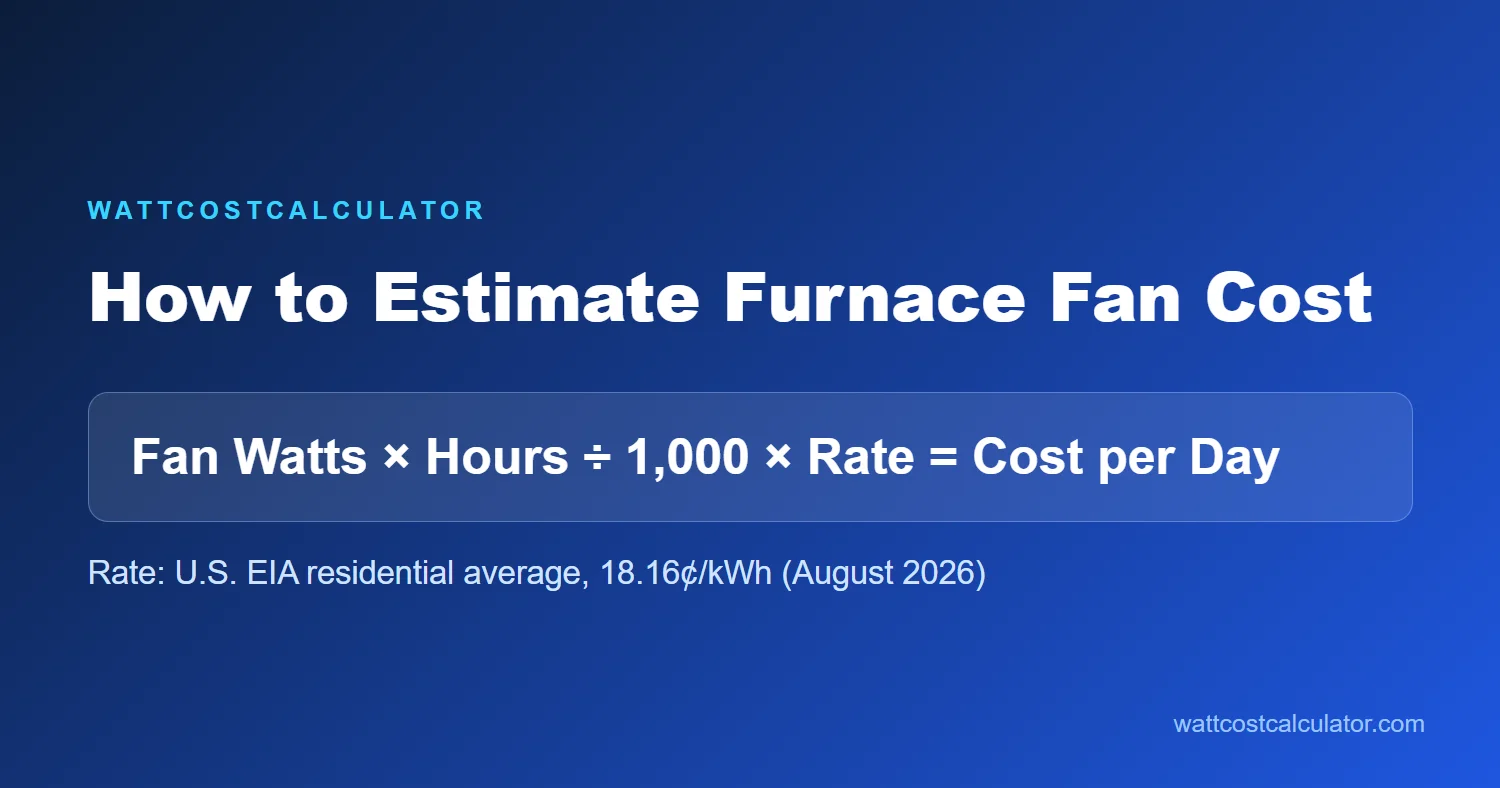
At 18.16¢/kWh, a fan that uses 1.3 kWh a day costs about 24 cents a day in AUTO mode. Running it continuously at 2.3 kWh a day costs about 42 cents, so the setting adds up over a month.
What would this cost in your home?
Adjust the starting values to match your appliance and electricity plan.
Disclaimer: The figures on this page use statewide or standardized averages and the inputs shown. They are for general information only, not a utility quote, a bill, or financial advice. Check your own electricity bill and the official EIA or manufacturer sources for current figures.

Waterbed Heater Electricity Cost: 170 W vs 325 W Per Month
A waterbed heater costs about $22.23 to $42.49 a month at 18.16¢/kWh if it runs 24 hours at 170 W or 325...

Infrared Sauna Electricity Cost: Cost Per 1-Hour Session by Model
An infrared sauna costs about $0.25 to $0.49 per one-hour session at 18.16¢/kWh, depending on model. Here is the cost per session...

Engine Block Heater Electricity Cost: 1,000 W vs 1,500 W Per Month
An engine block heater costs about $10.90 to $16.34 a month at 18.16¢/kWh when plugged in 2 hours a night at 1,000...

Heated Dog Bed Electricity Cost: Small vs Medium Pad Per Month
A heated dog bed costs about $2.62 to $5.23 a month at 18.16¢/kWh if it runs 24 hours at 20 W to...