
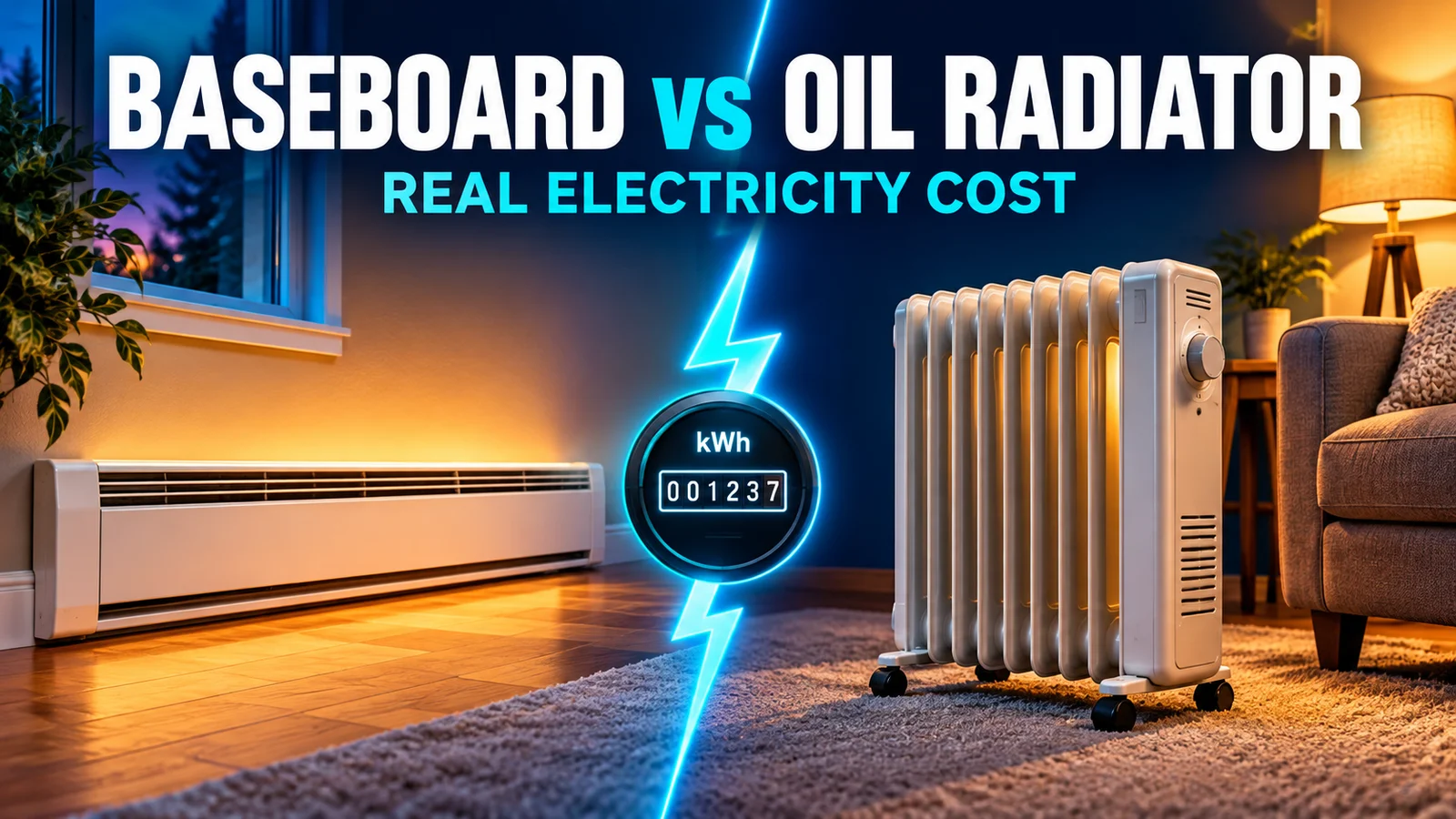
- Baseboard heater vs. oil-filled radiator: the short answer
- Two real labels, two different heating jobs
- How to calculate the running cost
- Example cost table at 18.16¢/kWh
- What I would check before replacing an existing baseboard
- Which heater fits your room?
- Use the calculator with your own rate
- Heater duty-cycle cost
- Safety and practical limits
- Sources and assumptions
- Estimate the cost with your own inputs
- What would this cost in your home?
Baseboard heater vs. oil-filled radiator cost comes down to input watts, actual heating time, and your electricity rate—not whether the heater contains oil. At the same wattage and equivalent full-power time, an electric baseboard heater and an oil-filled radiator use essentially the same electricity. Your bill also depends on how the thermostat cycles.
This comparison uses the latest monthly U.S. residential average available in the EIA table when checked: 18.16 cents per kWh for August 2026. Your utility’s marginal rate may be quite different, so treat the examples as a starting point and replace the rate with the one on your bill.
Baseboard heater vs. oil-filled radiator: the short answer
Both are electric resistance heaters: electricity powers a heating element and becomes heat in the room. An oil-filled radiator heats sealed oil inside its fins; the oil stores and releases heat after the element switches off. That thermal mass can make the heat feel steadier, but it does not create extra heat for free or automatically cut electricity use. A baseboard heater may be fixed in place and controlled room by room, while a portable radiator can be moved to the room you are using.
For a fair cost comparison, look at the label for each model’s input watts and compare the same useful warmth over the same period. If both draw 1,500 W while on for four equivalent full-power hours per day, both use 6 kWh per day. A different thermostat duty cycle can change the result: one unit might satisfy the room’s heat demand sooner because of placement, controls, insulation, or the user’s setpoint. That is a room-and-use difference, not a guaranteed savings advantage of oil-filled radiators.
Two real labels, two different heating jobs
| Documented model | Listed power | What the number means |
|---|---|---|
| De’Longhi Dragon4 TRD40615T-6A | 1,500 W maximum | Portable radiator; thermostat settings determine how long the element runs. |
| Cadet 4F1000W F-Series | 1,000 W at 240 V; 750 W at 208 V | Fixed baseboard; use the wattage for the installed supply voltage. |
These are manufacturer specifications, not a ranking. Comparing these two devices at maximum power compares different heat outputs. A 1,000-W heater can run longer to maintain the same room temperature; its lower hourly cost alone does not establish a lower daily bill.
How to calculate the running cost
Use these two steps:
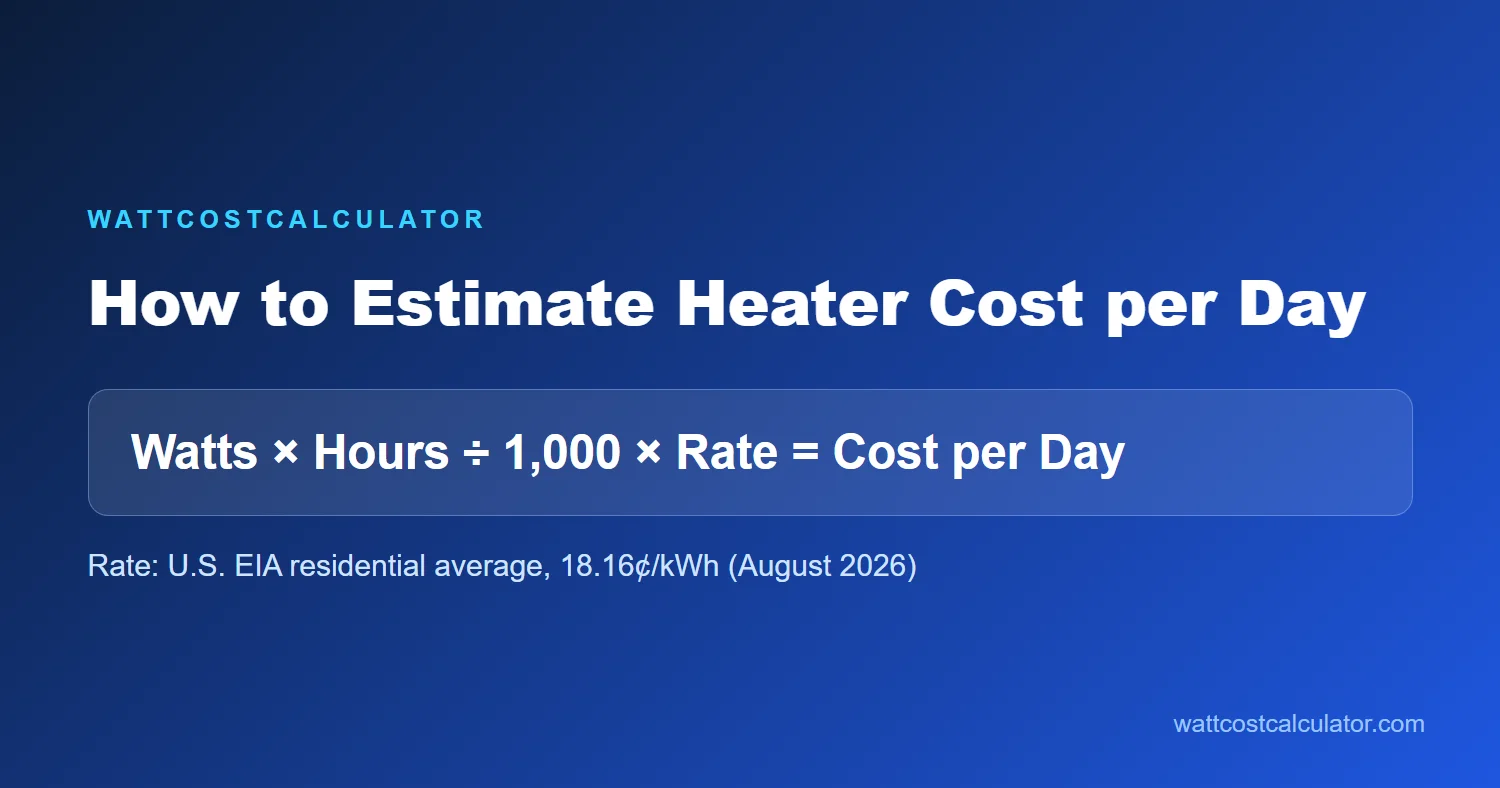
Daily energy (kWh) = watts × equivalent full-power hours per day ÷ 1,000
Cost = kWh × electricity price per kWh
For example, a 1,500 W heater running at full power for four hours uses 1,500 × 4 ÷ 1,000 = 6 kWh. At 18.16¢/kWh, that is about $1.09 per day, $32.69 for 30 days, or $397.70 for 365 days. The flat-rate calculation excludes fixed bill charges; use your applicable supply-plus-variable-delivery rate for a household estimate.
Example cost table at 18.16¢/kWh
The table assumes the heater draws its listed watts for the full hours shown every day. It is a controlled comparison: a 1,000 W baseboard and a 1,000 W radiator would have the same row of estimates if both actually ran for the same time.
| Heater input | Equivalent full-power use | Energy per day | 30-day cost | 365-day cost |
|---|---|---|---|---|
| 1,000 W | 4 hours/day | 4 kWh | $21.79 | $265.14 |
| 1,000 W | 8 hours/day | 8 kWh | $43.58 | $530.27 |
| 1,000 W | 12 hours/day | 12 kWh | $65.38 | $795.41 |
| 1,500 W | 4 hours/day | 6 kWh | $32.69 | $397.70 |
| 1,500 W | 8 hours/day | 12 kWh | $65.38 | $795.41 |
| 1,500 W | 12 hours/day | 18 kWh | $98.06 | $1,193.11 |
How thermostat cycling changes the estimate: “Eight hours of use” can mean the heater is scheduled or attended for eight hours, not that its element draws full power continuously. As a simplified example, if a 1,500 W heater’s element is on about half of an eight-hour window, its equivalent full-power time is about four hours: roughly 6 kWh per day and $32.69 over 30 days at this example rate. Actual cycling varies with the room, weather, insulation, thermostat location, and set temperature. A plug-in energy meter rated for the appliance or your utility’s interval data can give a more useful measurement where appropriate.
What I would check before replacing an existing baseboard
If a room already has a working baseboard, I would first compare its thermostat schedule with the hours the room is occupied. Buying an oil radiator does not remove the room’s heat loss. If both heaters run together, the portable unit can add consumption instead of replacing it.
For a useful comparison, record room temperature, thermostat setting, outdoor conditions and total kWh for similar occupied periods. Do not infer savings by touching a radiator after it switches off: the remaining warmth came from energy stored earlier. A hardwired baseboard needs circuit-level data or a qualified professional, rather than an ordinary plug-in meter.
Which heater fits your room?
- Consider a baseboard heater when you want permanent, room-by-room heat and your home’s wiring and installation are suited to that model. A separate control for an infrequently used room may help you avoid heating the whole home to meet one room’s needs.
- Consider an oil-filled radiator when you need portable supplemental heat that can move between occupied rooms. Its warm-up and cool-down feel differs from a baseboard, and its thermostat and settings may make it easier for your household to manage. Compare actual input watts and usable controls, not marketing claims that imply oil itself saves electricity.
- For either type, compare the delivered comfort. The least expensive device on paper may run longer if it is undersized, poorly placed, or used to heat a drafty space. Lowering the thermostat or heating only the room you use can matter more than the heater’s shape.
The U.S. Department of Energy describes electric baseboard heaters as a form of zone heating and notes that electric resistance heating can be costly as a whole-home heating strategy depending on the home and utility rates. If you need whole-home heat, compare the bill and comfort with your central system or a heat pump rather than assuming a portable resistance heater is the cheaper substitute.
Use the calculator with your own rate
Enter the heater’s input watts, the hours it is available to heat, and the percentage of that time its element is on. Eight hours at 50% on-time equals four full-power hours. Keep the same assumed duty cycle when comparing wattages; the presets do not claim one heater automatically cycles less. Use measured daily kWh to check the result where suitable.
Heater duty-cycle cost
The duty cycle is your assumption, not a model efficiency rating.
Rate reference: EIA August 2026 residential averages, released October 23; checked and reflected November 9, 2026. Examples are editable assumptions. Estimates cover entered electricity only. Method & limitations.Rate reference: EIA August 2026, 18.16¢/kWh U.S. residential average; released October 23 and checked November 9, 2026.
For more space-heater examples, see our guide to space heater electricity use, cost, and safety. If you heat with a gas furnace, our comparison of fan set to AUTO versus ON explains why the blower schedule changes electric use. You can also enter a different appliance wattage in the full electricity cost calculator.
Safety and practical limits
Cost estimates do not replace the manufacturer’s instructions. For portable electric heaters, the U.S. Consumer Product Safety Commission advises keeping combustibles at least three feet away, plugging the heater directly into a wall outlet, and never leaving it operating unattended or while sleeping. Follow the labels and clearance instructions for fixed baseboard units as well.
Sources and assumptions
- U.S. Energy Information Administration, Average Price of Electricity to Ultimate Customers — August 2026 residential average of 18.16¢/kWh; accessed October 26, 2026.
- U.S. Department of Energy, Energy Renovations: HVAC Guide — background on electric resistance heaters, baseboards, and room heating.
- U.S. Consumer Product Safety Commission, portable heater safety guidance.
Updated October 29, 2026: added manufacturer model specifications and a room-comparison checklist.
Estimate the cost with your own inputs
The starting values model one 1,500 W resistance heater for four equivalent full-power hours. Adjust the runtime for thermostat cycling, then compare heaters at the same delivered heat and rate.
What would this cost in your home?
Adjust the starting values to match your appliance and electricity plan.
Disclaimer: The figures on this page use statewide or standardized averages and the inputs shown. They are for general information only, not a utility quote, a bill, or financial advice. Check your own electricity bill and the official EIA or manufacturer sources for current figures.

Waterbed Heater Electricity Cost: 170 W vs 325 W Per Month
A waterbed heater costs about $22.23 to $42.49 a month at 18.16¢/kWh if it runs 24 hours at 170 W or 325...

Infrared Sauna Electricity Cost: Cost Per 1-Hour Session by Model
An infrared sauna costs about $0.25 to $0.49 per one-hour session at 18.16¢/kWh, depending on model. Here is the cost per session...

Engine Block Heater Electricity Cost: 1,000 W vs 1,500 W Per Month
An engine block heater costs about $10.90 to $16.34 a month at 18.16¢/kWh when plugged in 2 hours a night at 1,000...

Heated Dog Bed Electricity Cost: Small vs Medium Pad Per Month
A heated dog bed costs about $2.62 to $5.23 a month at 18.16¢/kWh if it runs 24 hours at 20 W to...