
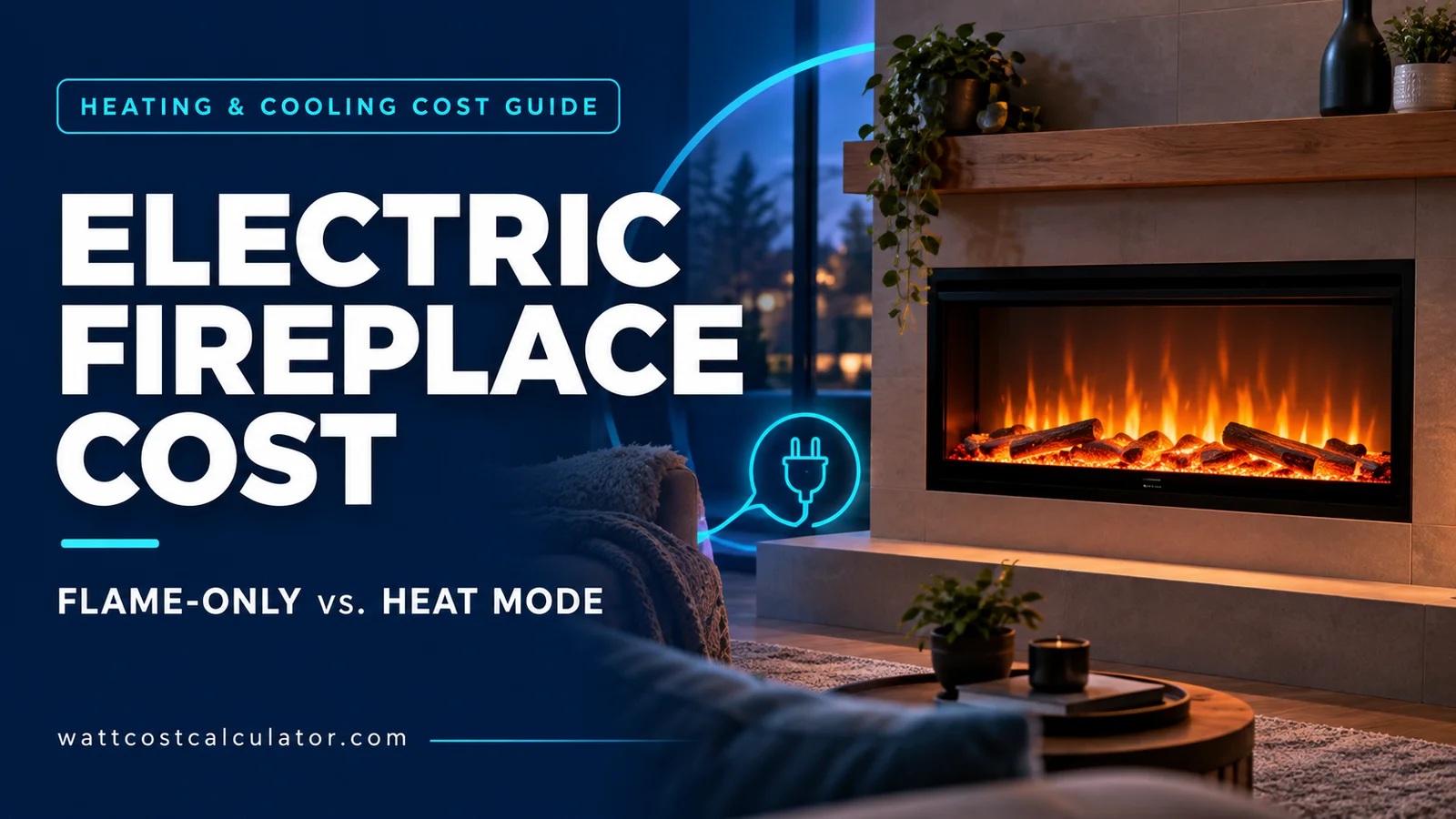
- Flame-only mode and heat mode use different amounts of power
- Example electric fireplace costs at 18.16¢/kWh
- Calculate your own fireplace cost
- What would this cost in your home?
- Does an electric fireplace save money on heating?
- What to check on your model
- Electric fireplace safety reminder
- Sources and assumptions
Electric fireplace electricity cost depends on whether you run the flame display, the heater, or both. An electric fireplace can look like one appliance but operate in two very different ways: the flame display may run by itself, while the heater adds a much larger electrical load. That distinction matters if you enjoy the ambiance most evenings but only need heat occasionally. This guide shows how to estimate each mode, why a thermostat changes real-world use, and what to check before assuming the fireplace will lower your heating bill.
Quick answer: As an illustrative example, a fireplace using 300 watts for its flame effect costs about $8.17 per 30 days at five hours a day and 18.16¢/kWh. A 1,500-watt heater running at full power for those same five hours costs about $40.86 per 30 days. If its heating element runs for only half of that window, the modeled heating cost is about $20.43 per 30 days. Your model, utility rate, and thermostat behavior determine the real result.
Flame-only mode and heat mode use different amounts of power
In flame-only mode, the fireplace runs its lighting and display effects without the heating element. Dimplex says its flame effect uses slightly under 300 watts on the models covered by its technical support guidance. That is a useful example, not a universal specification: some fireplaces use less, and the exact input depends on the model and selected effects. Check your manual or rating information before using a specific wattage.
When heat is enabled, the electric resistance heater is usually the main load. Dimplex describes approximately 1,500 watts when heat is activated, while Napoleon lists 750-watt low and 1,500-watt high settings on some models. Other fireplaces may have different ratings. The label and manual for your own unit are the best source.
Example electric fireplace costs at 18.16¢/kWh
The following comparison uses five hours per day and the U.S. residential average revenue per kWh of 18.16¢ for August 2026. It is an illustrative national benchmark, not necessarily your plan’s exact marginal rate. The EIA explains that its average revenue per kWh is calculated from retail sales revenue and volume as a proxy for retail prices.
| Mode and modeled input | Energy per day | Cost per day | 30-day estimate | 365-day estimate |
|---|---|---|---|---|
| Flame effect only, 300 W illustrative example | 1.5 kWh | $0.27 | $8.17 | $99.43 |
| Heat on, 1,500 W at full power for all five hours | 7.5 kWh | $1.36 | $40.86 | $497.13 |
| Heat scheduled for five hours, element averages 50% on-time | 3.75 kWh | $0.68 | $20.43 | $248.57 |
| Low heat, 750 W at full power for all five hours | 3.75 kWh | $0.68 | $20.43 | $248.57 |
How to read the table: “50% on-time” is a simplified scenario that assumes a 1,500 W element is energized for the equivalent of 2.5 hours during a five-hour period. It is not a measured result or a promise that your fireplace will cycle that way. A thermostat may switch the element on and off as the room warms; actual cycling depends on the set temperature, room size, insulation, outdoor weather, and where the thermostat senses temperature. Flame and heat can also have separate power requirements.
Calculate your own fireplace cost
Use the input watts and estimate the equivalent hours the heating element is actually on—not only the time the fireplace is switched on. If the unit has separate flame and heat modes, calculate them separately and add the costs only when you use both.
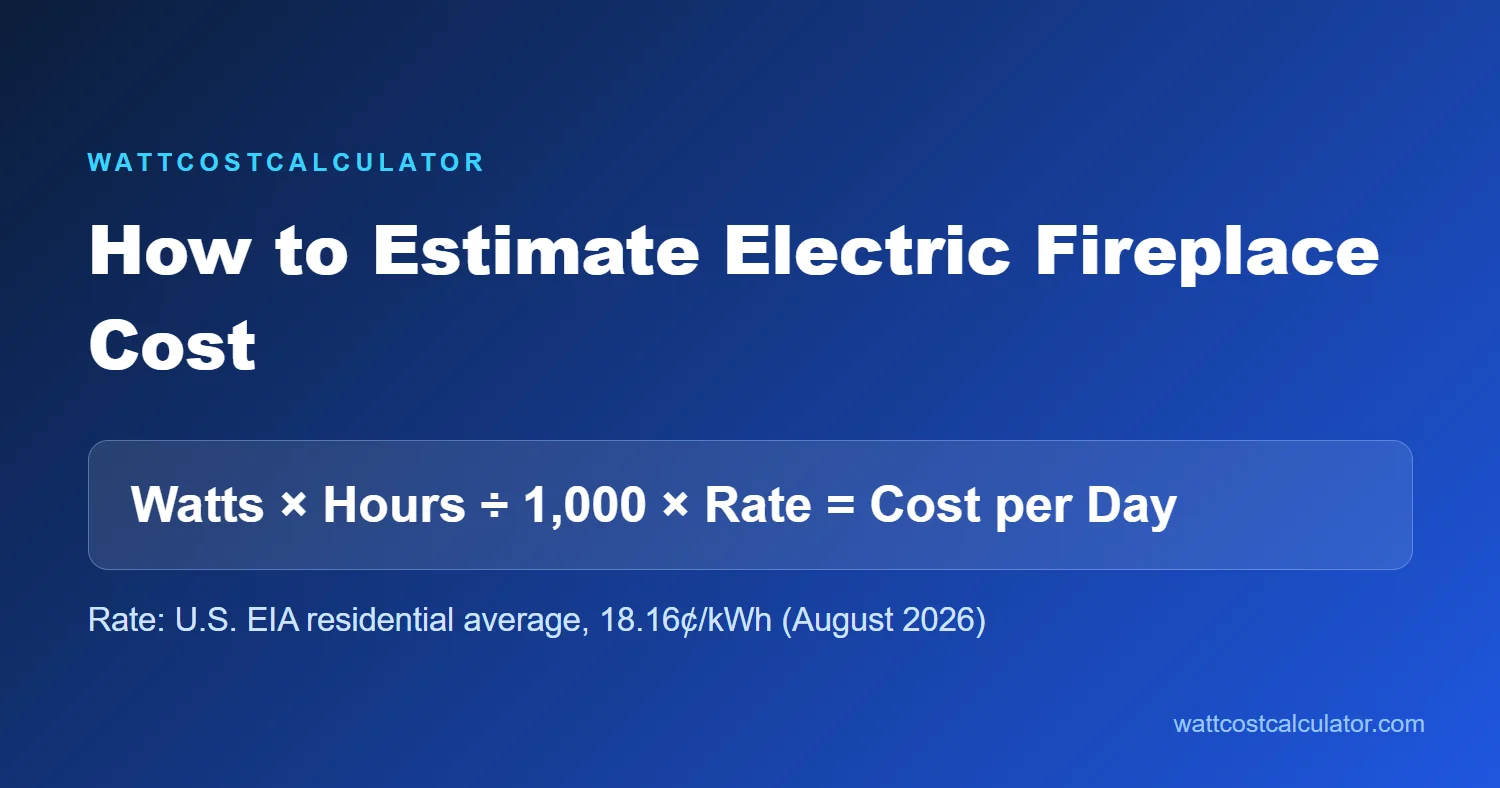
Daily kWh = watts × hours ÷ 1,000
Daily energy cost = daily kWh × your price per kWh
For example, 1,500 W × 5 hours ÷ 1,000 = 7.5 kWh. At $0.1816/kWh, that is $1.362 per day, or about $40.86 for 30 days. For a tailored estimate with your own rate and schedule, use the calculator below.
What would this cost in your home?
Adjust the starting values to match your appliance and electricity plan.
Does an electric fireplace save money on heating?
It can make sense as zone heating when you warm the occupied room and lower the central thermostat, but the result depends on how much central heating you actually displace. If the central system keeps running at the same setting while the fireplace adds heat, your total energy use can increase. A fireplace’s “covers up to” room-size claim also does not guarantee comfort or savings in a drafty room or during very cold weather.
For a fair comparison, look at the fireplace’s heat input, the central system’s fuel and efficiency, the rooms you heat, and your actual utility prices. The resistance heater itself converts electricity to heat at the point of use; the attractive flame effect does not make that heat less expensive per watt. If you want to compare supplemental heaters, see our guides to space heater electricity cost, electric blanket vs. space heater cost per night, and baseboard heater vs. oil-filled radiator. If your home uses a gas furnace, our guide to furnace fan AUTO vs. ON electricity use covers the blower’s contribution to your bill.
What to check on your model
- Find separate flame and heat wattages. The maximum wattage on a label may refer to heat plus flame, while flame-only power may be lower.
- Check low and high heat settings. Some models list 750 W and 1,500 W; do not assume every unit has those exact modes.
- Use your actual electricity rate. The energy charge per kWh on your bill is a better input than a national average, though time-of-use periods and delivery charges can complicate the total bill.
- Account for cycling. A thermostat-controlled unit may not draw full heater power continuously, so a plug-in energy monitor can help for compatible plug-in models if the monitor is rated for the load. Follow both manufacturers’ instructions.
Electric fireplace safety reminder
Use the clearances and operating instructions supplied with your specific fireplace. For portable electric heaters, the U.S. Consumer Product Safety Commission advises keeping the heater at least three feet from combustible materials, plugging it directly into a wall outlet, and not leaving it operating unattended or while sleeping. Built-in or wall-mounted fireplaces have their own installation and clearance requirements; follow the product manual.
Sources and assumptions
- U.S. Energy Information Administration, Electricity Monthly Update, August 2026 data — residential average revenue per kWh of 18.16¢; released October 23, 2026. EIA notes this is a proxy for retail rates and prices, not a direct collection of every customer tariff.
- Dimplex Electric Fireplace Technical Support — manufacturer examples for flame-only and heater power; model specifications vary.
- Napoleon Purview 50 product specifications — an example model listing low 750 W and high 1,500 W heating functions.
- U.S. Consumer Product Safety Commission, winter heating safety guidance.
Checked October 26, 2026. Dollar figures are estimates from stated wattage, usage assumptions, and the cited EIA benchmark; they exclude fixed fees, taxes, and other bill charges. Actual cost varies by model, thermostat cycling, local rate, and usage.
Disclaimer: The figures on this page use statewide or standardized averages and the inputs shown. They are for general information only, not a utility quote, a bill, or financial advice. Check your own electricity bill and the official EIA or manufacturer sources for current figures.
Source check (November 9, 2026): Dimplex technical support states that the flame uses slightly under 300 W and that the heat setting uses about 1,500 W.
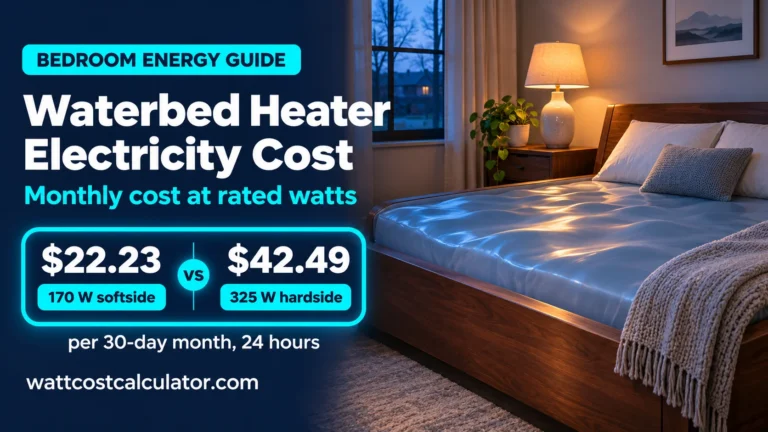
Waterbed Heater Electricity Cost: 170 W vs 325 W Per Month
A waterbed heater costs about $22.23 to $42.49 a month at 18.16¢/kWh if it runs 24 hours at 170 W or 325...

Infrared Sauna Electricity Cost: Cost Per 1-Hour Session by Model
An infrared sauna costs about $0.25 to $0.49 per one-hour session at 18.16¢/kWh, depending on model. Here is the cost per session...
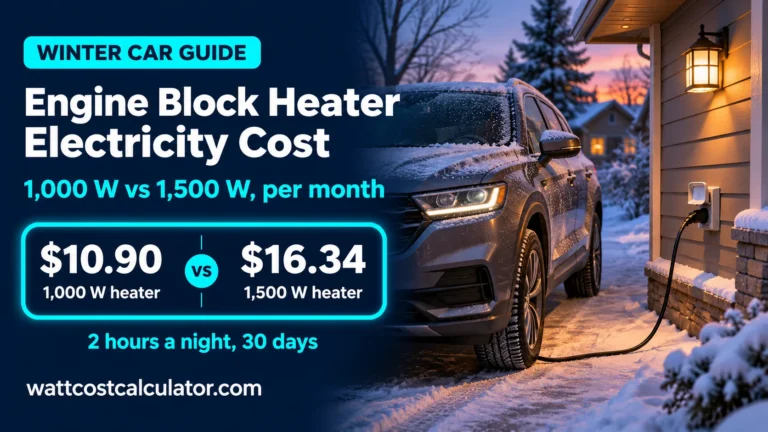
Engine Block Heater Electricity Cost: 1,000 W vs 1,500 W Per Month
An engine block heater costs about $10.90 to $16.34 a month at 18.16¢/kWh when plugged in 2 hours a night at 1,000...

Heated Dog Bed Electricity Cost: Small vs Medium Pad Per Month
A heated dog bed costs about $2.62 to $5.23 a month at 18.16¢/kWh if it runs 24 hours at 20 W to...