
- Auxiliary heat and emergency heat are not the same setting
- A simple way to estimate electric strip heat cost
- Manufacturer examples: auxiliary heat-kit ratings
- Estimate your own auxiliary-heat electricity cost
- Read AUX runtime in context
- What would this cost in your home?
- Why a cold day can change the calculation
- How to get a more reliable number from your home
- Practical checks before changing your thermostat
Heat pump auxiliary heat cost can add a noticeable amount to a winter electric bill when electric resistance strips run for long periods. For a clearly labeled example, a 5 kW strip energized for one full hour uses 5 kWh and costs about $0.91 at the EIA monthly U.S. residential average of 18.16¢/kWh (August 2026). Your system’s strip size, actual on-time, local rate, and thermostat controls determine your result.
The useful question is not simply whether the thermostat shows “AUX.” It is how much electric resistance heat actually ran, and whether it was supplementing the compressor or replacing it. Those situations have different energy use and different implications for comfort and service.
Auxiliary heat and emergency heat are not the same setting
Auxiliary heat (often marked AUX) is an automatic second heating stage. In many all-electric systems it uses resistance elements in the indoor air handler while the heat pump continues running. It can help during very cold weather, a defrost cycle, or when the system is catching up after a large thermostat change. The exact controls vary by equipment.
Emergency heat (often marked EM HEAT) is a manual thermostat mode. On many systems it disables the outdoor heat-pump compressor and relies on the backup source alone. Carrier explains the distinction and advises following the system’s instructions; check your thermostat and equipment manual before changing modes. Do not switch settings just to lower a bill if doing so could affect safe operation or comfort.
Not every backup source is an electric strip. Some homes have a dual-fuel system with a gas furnace, and some systems stage auxiliary heat differently. The calculations below apply only to electric resistance backup. They do not estimate gas use or the heat-pump compressor’s separate electricity.
A simple way to estimate electric strip heat cost
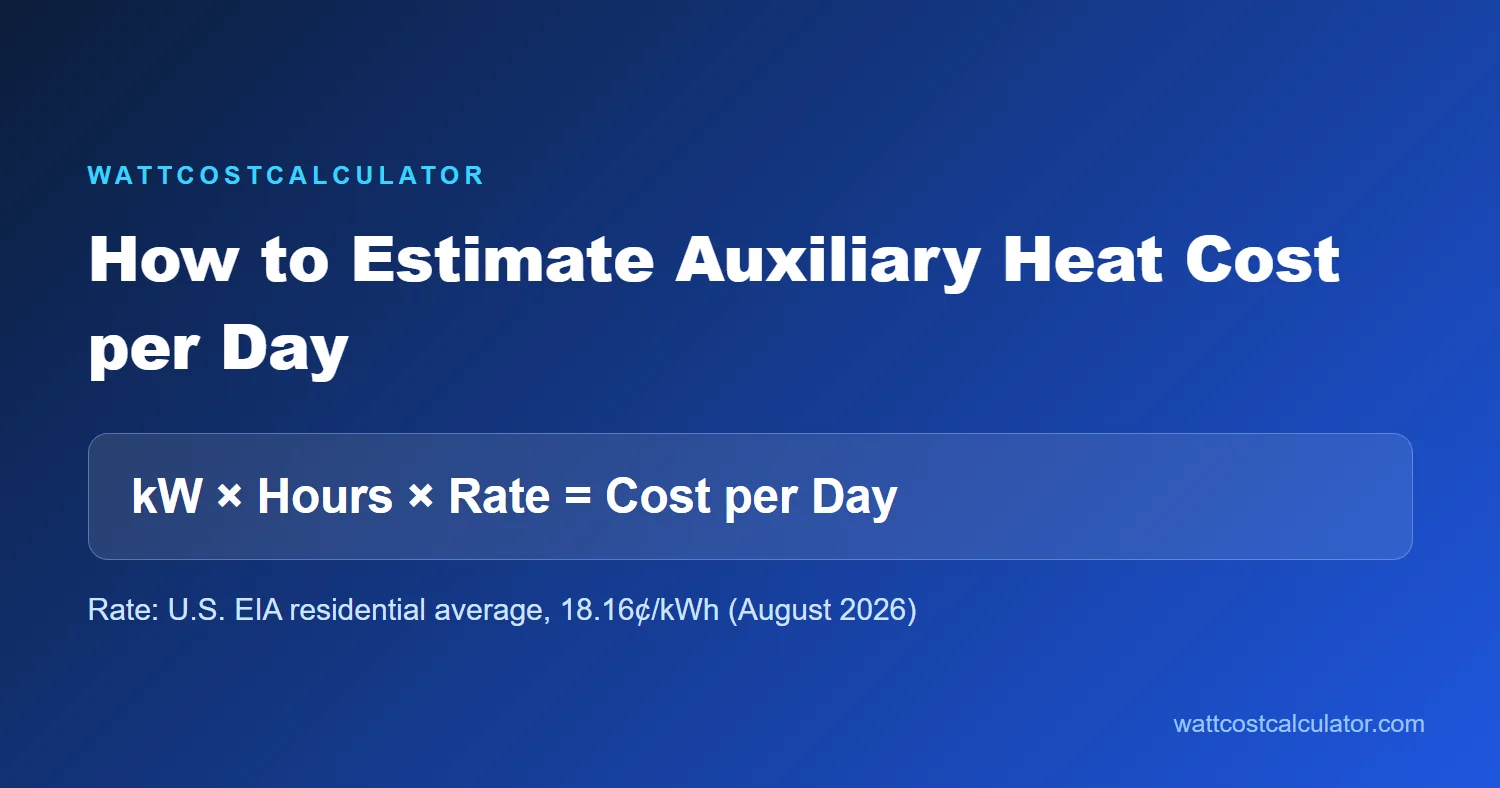
Use the strip heater’s electrical input in kilowatts and the number of hours its elements are actually energized:
Energy (kWh) = strip input (kW) × energized hours
Energy cost = kWh × electricity rate in dollars per kWh
For example, 5 kW × 1 hour = 5 kWh. At 18.16¢/kWh, 5 × $0.1816 = $0.908, or about 91¢ for that hour. This assumes the full 5 kW stage stays on for the entire hour. It is an arithmetic scenario, not a measured average or a typical system size.
| Illustrative resistance-strip input | Actual energized time | Energy used | Estimated cost at 18.16¢/kWh |
|---|---|---|---|
| 5 kW | 15 minutes | 1.25 kWh | $0.23 |
| 5 kW | 1 hour | 5 kWh | $0.91 |
| 5 kW | 2 hours | 10 kWh | $1.82 |
| 10 kW | 1 hour | 10 kWh | $1.82 |
Manufacturer examples: auxiliary heat-kit ratings
These Lennox electric heat kits show how nominal 5 kW and 10 kW labels map to named products. Their electrical input varies with supply voltage, so use the value listed for the installed system rather than treating the kit label as a constant wall reading.
| Heat-kit model | Nominal kit size | Input at 208 V | Input at 230 V | Example cost/hour at 18.16¢/kWh (208 V / 230 V) | Listed air-handler examples |
|---|---|---|---|---|---|
| V1EHK02-1P | 5 kW | 3.76 kW | 4.59 kW | $0.68 / $0.83 | MMD018M6-1P, MMD024M6-1P |
| V1EHK04-1P | 10 kW | 7.51 kW | 9.18 kW | $1.36 / $1.67 | MMD030S6-1P, MMD036S6-1P |
Source: Lennox V1EHK0 electric heat-kit submittal. The document lists heater-kit and compatible air-handler combinations; confirm the exact indoor-unit model and installation data with a qualified HVAC professional.
If a 5 kW strip were energized for one hour every day for 30 days, the modeled total would be 150 kWh and $27.24 at the same example rate. Two hours each day would be 300 kWh and $54.48. These are “what if” budgets—not a prediction of your heat pump’s monthly use. Actual auxiliary operation can cycle, stage multiple elements, or overlap with the compressor.
Estimate your own auxiliary-heat electricity cost
Find the electric backup heat’s input rating in your equipment documentation or ask a qualified HVAC technician. Enter the combined rated watts for the stage you want to estimate, then enter actual element on-time per day—not simply the time the thermostat displayed AUX. Enter your local marginal electricity price in cents per kWh; the calculator starts with an EIA national reference that you can replace.
Read AUX runtime in context
If a thermostat records two hours of 5 kW backup heat, the strip energy is approximately 10 kWh, or $2 at 20¢/kWh. A thermostat’s AUX indicator may include staging or reporting delays, and other heat-pump components use electricity too. Use the equipment rating and a runtime or energy report appropriate to the system.
What would this cost in your home?
Adjust the starting values to match your appliance and electricity plan.
Default-rate reference: 18.16¢/kWh, EIA U.S. residential average for August 2026 (monthly, preliminary). Source checked and value reflected October 28, 2026: EIA Electric Power Monthly, Table 5.6.A. The national average is a comparison point, not your utility’s exact marginal rate. Replace it with the applicable variable energy price from your bill.
Why a cold day can change the calculation
An air-source heat pump moves heat rather than making all of it with resistance elements. Its output and efficiency vary with outdoor temperature, system design, controls, and the home’s heating load. ENERGY STAR’s cold-climate designation uses laboratory performance requirements that include a coefficient of performance (COP) of at least 1.75 at 5°F and at least 70% of the heating capacity measured at 47°F. Those certification thresholds show why model-specific low-temperature performance matters; they do not predict how many hours your own backup strips will run.
DOE also notes that heat pumps can reduce electricity use for heating compared with electric resistance heating, while cold-climate and hybrid systems have different operating strategies. A heat pump that uses backup heat during a defrost event is not automatically malfunctioning. Conversely, frequent auxiliary operation in mild weather, a sudden bill increase, or poor heating deserves a check of the air filter, thermostat settings, outdoor unit, and system operation by a qualified professional.
How to get a more reliable number from your home
- Identify the backup source. Use the equipment manual to confirm whether AUX heat is electric resistance, gas, or another configuration.
- Find the rated input and stages. Air-handler nameplates and installation documents may list heater-kit ratings. Do not treat heating output in BTU/h as the same thing as electrical input watts.
- Use equipment data, not thermostat time alone. A thermostat’s AUX runtime may include periods when an element is cycling or only one stage is active. A compatible system energy report or properly installed circuit monitor can provide better kWh data.
- Use safe monitoring. Central heat-pump equipment commonly uses hardwired 240 V circuits. Do not connect a standard plug-in watt meter to HVAC wiring. Have circuit monitoring installed by a qualified person.
- Compare similar weather and settings. Outdoor temperature, thermostat setpoint, wind, defrost, and home heat loss can change both compressor and backup use. A single cold day should not be treated as a full-season average.
Practical checks before changing your thermostat
Look at the system’s manual before changing setback schedules or using EM HEAT. Some heat pumps may call for auxiliary heat after a large temperature recovery; gradual setpoint changes may reduce that call on some systems, but control behavior varies. Keep filters maintained and outdoor airflow clear according to the manufacturer’s instructions. Never block the outdoor unit or disable a safety control to avoid a cost.
If AUX stays on for long periods in moderate weather, the system cannot maintain its setpoint, or the outdoor unit is not operating as expected, record the outdoor temperature and thermostat display and contact an HVAC professional. The goal is to understand whether the operation is expected—not to suppress needed backup heat.
For related comparisons, see our heat-pump water heater versus standard electric tank guide, the gas furnace fan electricity cost guide, and our baseboard heater versus oil-filled radiator comparison. Those cover water heating, blower power, and resistance room heat; this page isolates the possible electricity cost of backup strips in a space-heating heat pump.
Try your heater’s documented strip rating, actual energized time, and local rate above. For other household loads, use the Appliance Electricity Cost Calculator.
Sources and method
- ENERGY STAR, Heat Pump Equipment Key Product Criteria — cold-climate low-ambient performance criteria.
- U.S. Department of Energy, Heat Pump Systems — heat-pump operation and comparison with electric resistance heating.
- Carrier, What Is Auxiliary Heat? — manufacturer explanation of AUX and emergency heat operation; follow your own system’s manual.
- U.S. Energy Information Administration, Electric Power Monthly, Table 5.6.A — August 2026 U.S. residential monthly average, 18.16¢/kWh, released October 23, 2026.
Reviewed October 30, 2026. Method: each example multiplies the stated electric heat-kit input by energized time and the cited EIA comparison rate of 18.16¢/kWh. Model ratings and listed air-handler compatibility come from Lennox documentation; runtime examples are scenarios, not observed household use. Estimates exclude fixed utility fees, taxes, demand charges, and any gas-furnace fuel cost.
Disclaimer: The figures on this page use statewide or standardized averages and the inputs shown. They are for general information only, not a utility quote, a bill, or financial advice. Check your own electricity bill and the official EIA or manufacturer sources for current figures.

Waterbed Heater Electricity Cost: 170 W vs 325 W Per Month
A waterbed heater costs about $22.23 to $42.49 a month at 18.16¢/kWh if it runs 24 hours at 170 W or 325...

Infrared Sauna Electricity Cost: Cost Per 1-Hour Session by Model
An infrared sauna costs about $0.25 to $0.49 per one-hour session at 18.16¢/kWh, depending on model. Here is the cost per session...
Engine Block Heater Electricity Cost: 1,000 W vs 1,500 W Per Month
An engine block heater costs about $10.90 to $16.34 a month at 18.16¢/kWh when plugged in 2 hours a night at 1,000...

Heated Dog Bed Electricity Cost: Small vs Medium Pad Per Month
A heated dog bed costs about $2.62 to $5.23 a month at 18.16¢/kWh if it runs 24 hours at 20 W to...