Two households on opposite sides of the New York metro area can see similar electricity prices on a state-average chart and still receive very different bills. The reason is not just the price of electricity: usage, the supply contract, delivery charges and fixed fees all matter. Here is how to compare New Jersey and Connecticut without mistaking a supplier quote for the entire bill.
To see how these states rank against the rest of the country, check out our 2026 US State-by-State Electricity Cost Master Guide.
For all 50 states, see our 2026 U.S. Electricity Rates by State Hub.
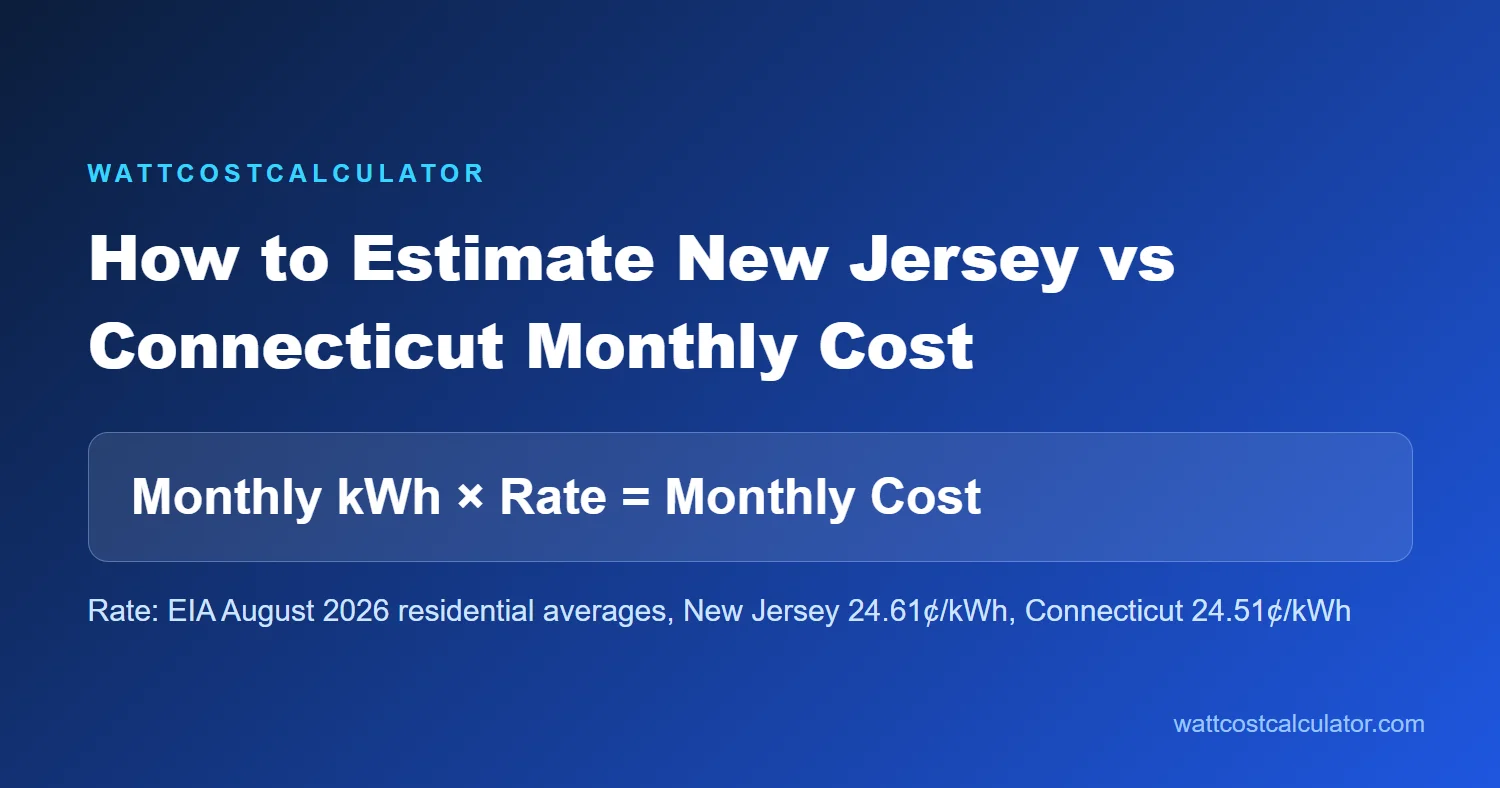
The short answer: EIA’s August 2026 preliminary residential averages were 24.61¢/kWh in New Jersey and 24.51¢/kWh in Connecticut. At 850 kWh, multiplying by those averages gives $209.19 and $208.34, a difference of just 85 cents. These are historical statewide revenue-per-kWh averages, not current utility tariffs or predictions for your address.
The comparison changes with the month
In EIA’s full-year 2025 data, the residential averages were 22.48¢ in New Jersey and 29.31¢ in Connecticut. At 850 kWh those historical averages imply $191.08 and $249.14 respectively. That $58.06 difference is much larger than the August 2026 snapshot. A single month and a full-year average answer different questions; neither establishes a permanent state price gap.
| Usage | NJ: 24.61¢ | CT: 24.51¢ |
|---|---|---|
| 500 kWh | $123.05 | $122.55 |
| 850 kWh | $209.19 | $208.34 |
| 1,200 kWh | $295.32 | $294.12 |
For example, suppose a supplier offer were 3¢/kWh below a household’s current supply price at 850 kWh per month. The gross supply difference would be $25.50 for that usage. If the offer also charged a $10 monthly fee, the arithmetic advantage would fall to $15.50 before taxes and any other terms. This hypothetical does not predict savings: compare the offer’s contract length, variable-price rules, cancellation fee and usage against the supply portion of your actual bill; delivery remains separate.
The averages divide electricity revenue by sales and reflect a mix of customers and charges. Avoid adding a full fixed fee to the statewide average as if it were a pure variable tariff. For a real bill estimate, use your own provider’s itemized rates and fees instead.
Supply is only one part of the bill
In New Jersey, Basic Generation Service (BGS) is the default electricity supply for eligible customers who have not selected an alternative supplier. New Jersey’s Board of Public Utilities explains that supply is distinct from delivery. In Connecticut, Eversource or United Illuminating typically delivers power in its service territory while eligible customers can choose a supplier or remain on Standard Service. Municipal utilities have different arrangements.
Consider an illustrative 850 kWh bill: supply at 11.58¢/kWh is $98.43. Connecticut’s consumer counsel lists that figure for Eversource residential Rate 1 Standard Service effective July 2026; it is supply only, not the full bill. If an alternative supplier charges 10.58¢ for the same usage, the supply difference is $8.50 before any other differences. Delivery charges continue; contract fees, changing prices, taxes or additional charges can affect actual savings. Verify the current rate, service territory and contract terms before deciding.
What winter heating adds
Imagine a 1,500-watt electric space heater operating at full power for four hours per day in a home office. It uses 6 kWh per day, or 180 kWh in 30 days. At the August statewide reference prices, that extra energy is approximately $44.30 in New Jersey or $44.12 in Connecticut. The difference between the state averages is only 18 cents, while reducing the heater’s full-power runtime to two hours halves this illustrative energy use. Thermostats cycle on and off, so elapsed time is not necessarily full-power time. Keep heaters clear of combustibles and follow the manufacturer’s safety instructions.
Check whether a supply offer changes the whole bill
Read the term and any monthly fee before comparing a third-party supply offer with your utility rate. A $5 monthly supplier fee adds 1¢/kWh at 500 kWh and 0.5¢/kWh at 1,000 kWh. That example shows why the same offer can look different for a small apartment and a larger household. See how to find the applicable rate on your electric bill.
What would this cost in your home?
Adjust the starting values to match your appliance and electricity plan.
Default rate: 24.61¢/kWh, EIA New Jersey residential average for August 2026, preliminary; checked and set November 9, 2026. To compare Connecticut’s August reference, enter 24.51¢/kWh. Replace these historical averages with your own applicable variable rate for an appliance estimate. The widget excludes fixed charges and does not model tiers or time-of-use periods.
A practical bill check before switching
- Find your billing dates, total kWh and supply line. A quote in cents per kWh is usually not the full delivered cost.
- Identify your utility, rate class and current default or supplier rate. Compare equivalent supply components and check whether taxes, fees and credits are included.
- Read the contract term, whether the rate is fixed or variable, early termination fees and renewal conditions. Connecticut PURA directs customers to the official Energize CT rate board.
- Review delivery and fixed charges separately. Calculate the effect of an additional appliance using charges that actually vary with its extra kWh; do not attribute the entire monthly fixed fee to it.
For a line-by-line explanation, see our guide to reading an electric bill. For a neighboring state’s supply comparison, read Pennsylvania’s price to compare; for heating use, explore space heater electricity costs. You can also use the main calculator with a rate from your own bill.
Frequently asked questions
Is Connecticut really about eight cents per kWh more than New Jersey?
That large gap appears in the full-year 2025 averages cited above, while the August 2026 snapshot shows almost no difference. The periods answer different questions: rates move over time, and a statewide average does not set every household’s tariff. Compare the same month and your utility territory.
Can choosing a supplier lower my total bill in New Jersey or Connecticut?
It may lower the supply portion if the offer’s price and terms work for your usage, but delivery charges from your utility generally remain. Include monthly fees, introductory periods, variable pricing, cancellation terms and taxes before comparing the expected supply savings with your current rate.
Why can delivery charges remain high when I switch suppliers?
Supplier choice changes who sells the energy, not the local wires that deliver it. Your distribution utility continues to bill regulated delivery charges for its service territory. Check the utility bill’s delivery section and current tariff; the EIA state average does not break those charges out for your account.
Sources
- EIA Electric Power Monthly Table 5.6.A, August 2026 preliminary state residential averages.
- EIA Electric Power Annual, 2025 residential state averages.
- New Jersey Board of Public Utilities: Basic Generation Service.
- Connecticut Office of Consumer Counsel: Understand your electric bill, supply and delivery.
- Connecticut PURA: consumer questions and supplier contracts.
For all 50 states, see our 2026 U.S. Electricity Rates by State Hub.
Disclaimer: The figures on this page use statewide or standardized averages and the inputs shown. They are for general information only, not a utility quote, a bill, or financial advice. Check your own electricity bill and the official EIA or manufacturer sources for current figures.
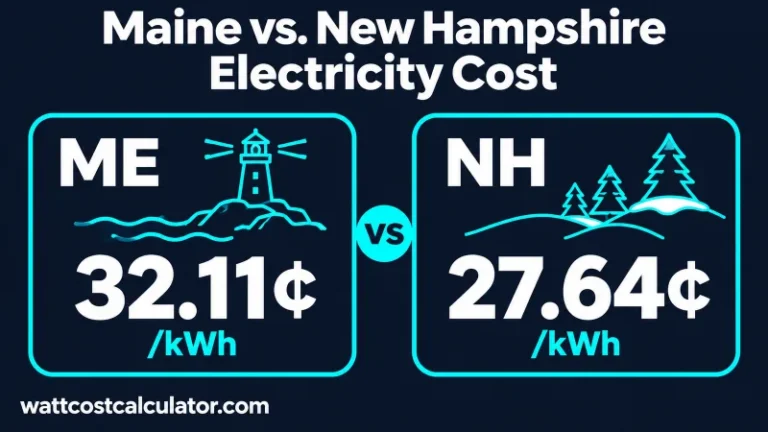
Maine vs. New Hampshire Electricity Cost: Winter Heat Pump & Delivery Bills
Residential electricity in Maine averaged 32.11¢/kWh in August 2026 (EIA), compared with 27.64¢/kWh in New Hampshire—making a 700 kWh monthly bill $31.29...

2026 US State-by-State Electricity Cost Master Guide
Compare electricity prices across U.S. states using EIA data: the five most expensive and cheapest states, plus California, Texas, Florida and New...
U.S. Electricity Rates by State (2026 Comparison Hub)
Compare residential electricity prices in all 50 states and DC, using EIA August 2026 data with August 2025 for comparison, and jump...
Illinois vs Ohio Electricity Cost: Supply Rates and the Total Bill
A supplier advertises electricity for 10 cents per kilowatt-hour. Should a 1,000-kWh month cost $100? The supply portion might be about that...