
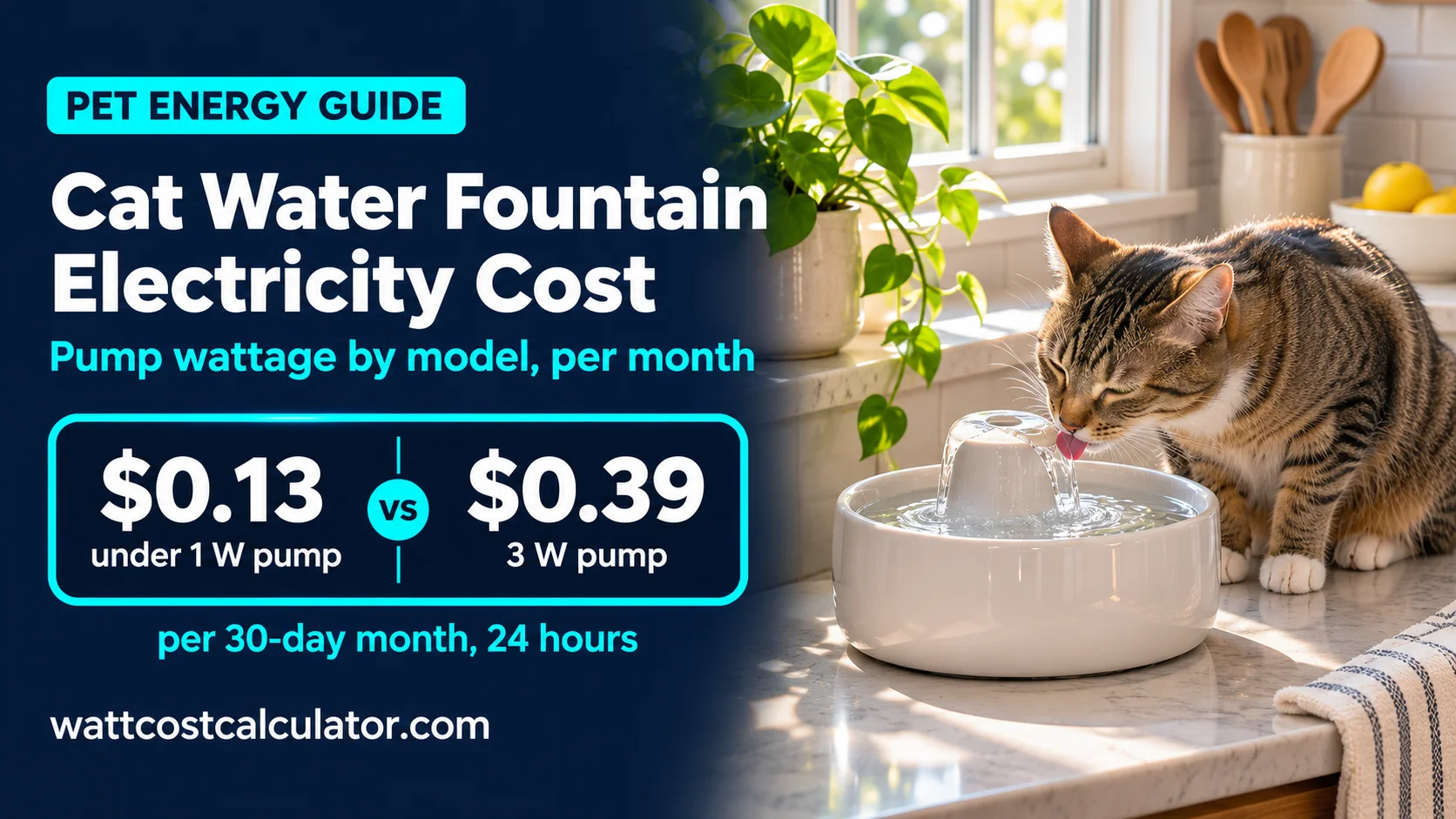
A cat water fountain that runs 24 hours a day costs about $0.13 to $0.39 per 30-day month when its pump is rated 1 W to 3 W, and about $1.31 per month for a 10 W high-flow pump at the same rate. The electricity is the smallest recurring cost of owning a fountain. Filters, replacement pumps, and cleaning time usually cost more over a year. This guide shows how the number is calculated, what the pump wattage really means for duty cycle, and how to check your own model.
- How the monthly figure is calculated
- What pump wattage means in practice
- Monthly and yearly cost by pump wattage
- Where the listed wattage comes from
- How to measure your own fountain
- Duty cycle, timers, and energy-saving modes
- Practical ways to keep the cost low
- Why the pump is not the whole story
- How this compares with other pet and home devices
- Frequently asked questions
- Sources and method
How the monthly figure is calculated
Electricity used by any constant-load appliance is watts multiplied by hours, divided by 1,000 to get kilowatt-hours. A 1 W pump running for 24 hours uses 24 Wh per day, or 0.72 kWh over a 30-day month. Multiply that by the residential rate and you get the cost. At 18.16 cents per kWh, the U.S. average for August 2026 published in Table 5.6.A of the U.S. Energy Information Administration Electric Power Monthly, the result is about $0.13 per month.
The formula is simple, but three details change the result. The first is whether the pump runs continuously or cycles. Most cat fountains use a submersible pump that runs all day, because the water must keep moving to stay fresh and to keep the cat drinking. The second is the rated wattage. Manufacturers list maximum or nominal power, while the actual draw can be lower at low head height. The third is standby power. Some fountains include an LED light or a small controller that draws a fraction of a watt even when the pump is stopped. Those loads are small enough to ignore for a rough estimate, but they matter if you want a precise number.
What pump wattage means in practice
Cat fountains use small DC or low-voltage AC pumps that push water up a short tube and out over a spout or into a bowl. A pump lifts water only a short height above the reservoir, so the load is mostly the friction of the water flowing through the spout, the filter, and the tubing. Two things increase the power draw. A clogged carbon or foam filter forces the pump to work against higher resistance. A very low water level can make the pump run dry or cavitate, which reduces efficiency and shortens the motor life.
For cost purposes, the practical rule is that wattage sets the hourly cost and runtime sets the total. A 2 W pump and a 3 W pump differ by only $0.13 per month when both run 24 hours a day. The runtime is where most of the difference comes from. A fountain on a timer that runs 8 hours a day uses one-third of the electricity of the same pump running around the clock, and a timer does not change how much water the cat can drink when the fountain is off because the reservoir holds enough water to last through the off period in most designs. Check the manual before setting a timer. Some fountains are designed to run continuously, and stopping the pump can let the water stagnate.
Monthly and yearly cost by pump wattage
The table below uses 24-hour operation, 30-day months, and 18.16 cents per kWh. It is a calculation from listed wattage, not a laboratory test of any specific model.
| Pump wattage (listed) | Energy per 30 days | Cost per 30 days | Cost per year |
|---|---|---|---|
| 1 W | 0.72 kWh | $0.13 | $1.57 |
| 2 W | 1.44 kWh | $0.26 | $3.14 |
| 3 W | 2.16 kWh | $0.39 | $4.71 |
| 10 W (high-flow model) | 7.20 kWh | $1.31 | $15.69 |
The 10 W row is included for larger fountains with multi-level flow or a high-flow pump. Check the label on your own pump before choosing a row. Figures exclude fixed utility charges.
Use the table below to see how the same 3 W, 24-hour fountain costs in four states from EIA Table 5.6.A (August 2026).
| Location (EIA August 2026 average) | Rate | Cost per 30 days (3 W, 24 h) | Cost per year |
|---|---|---|---|
| Washington | 14.63 cents/kWh | $0.32 | $3.79 |
| United States | 18.16 cents/kWh | $0.39 | $4.71 |
| New York | 28.65 cents/kWh | $0.62 | $7.43 |
| California | 29.75 cents/kWh | $0.64 | $7.71 |
Even in California, the highest rate in this table, a 3 W fountain costs under $8 per year in electricity.
Where the listed wattage comes from
Retailers and brand pages list pump wattage in different ways, so the figures in this guide were checked against the makers’ own pages. Catit’s PIXI Smart specification lists average power use of under 1 W on a 5 V USB adapter. The Catit Flower Fountain page gives the North American adapter as 12 VA at 120 V and 60 Hz, which is an input limit rather than a measured draw, and the 3 W figure for the stainless steel model comes from retailer listings that cite the maker’s pump. Closer Pets, the company behind Cat Mate, lists a low-voltage pump of about 2 W for its fountains. Treat each figure as a ceiling and check the label on the pump in your box before relying on it.
Some general guides quote a range of 3 W to 15 W for all fountains. This guide does not use that range for a standard model, because no specific manufacturer specification supports the upper figure for the small pumps used in cat fountains. The 10 W row above is a stated high-flow case, not a typical cat fountain.
How to measure your own fountain
A plug-in energy meter gives the most reliable answer. Plug the fountain into the meter, let it run for 7 days, and read the total kWh. Divide by 7 to get the daily figure, then multiply by 30 to get the monthly kWh. Multiply that by your rate to get the monthly cost. A week is long enough to smooth out any short cycles from a sensor, and it avoids the error of reading the meter after only a few hours.
If you do not have a meter, use the calculator below.
Adjust the starting values to match your appliance and electricity plan.What would this cost in your home?
Duty cycle, timers, and energy-saving modes
Duty cycle is the share of time a pump is actually running. A fountain with a motion sensor, a low-water cut-off, or an automatic timer can have a duty cycle well below 100 percent. The savings are proportional. A 3 W pump running 12 hours a day rather than 24 uses $0.20 less electricity per month at 18.16 cents per kWh, which is about $2.35 per year. That is a small saving in absolute dollars, but it is a real one if your rate is high. In California or New York, where the EIA August 2026 averages are 29.75 cents and 28.65 cents per kWh, the same change saves about $0.32 and $0.31 per month.
Whether a timer is worth using depends on the cat and the water supply. A fountain that is refilled every few days can usually go through a quiet period at night without a problem. A fountain that is topped up only once a day may not give the cat clean, moving water between refills, and clean water is the reason most owners buy a fountain in the first place. Test a timer for a week and watch the water level and the cat’s drinking pattern before committing to it.
Practical ways to keep the cost low
Keep the filter clean. A blocked filter raises the head the pump must work against. Replace or rinse the filter on the schedule the manufacturer recommends. A clean filter also keeps the water flowing, which helps the cat drink.
Keep the pump submerged. Running a pump dry overheats the motor. Keep the water level above the minimum line in the manual and refill before the level drops.
Place the fountain away from heat sources. A pump in a warm room or next to a radiator runs warmer and may age faster. This does not change the electricity cost much, but it can shorten the life of the pump, which is a larger expense than the electricity.
Compare the total cost of ownership. A replacement pump, a set of filters, and a few minutes of cleaning each week usually cost more than the electricity. If you are choosing between two fountains, compare filter prices and warranty terms along with the listed wattage.
Use the right outlet. A small fountain does not need a dedicated circuit. Plug it into a grounded outlet and avoid sharing that circuit with a space heater or a microwave, so that a breaker trip on the shared circuit does not stop the water flow.
Why the pump is not the whole story
Most of the electricity a fountain uses goes into moving water against friction and, in a small share, into the pump’s own heat. A pump that runs continuously in a closed reservoir warms the water slightly over time, which is one reason many owners rinse and refill on a fixed schedule. That heat is minor compared with a room heater, but it is a reason not to leave a fountain running in a sealed bowl with no fresh water added for long periods.
Evaporation matters more than electricity for many households. A reservoir that loses water through evaporation and spillage has to be topped up, and that water usually comes from the tap at a price that is far higher per gallon than the power used to circulate it. If you measure the total running cost of a fountain, include the water and the filter cartridges, not only the kilowatt-hours.
Cold rooms slow evaporation but do not change the pump’s electrical draw in any meaningful way for a small fountain, so the seasonal change in the electricity bill is close to zero. Warm rooms with heating vents can dry the bowl faster, which changes how often you refill but not how many kilowatt-hours the pump uses.
How this compares with other pet and home devices
Cat fountains are one of the lowest-cost devices in a home. Their pumps draw a few watts, while a refrigerator runs its compressor for a large share of the day, as the refrigerator electricity cost guide explains. A humidifier or a kettle, by contrast, can draw hundreds of watts for short periods, and the humidifier electricity cost guide covers how runtime changes its bill. For a pet fountain, the electricity is not the decision factor. Choose by filter design, noise, and how easy the reservoir is to clean.
Frequently asked questions
Does a cat water fountain use a lot of electricity? No. A 1 W to 3 W pump running 24 hours a day costs about $0.13 to $0.39 per month at the U.S. average rate.
Is the cost different in other states? Yes, but the change is small. At California’s August 2026 average of 29.75 cents per kWh, a 3 W fountain costs about $0.64 per month. At Washington’s average of 14.63 cents, it costs about $0.32.
Should I turn the fountain off at night? Only if the manufacturer says it is safe and the reservoir stays topped up. The savings are small.
Where do I find the wattage? Check the label on the pump, the box, or the manual. If only a range is listed, use the higher figure for a conservative estimate.
Sources and method
Monthly kWh is calculated as pump watts multiplied by hours per day, multiplied by 30, divided by 1,000. Cost is kWh multiplied by the residential rate. The rate is the U.S. average of 18.16 cents per kWh for August 2026 from the EIA Electric Power Monthly, Table 5.6.A. Pump wattage comes from the retailer and brand listings noted above. Where a listing is a retailer summary, confirm it against the manufacturer’s specification or the pump label. The U.S. Department of Energy Energy Saver site gives general guidance on how to estimate and reduce household appliance energy use.
Last checked: November 21, 2026. These are calculated estimates from listed wattage and average tariffs, not measured results for any specific model.
CPAP Machine Electricity Cost: Heated Humidifier & Heated Tube Impact
Running a CPAP machine for 8 hours a night costs roughly $0.65 per 30-day month ($7.95/year) with humidification off, or $2.58 per...

Christmas Lights Electricity Cost: LED vs. Incandescent Holiday Displays
Lighting 600 incandescent mini Christmas bulbs for 6 hours a night costs roughly $7.85 per 30-day month at 18.16¢/kWh, whereas an equivalent...
Robot Vacuum & Auto-Empty Wash Dock Electricity Cost: Charging vs. Hot-Air Drying
A basic charging-only robot vacuum costs roughly $0.46 per 30-day month ($5.62/year) at 18.16¢/kWh, while an all-in-one mop-washing and hot-air drying station...
Home Printer Electricity Cost: HP OfficeJet Pro 9125e vs. Brother HL-L2405W
A lightly used HP OfficeJet Pro 9125e costs about $0.32 a month in electricity, while a Brother HL-L2405W left in its 4-watt...