
- Start with the cable’s watts, not just its length
- Calculate your pipe heating cable electricity cost
- Treat thermostat runtime as the key unknown
- What would this cost in your home?
- Monthly cost by length and heating time
- Why “plugged in all winter” does not mean full power all winter
- Measure the whole day without double-counting cycling
- Lower the load without compromising freeze protection
- Our take: budget the cold periods, then check the result
Pipe heating cable electricity cost depends on cable wattage, active heating time, and your electricity rate. A 30-foot cable rated at 7 watts per foot draws 210 watts while heating. At an illustrative 20¢/kWh, that costs about $15.12 for 30 days at 12 active hours per day, or $30.24 if it heats continuously. These are calculated scenarios, not measured winter averages or a guarantee that a particular cable will protect your pipes.
The overlooked question is how many hours the cable actually heats, rather than how many hours it stays plugged in. This guide separates cable length, rated input, thermostat cycling, and variable electricity prices so you can build a realistic freeze-protection budget. We have not field-tested these cables; the product facts come from manufacturer documentation and the dollar amounts are our calculations.
Start with the cable’s watts, not just its length
Frost King’s automatic water-pipe cable range provides one concrete example: the manufacturer lists 120 V and 7 W per foot. Its published thermostat thresholds are approximately 38°F on and 45°F off. Those specifications describe this product family, not every cable sold as heat tape.
For a constant-wattage cable with that rating, multiply the installed heating-cable length by 7. A 12-foot cable is 84 W, an 18-foot cable is 126 W, and a 30-foot cable is 210 W. Use the cable’s rated heating length, not an assumed length of pipe or the combined length of the heating section and cold power lead. If your label gives total watts, use that number directly.
Self-regulating products need a different interpretation. Their output changes with temperature; Amphenol TPC’s self-regulating assembly documentation describes heat output adjusting to surface and ambient temperature. A nominal W/ft value should therefore not be treated as an unchanging measured draw. Use the manufacturer’s relevant data or safely measured session kWh when available.
Calculate your pipe heating cable electricity cost
Cost = total watts ÷ 1,000 × active heating hours × electricity price in dollars per kWh. The calculator below takes the rate in cents: enter 20 for $0.20/kWh. Its starting values represent a 30-foot, 7 W/ft constant-wattage cable heating for 12 hours per day. Change the watts for your own cable and the hours for a realistic operating scenario.
Treat thermostat runtime as the key unknown
At 210 W, 6 active hours per day uses 1.26 kWh daily. That is $7.56 for 30 days at 20¢/kWh. Twelve active hours doubles that example. A self-regulating cable can vary its draw along its length and with temperature, so use manufacturer guidance or a suitable whole-cable energy reading.
What would this cost in your home?
Adjust the starting values to match your appliance and electricity plan.
The 30-day result is a monthly scenario. The calculator’s 365-day result assumes the same use every day of the year; it is not a winter-season forecast. For a season, add the estimated kWh for the actual periods you need protection. Our U.S. electric-bill guide explains how to identify the applicable usage charges without treating a fixed customer fee as an extra appliance cost.
Monthly cost by length and heating time
All rows below assume a constant 7 W/ft while energized, 20¢/kWh, and 30 days. The 25%, 50%, and 100% columns are invented duty-cycle scenarios, equivalent to 6, 12, and 24 active heating hours per day. They are not predicted runtimes for any city, temperature, or installation.
| Heating length | Total input | 6 h/day (25%) | 12 h/day (50%) | 24 h/day (100%) |
|---|---|---|---|---|
| 12 ft | 84 W | $3.02 | $6.05 | $12.10 |
| 18 ft | 126 W | $4.54 | $9.07 | $18.14 |
| 30 ft | 210 W | $7.56 | $15.12 | $30.24 |
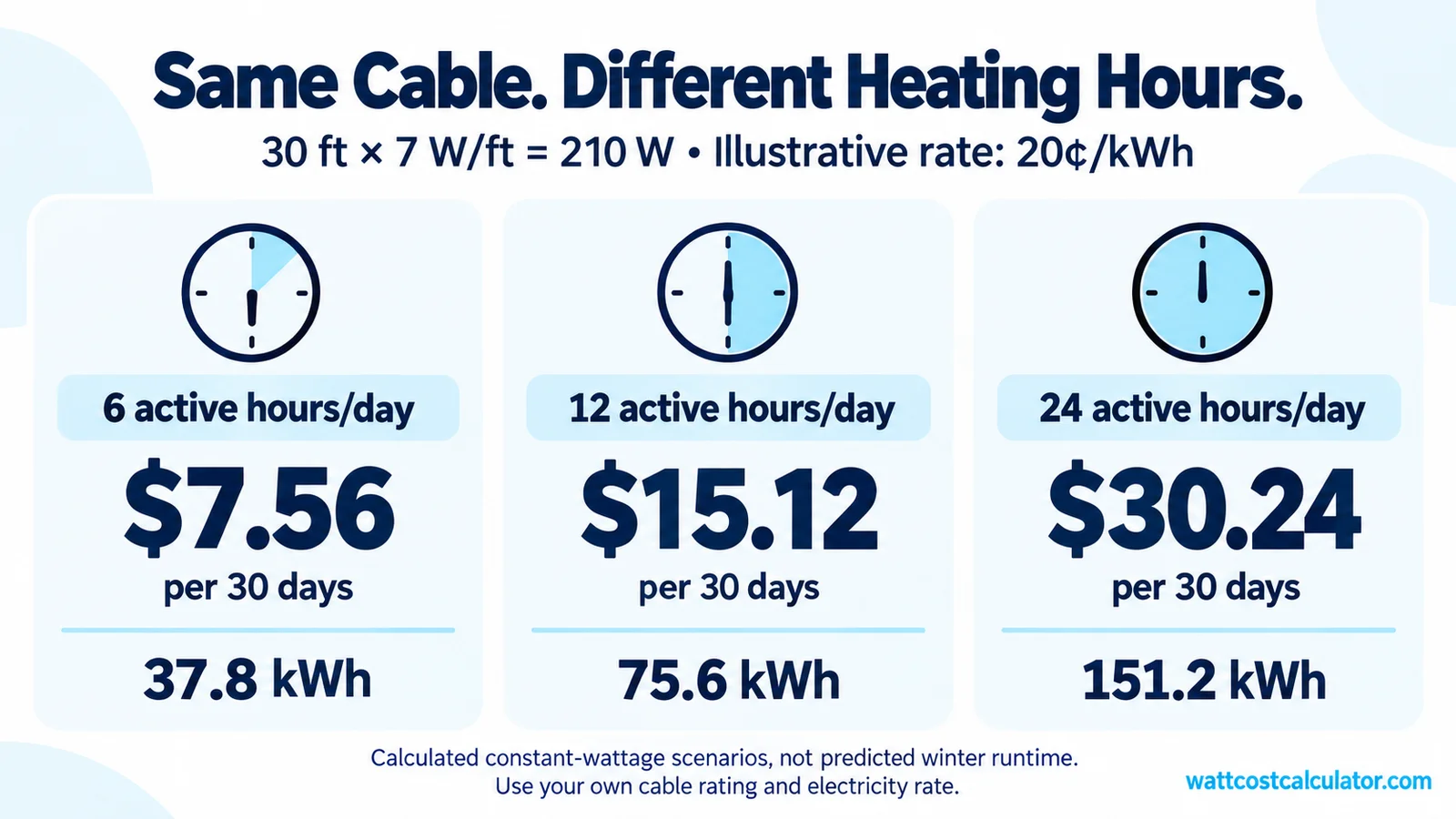
For example, 210 W × 12 hours ÷ 1,000 = 2.52 kWh per day. Over 30 days that is 75.6 kWh; multiplied by $0.20, it costs $15.12. At an illustrative 35¢/kWh, the same heating pattern costs $26.46. A high-rate household can have a larger bill even when its cable operates for exactly the same hours.
Why “plugged in all winter” does not mean full power all winter
A thermostat-controlled constant-wattage cable can remain connected while its heating element switches off. Its sensor responds to local conditions; outdoor weather-app temperature alone cannot tell you the daily runtime. Pipe location, exposure, insulation, incoming water, and thermostat placement can all affect the heating pattern. A sunny afternoon and a windy overnight freeze should not automatically receive the same hours in your budget.
For a transparent seasonal example, suppose a 210 W cable heats continuously on 10 days and for six hours on each of 20 other days. That totals 360 active hours, 75.6 kWh, and $15.12 at 20¢/kWh. The calendar month and cable length are unchanged, but the estimate comes from the operating periods rather than a claim of “typical” winter use.
On a time-of-use plan, assign each period’s kWh to its own price. Do not shift freeze protection away from a cold period just to avoid a higher rate. Our time-of-use electricity guide explains the billing arithmetic; the cable’s protection requirements still determine when it must operate.
Measure the whole day without double-counting cycling
For existing equipment, our preference is a measured kWh total over representative conditions before buying a supposedly cheaper replacement. Only use monitoring equipment that is suitable for the circuit, current, environment, and manufacturer instructions; keep the required electrical protection and weather protection intact. Ask a qualified professional if safe monitoring is uncertain.
As a hypothetical example, 1.68 kWh recorded over 24 hours is an average input of 70 W. You can model that as 70 W for 24 hours, or, for an ideal constant 210 W heating load, approximately eight active hours. Do not enter 70 W for eight hours: that would discount the same cycling twice. The meter total can also include controller or indicator use that the simplified heating-only table omits.
Keep a note of the observation dates and weather conditions. A mild-day measurement is useful for that day, but does not establish the cost of a severe cold spell. For several cables, measure or estimate each circuit and add their kWh rather than assuming one cable represents every exposed pipe.
Lower the load without compromising freeze protection
The practical starting point is appropriate cable selection and manufacturer-approved insulation, rather than arbitrary timer settings. Insulation requirements, pipe compatibility, cable positioning, and overlap permissions vary by product. Frost King’s cited instruction sheet specifically prohibits spiraling its cable. Do not generalize another product’s installation method to yours.
CPSC’s heat-tape guidance emphasizes following the instructions, checking deterioration, and using ground-fault protection. Damaged cable, unexplained trips, or installation questions call for correction rather than a cheaper operating schedule. This article estimates energy cost; use the current instructions supplied with your exact product for installation and inspection.
A room heater and a pipe cable also solve different problems. Compare our space heater electricity cost guide for occupied-room comfort, and furnace fan AUTO versus ON guide for central-system fan use. A lower wattage is not proof that one can safely replace the other.
Our take: budget the cold periods, then check the result
We would start with the label’s total watts, calculate a continuous-heating reference scenario, and then refine it with appropriate runtime information or measured kWh. That makes the uncertainty visible without promising a fixed winter bill. A replacement’s financial payback should use comparable protection and conditions, not an assumed 24-hour old cable versus an assumed six-hour new one.
Try your cable’s total watts, active heating hours, and local rate in the calculator above, or open our Appliance Electricity Cost Calculator. For regional context, see our New York electricity rate guide; its dated statewide average is background information, while your actual rate is the better personal input.
Sources and calculation notes
Checked November 9, 2026: Frost King product specifications; Frost King installation sheet; Amphenol TPC self-regulating assembly documentation; and CPSC heat-tape guidance. CPSC’s cited bulletin is historical guidance, not a recent product test. All rates and duty cycles in the tables are explicitly illustrative, not current national averages. Images illustrate the topic and arithmetic; they do not document our testing or serve as installation diagrams.
Disclaimer: The figures on this page use statewide or standardized averages and the inputs shown. They are for general information only, not a utility quote, a bill, or financial advice. Check your own electricity bill and the official EIA or manufacturer sources for current figures.
Waterbed Heater Electricity Cost: 170 W vs 325 W Per Month
A waterbed heater costs about $22.23 to $42.49 a month at 18.16¢/kWh if it runs 24 hours at 170 W or 325...

Infrared Sauna Electricity Cost: Cost Per 1-Hour Session by Model
An infrared sauna costs about $0.25 to $0.49 per one-hour session at 18.16¢/kWh, depending on model. Here is the cost per session...
Engine Block Heater Electricity Cost: 1,000 W vs 1,500 W Per Month
An engine block heater costs about $10.90 to $16.34 a month at 18.16¢/kWh when plugged in 2 hours a night at 1,000...

Heated Dog Bed Electricity Cost: Small vs Medium Pad Per Month
A heated dog bed costs about $2.62 to $5.23 a month at 18.16¢/kWh if it runs 24 hours at 20 W to...