
- Use the rate for your utility territory
- What would this cost in your home?
- New York electricity rates in 2026
- What does a 1,500-watt space heater cost?
- Why your New York bill may look different
- A practical way to lower winter heating costs
- Try the estimate with your own numbers
- New York electricity cost: common questions
- Sources and notes
New York households pay more for electricity than the U.S. average, but the number on a rate chart is not the same as the exact price on every utility bill. This guide compares the latest statewide data, shows what a 1,500-watt space heater could cost to run, and explains why your location, utility, and rate plan matter.
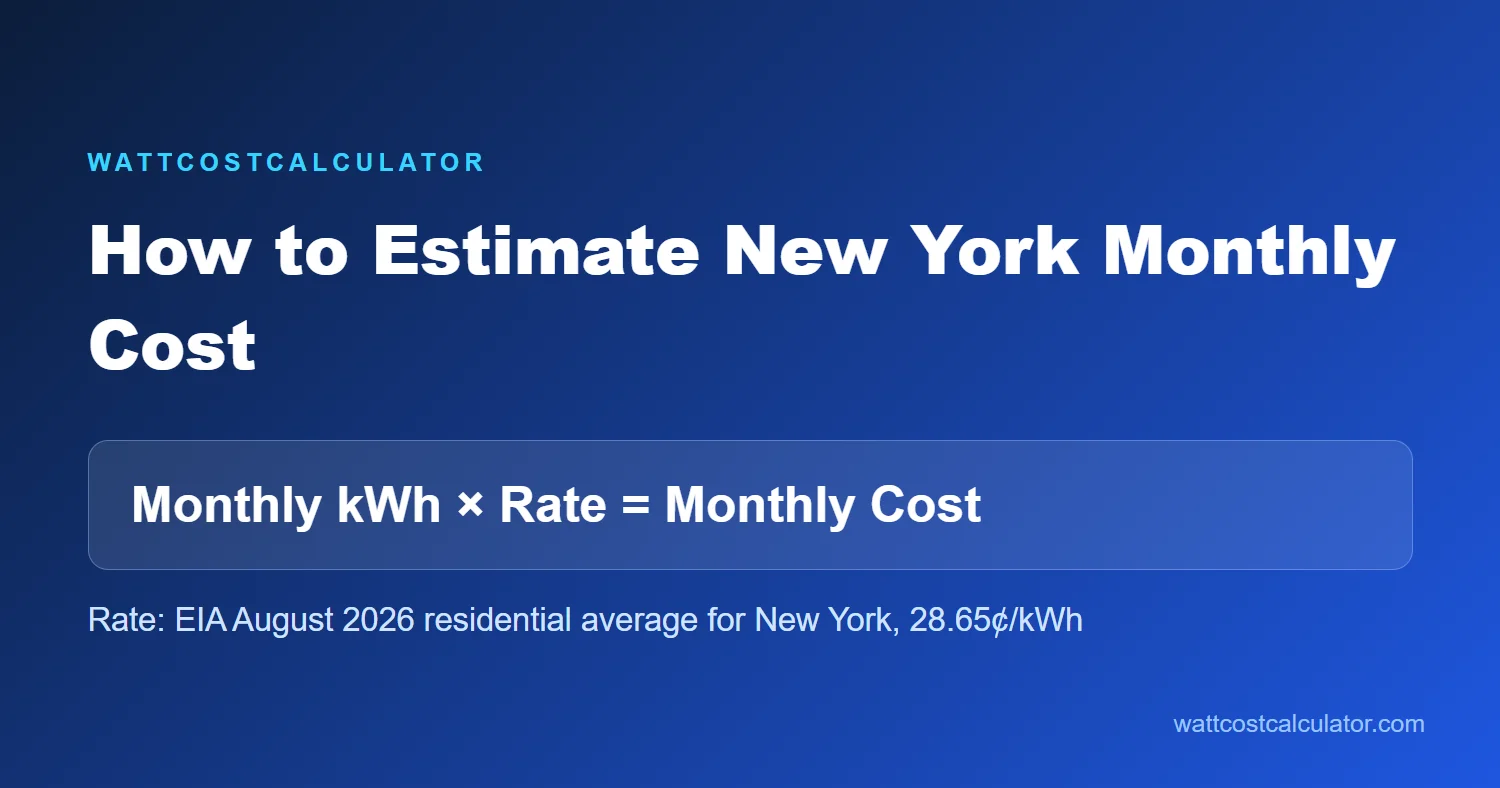
For a quick personal estimate, use the calculator below. Enter the heater’s rated wattage, the hours you actually use it, and the per-kWh rate from your bill. The example starts at the EIA August 2026 New York residential average; your bill may differ.
Use the rate for your utility territory
A statewide average is a starting benchmark. For an apartment heater, find the usage-linked supply and delivery lines on your own bill. If their sum is 28¢/kWh, an extra 5 kWh costs $1.40. Check the applicable period if the plan varies by time. See how to find the applicable rate on your electric bill.
What would this cost in your home?
Adjust the starting values to match your appliance and electricity plan.
New York electricity rates in 2026
The U.S. Energy Information Administration (EIA) reports a preliminary August 2026 average residential electricity price of 28.65¢/kWh for New York and 18.16¢/kWh for the United States. New York’s monthly average was about 58% higher. The EIA released these data on October 23, 2026. They are statewide revenue-per-kWh averages, not quotes for individual utility customers.
NYSERDA’s latest monthly series currently lists 29.9 cents per kWh for July 2026. It calculates the average from total residential bills divided by electricity consumed, so it reflects the bill as a whole. This is useful context, but it is not necessarily the marginal price you should use to forecast one more appliance: fixed charges, taxes, delivery, supply, and adjustments can all affect the bill.
What does a 1,500-watt space heater cost?
A 1,500-watt heater draws 1.5 kW while its heating element is on. At the EIA New York average of 28.65¢/kWh, continuous full-power operation would use 6 kWh in four hours and cost about $1.72 per day. If used four hours every day for 30 days, that is about $51.57 per month. Actual use can be lower when a thermostat cycles the heater off, or higher if your applicable rate is above the statewide average.
| Heater use (1,500 W) | Energy used | Estimated cost at 28.65¢/kWh |
|---|---|---|
| 2 hours per day | 3 kWh/day | $0.86/day · $25.79/30 days |
| 4 hours per day | 6 kWh/day | $1.72/day · $51.57/30 days |
| 8 hours per day | 12 kWh/day | $3.44/day · $103.14/30 days |
A statewide average cannot identify the supplier rate, delivery territory, or billing plan for a particular New York address. For a renter using a portable heater, the apartment’s electric bill is usually the most useful starting point: check whether the supply rate is fixed or variable, then identify usage-based delivery charges for the same billing period. In New York City, Long Island and upstate territories, the utility and tariff structure can differ. Treat the statewide number as context, not a universal “New York rate.”
How we calculated it: 1,500 W ÷ 1,000 = 1.5 kW; 1.5 kW × hours used = kWh; kWh × $0.2865 = estimated energy cost. Monthly figures use 30 days and assume the heater draws its full rated power for every hour. This is an estimate, not a guaranteed bill increase.
Why your New York bill may look different
New York is not one uniform electricity market for household bills. Your utility territory, supply choice, seasonal usage, and rate plan affect the final amount. In many areas, the bill includes separate delivery and supply charges, along with fixed fees and taxes. A statewide average blends these differences, so check your own bill for the rate that best matches the calculator’s purpose.
Time-of-use plans also have specific eligibility and territory rules. For example, NYSEG’s published time-of-use service class is a particular offering with its own eligibility requirements; PSEG Long Island’s time-of-day plan is a separate program with designated peak and off-peak periods. Neither should be assumed to apply to every New York resident. Confirm current terms with your provider before shifting heavy use.
A practical way to lower winter heating costs
- Use a portable heater only in the occupied room, and follow the manufacturer’s clearance and safety instructions.
- Check the nameplate for the actual wattage and use a plug-in energy monitor if you want to measure cycling and real energy use.
- Seal drafts and close doors so the heater warms a smaller space.
- Compare the heater estimate with your central heating costs before lowering your thermostat; the cheapest option depends on your home, equipment, and rates.
- Use the rate shown on your bill when estimating costs. For an overview of regional differences, see our California electricity cost guide and Texas electricity cost guide.
Try the estimate with your own numbers
Change the wattage, daily hours, and electricity rate in the calculator above to model your own usage. For a heater-specific explanation of wattage and operating time, read our space heater electricity cost guide. You can also compare another heating choice in our electric fireplace cost guide.
New York electricity cost: common questions
Is 28.65¢/kWh the rate every New York customer pays?
No. It is a statewide residential average for the stated period. Utility territory, supplier, rate plan, usage tier, delivery charges, taxes, and fixed fees affect an individual bill. Use the relevant usage-based charges from your bill for a closer estimate.
Will a 1,500-watt heater always add $51.57 per month?
No. That example assumes the element draws its full 1.5 kW for four hours every day and applies the statewide average rate. A thermostat may cycle the element off, while room temperature, insulation, heater setting, and your actual marginal rate change the result.
Should I use my supply rate or the full bill average?
For the approximate cost of one more kWh, include the usage-based supply and delivery charges that apply to that kWh. A whole-bill average may also include fixed fees and taxes, so it answers a different question. Your utility’s tariff and bill format determine which line items apply.
Sources and notes
- U.S. EIA, Electric Power Monthly, Table 5.6.A (August 2026 monthly residential prices; preliminary).
- NYSERDA, Monthly Average Retail Price of Electricity – Residential (latest listed monthly value used here: July 2026).
- NYSEG, Time-of-use service class.
- PSEG Long Island, Time-of-Day rates.
Rate data checked November 5, 2026. Rates change over time; treat the figures above as dated reference points and use your latest utility bill for a personal estimate.
Disclaimer: The figures on this page use statewide or standardized averages and the inputs shown. They are for general information only, not a utility quote, a bill, or financial advice. Check your own electricity bill and the official EIA or manufacturer sources for current figures.
Maine vs. New Hampshire Electricity Cost: Winter Heat Pump & Delivery Bills
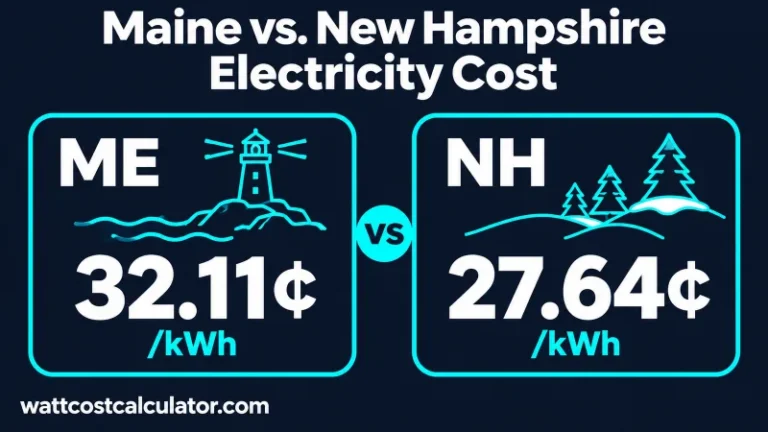
Residential electricity in Maine averaged 32.11¢/kWh in August 2026 (EIA), compared with 27.64¢/kWh in New Hampshire—making a 700 kWh monthly bill $31.29...

2026 US State-by-State Electricity Cost Master Guide
Compare electricity prices across U.S. states using EIA data: the five most expensive and cheapest states, plus California, Texas, Florida and New...
U.S. Electricity Rates by State (2026 Comparison Hub)
Compare residential electricity prices in all 50 states and DC, using EIA August 2026 data with August 2025 for comparison, and jump...

Illinois vs Ohio Electricity Cost: Supply Rates and the Total Bill
A supplier advertises electricity for 10 cents per kilowatt-hour. Should a 1,000-kWh month cost $100? The supply portion might be about that...