
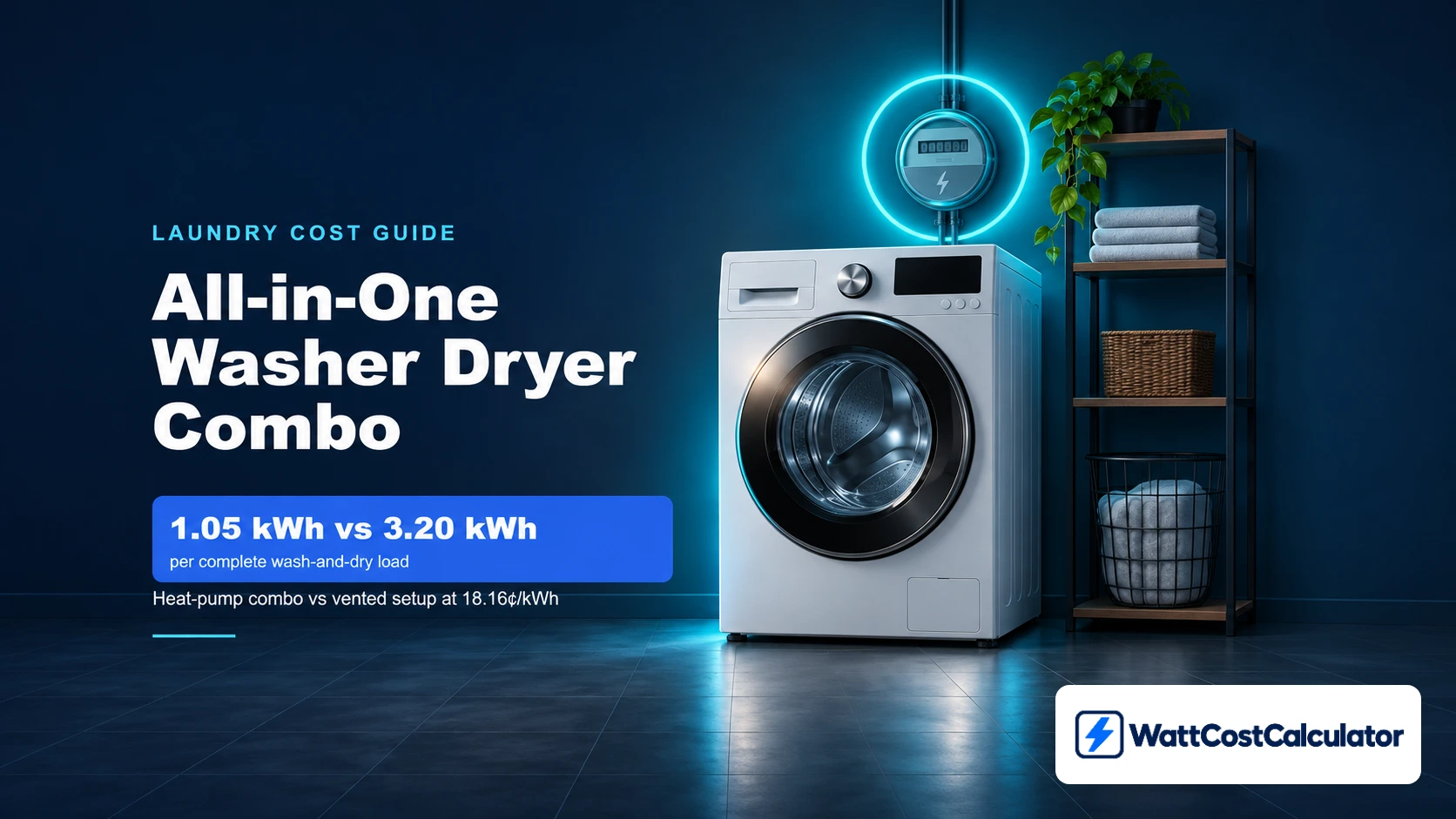
At five loads a week, a heat-pump all-in-one washer-dryer combo uses about 273 kWh a year in the scenario below, which costs about $49.58 per year, or about $4.13 per month. A separate washer and a vented electric dryer in the same scenario use about 832 kWh a year, or about $151.09 per year. The per-load energy figures are scenario inputs, not test results. Replace them with the kWh-per-cycle value from the energy label or the manufacturer’s data for your model before you rely on the total.
- How the calculation works
- Why a heat-pump combo draws less per load
- Scenarios used in this guide
- Electrical requirements change the setup decision
- How sensitive the annual bill is to energy per load
- Checklist before you buy
- Using the calculator for your own household
- Monthly and annual cost by state
- Water and hot-water energy
- Maintenance that keeps energy use predictable
- Choosing between a combo and separate machines
- Frequently asked questions
- Sources and method
How the calculation works
A laundry load’s electricity use is the energy each cycle draws, multiplied by the number of loads, multiplied by the rate. The formula used throughout this guide is:
Annual cost = (kWh per load × loads per week × 52 weeks) × rate per kWh
For a heat-pump combo at 1.05 kWh per load, five loads a week is 273 kWh a year. At 18.16 cents per kWh, that is $49.58. The rate comes from the U.S. Energy Information Administration’s Electric Power Monthly, Table 5.6.A, for August 2026. The same formula applies to any machine as soon as you have its energy per load.
Why a heat-pump combo draws less per load
A conventional vented electric dryer heats room air with a resistance element, then exhausts the warm, humid air outdoors. The heating element is the main electricity load, and the exhaust air carries heat out of the home. A heat-pump dryer works differently. It condenses moisture from a closed air loop, and it reuses part of the heat that the refrigerant system has already moved. Because the heat is moved rather than generated from scratch, the same drying job can use less electricity.
A combo machine uses one drum for washing and drying. Its heat-pump system runs during the dry phase, and its wash phase draws the usual motor and pump energy. That is why the combo’s total per load depends on how long the drying phase runs and on the size of the load. A combo with a small drum and a short cycle will use less energy than a larger machine on a long cycle, even if the heat-pump design is the same.
Heat-pump dryers tend to run longer cycles than vented electric dryers, because the air moves more slowly through the condenser. That longer runtime is part of why heat-pump combos can be efficient on energy and slower on time. Check the cycle time on your model before deciding whether it fits your household’s laundry schedule.
Scenarios used in this guide
The tables use four scenarios. Each one assumes five loads a week, 52 weeks a year, and the rate shown. The kWh per load values are planning inputs chosen to show how each setup compares. They are not measured results for any specific product.
– Heat-pump all-in-one combo: 1.05 kWh per load (wash and dry) – Older condenser combo without a heat pump: 2.40 kWh per load – Separate front-load washer and heat-pump dryer: 1.25 kWh per load – Separate washer and vented electric dryer: 3.20 kWh per load
| Setup (scenario) | kWh per load | Cost per load (18.16 cents) | Annual cost at 5 loads per week |
|---|---|---|---|
| Heat-pump all-in-one combo | 1.05 kWh | $0.19 | $49.58 |
| Older condenser combo | 2.40 kWh | $0.44 | $113.32 |
| Separate washer and heat-pump dryer | 1.25 kWh | $0.23 | $59.02 |
| Separate washer and vented electric dryer | 3.20 kWh | $0.58 | $151.09 |
The table shows the annual electricity totals for the scenarios above. The heat-pump combo and the vented setup differ by about $101.51 per year at the U.S. average rate, in these inputs.
Electrical requirements change the setup decision
Electrical requirements matter as much as the energy number. A heat-pump combo marketed for a standard household outlet may run on a 120 V, 15 A circuit, which is a convenience for homes without a 240 V dryer outlet. A vented electric dryer typically needs a 240 V circuit, often rated at 30 A. Confirm the circuit rating in the manufacturer’s installation instructions before you buy, and check the breaker size in your panel. A new 240 V circuit can add installation cost that changes the payback period.
Do not assume that a combo’s listed amperage is continuous. A load that runs for an hour or more is treated as continuous for breaker sizing, so the continuous limit is the one to check. Your electrician can confirm whether the existing circuit can carry the appliance without overloading it.
How sensitive the annual bill is to energy per load
Because the annual figure is linear, it is easy to see how much each input matters. Every 0.1 kWh change in energy per load changes the annual total by 0.1 × 5 × 52 = 26 kWh. At 18.16 cents per kWh, that is about $4.72 per year. A machine that uses 0.3 kWh more per load than its label suggests costs about $14.16 more per year at five loads a week.
The same logic works in the other direction. Doubling the number of loads doubles the annual total, even if the machine is efficient. A household that moves from three loads a week to seven loads a week should expect the annual figure to rise by more than half. Check your weekly count before comparing machines, because the count often matters more than the model.
Checklist before you buy
Read the energy label. Find the kWh per cycle for the program you use most, and note whether the figure is for a full or partial load.
Confirm the circuit. Check the voltage, amperage, and plug type in the installation instructions. Compare them with the outlet or breaker in your home.
Check the cycle time. A long cycle may suit a weekend laundry routine but not a busy weekday schedule.
Measure your weekly loads. Count your loads for two weeks, including the ones you do by hand or at a laundromat, and use that average in the calculator.
Estimate the water-heating share. If you use warm or hot water, add a separate estimate for the water-heater energy, based on your water heater’s rating.
Compare the total cost. Add the purchase price, installation, and the annual electricity estimate, then compare over the expected life of the machine.
Using the calculator for your own household
The calculator at the end of this guide takes watts and hours. For a laundry load, enter the kWh per load as watts for one hour. For example, a 1.05 kWh per load value is entered as 1,050 W for one hour. Multiply the cost per load by your weekly loads and 52 to get the annual total, or use the formula at the top of this guide directly.
A simple check is to compare the calculator result with the scenario table. If your label shows a value close to a scenario row, the annual total should be close to the table value at the same rate. A large gap usually means a difference in loads per week or in the kWh per load value.
Monthly and annual cost by state
The table below applies the same two setups to the EIA August 2026 state averages from Table 5.6.A. It uses the heat-pump combo at 273 kWh per year and the vented setup at 832 kWh per year, both in the five-loads-a-week scenario.
| Location (EIA August 2026 average) | Rate | Heat-pump combo, per year | Vented setup, per year | Difference per year |
|---|---|---|---|---|
| Washington | 14.63 cents/kWh | $39.94 | $121.72 | $81.78 |
| United States | 18.16 cents/kWh | $49.58 | $151.09 | $101.51 |
| New York | 28.65 cents/kWh | $78.21 | $238.37 | $160.16 |
| California | 29.75 cents/kWh | $81.22 | $247.52 | $166.30 |
The difference is larger in high-rate states, but the setup’s upfront cost and the electrical circuit work also decide the total. In a low-rate state, the operating difference may take many years to repay a new 240 V circuit. For background on the state rate comparisons, see our U.S. electricity rates by state hub.
Water and hot-water energy
The electricity in these tables is for the appliance itself. It does not include the energy used to heat water for a hot wash. A warm or hot wash can add a significant amount of energy, especially if the home uses an electric storage water heater. The amount depends on the water temperature, the load size, and the water heater’s efficiency. If you use hot water regularly, measure the water-heater energy separately or check your water heater’s rating before comparing setups.
Cold-water washing avoids that extra energy. For an overview of how wash temperature affects the total, see our washing machine electricity cost guide.
Maintenance that keeps energy use predictable
Heat-pump dryers depend on airflow and clean heat-exchange surfaces. A clogged lint filter forces the fan to work harder, and a dirty condenser reduces heat transfer. Clean the lint filter before every cycle, and follow the manufacturer’s schedule for cleaning the condenser or the drain path. A clean machine is more likely to match the energy figure on its label.
Load size matters too. A drum packed full can trap moisture and make the dry phase run longer. Filling the drum to a moderate level usually dries clothes faster, and the shorter cycle uses less energy. Check the manufacturer’s recommended load size for your model.
Choosing between a combo and separate machines
A combo saves space, and it may be the right choice for an apartment, a small laundry closet, or a home without a 240 V dryer outlet. A separate washer and dryer may suit a larger family, because each machine can run a load while the other works. The energy difference matters, but it is only one factor. Consider drum capacity, cycle time, installation requirements, and the number of loads you run each week.
If you run only a few loads a week, the annual electricity difference is small, and the choice may depend more on space and cost. If you run an active household with daily loads, the difference in the tables grows, and a more efficient machine can pay back faster.
Frequently asked questions
Can a heat-pump combo run on a standard household outlet? Some models are designed for a 120 V, 15 A circuit. Check the installation instructions for your model and confirm the circuit with an electrician before you plug it in.
Does a combo use water during the dry cycle? Heat-pump dryers condense moisture from the air, and some models drain that water through a standpipe or collect it in a tank. Check the manual for your model, because some designs need periodic maintenance to keep the drain path clear.
Is the annual figure the same for every household? No. The annual figure depends on the kWh per load on your label, your loads per week, and your local rate. Use the calculator below to test your own values.
Where can I find the energy per load for a specific model? Check the ENERGY STAR product finder and the manufacturer’s label or specification sheet. Use the value that matches your cycle and load size, not an average.
What would this cost in your home?
Adjust the starting values to match your appliance and electricity plan.
Sources and method
Annual electricity is calculated as kWh per load multiplied by 5 loads per week and 52 weeks, and cost equals that energy multiplied by the residential rate. The rate is the U.S. average of 18.16 cents per kWh and the state averages from the EIA Electric Power Monthly, Table 5.6.A for August 2026. Energy-per-load figures in this guide are scenario inputs. For model-specific values, check the ENERGY STAR product finder and the manufacturer’s specification. The U.S. Department of Energy Energy Saver site gives general guidance on laundry energy use. Figures exclude fixed utility charges, local taxes, and water-heating energy.
Written by Seon (Site Founder & Energy Data Researcher / Home Tech Reviewer). Last checked: November 21, 2026. These are calculated estimates from scenario inputs and average tariffs, not measured results.

Top-Load vs Front-Load Washer Electricity Cost: Hot Water and Spin
Quick Scenario Summary In the scenario below, a top-load washer using 0.65 kWh per cold-water load costs about $30.69 per year at...
Sensor Dry vs Timed Dry: Dryer Electricity Use per Load
Sensor dry can reduce the cost of overdrying, but the savings depend on how much electricity the two complete cycles actually use....
Heated Drying Rack vs Electric Dryer: Electricity Cost per Load
A heated drying rack can draw far less power at any moment than a full-size electric dryer, but a low wattage number...

Laundry Cost per Load: Electricity for Washing and Drying
Estimate the complete electricity cost of washing and drying one load. Learn what to include, how to measure cycle kWh, and how...