
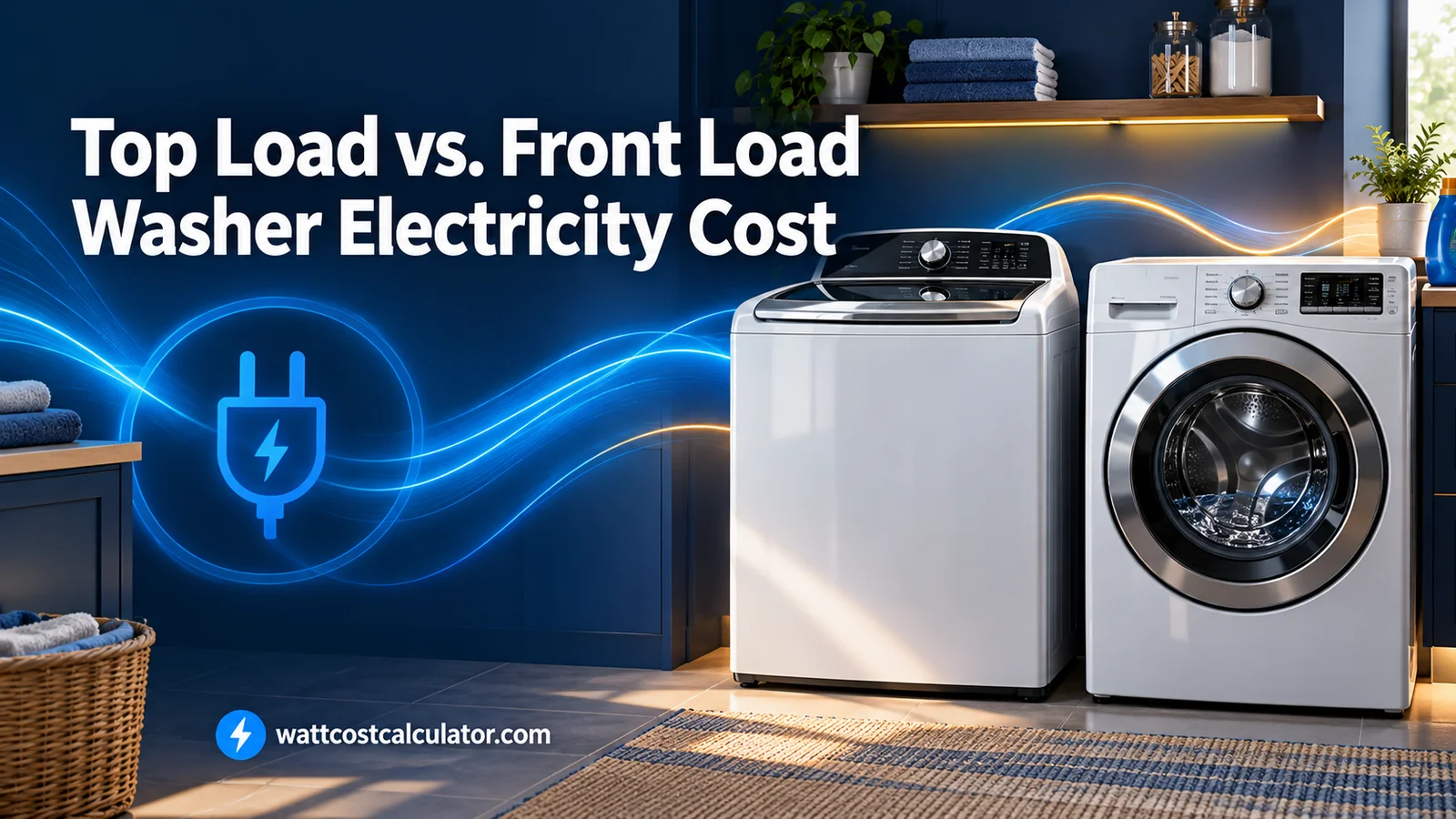
In the scenario below, a top-load washer using 0.65 kWh per cold-water load costs about $30.69 per year at five loads a week. A front-load washer using 0.45 kWh per load costs about $21.25 per year. The difference is about $9.44 per year at the U.S. average rate. The per-load energy values are scenario inputs, not test results. Check your model’s energy label and your own load pattern before relying on the totals.
- What drives a washer’s electricity use
- The inputs used in this guide
- The same schedule in four states
- Water use and why it matters too
- Cold, warm, and hot washes
- Load size and spin speed
- How the number of loads changes the gap
- Detergent and dosing
- Maintenance that keeps the energy figure close to the label
- Level, vibration, and stability
- Reading the energy label
- Before you buy: a short checklist
- Installation and circuit notes
- How to choose
- Checking your own washer
- Frequently asked questions
- Sources and method
What drives a washer’s electricity use
A washer’s electricity goes to three main places: the drive motor that turns the drum, the water pump that drains the tub, and the water heater, if the machine heats its own water. Most of the electricity in a cold-water wash goes to the motor and the pump. Hot-water washes add energy for heating, but that energy comes mostly from the water heater in the home, not from the washer’s electrical circuit. For that reason, this guide compares cold-water wash energy only and leaves water heating out.
The two designs differ in how they move the clothes and the water. A top-load washer uses an agitator or an impeller and fills the tub with more water, which it must heat or move. A front-load washer tumbles the clothes through a smaller volume of water and spins at high speed to extract more water before the dry phase. Those design differences change the energy per load, along with the spin speed and the cycle length.
The inputs used in this guide
The per-load values below are planning inputs for the two machine styles, based on cold-water cycles without a dry phase.
– Top-load washer: 0.65 kWh per load – Front-load washer: 0.45 kWh per load
Annual cost equals energy per load, multiplied by five loads a week and 52 weeks, multiplied by the rate. The U.S. average rate is 18.16 cents per kWh, from the U.S. Energy Information Administration’s Electric Power Monthly, Table 5.6.A, for August 2026.
| Washer type (scenario) | kWh per load | Cost per load (18.16 cents) | Annual cost at 5 loads per week |
|---|---|---|---|
| Top-load, cold wash | 0.65 kWh | $0.12 | $30.69 |
| Front-load, cold wash | 0.45 kWh | $0.08 | $21.25 |
The per-load cost figures are rounded from $0.118 and $0.082. The annual figures use the unrounded values.
The same schedule in four states
Electricity prices change the gap. The table below applies the EIA August 2026 state averages from Table 5.6.A to the five-loads-a-week scenario.
| Location (EIA August 2026 average) | Top-load, per year | Front-load, per year | Difference per year |
|---|---|---|---|
| Washington (14.63 cents/kWh) | $24.72 | $17.12 | $7.61 |
| United States (18.16 cents/kWh) | $30.69 | $21.25 | $9.44 |
| New York (28.65 cents/kWh) | $48.42 | $33.52 | $14.90 |
| California (29.75 cents/kWh) | $50.28 | $34.81 | $15.47 |
The gap is small in dollars for one household, but it adds up over the life of a machine, especially in high-rate states.
Water use and why it matters too
Energy is only part of the cost of running a washer. Water and sewer charges can be larger than the electricity bill for a washer, and they depend on the machine’s water use per load and on local rates. Front-load washers usually use less water per load than top-load washers, which can offset some of the electricity difference when water is expensive. Check the water-use figure on the energy label or the specification sheet, and use your local water rate to compare the total running cost. Write the water-use number next to the energy number, so the comparison stays complete when the next purchase comes up.
Cold, warm, and hot washes
The wash temperature changes the energy use more than most owners expect. A cold wash uses little or no heating energy from the machine. A hot wash can add a substantial amount of energy, and in homes with electric storage water heaters, that energy shows up on the water heater’s bill. The water heater’s share depends on the water volume, the set point, and the heater’s efficiency. The per-load values in this guide assume cold water, so compare the hot-wash energy separately if you use it often.
Load size and spin speed
A full, balanced load uses energy more efficiently than a small one, because the motor runs for the same time regardless of how much laundry is in the drum. Wait for a full load when you can, and use the load-size setting if the machine has one. A higher spin speed removes more water before any drying step, which reduces the energy needed later if you use a dryer. A front-load washer typically spins faster than a top-load washer, which is one reason the two machines differ in the dryer load.
How the number of loads changes the gap
The annual gap grows with the number of loads, because the per-load difference is the same each time. The table below uses the same cold-wash inputs and the U.S. average rate.
| Usage (scenario) | Top-load, per year | Front-load, per year | Difference per year |
|---|---|---|---|
| 3 loads per week | $18.41 | $12.75 | $5.67 |
| 5 loads per week | $30.69 | $21.25 | $9.44 |
| 7 loads per week | $42.97 | $29.75 | $13.22 |
A household that runs seven loads a week sees more than twice the gap of a household that runs three, and the gap per load stays the same in every row, so the difference is driven by how often the machine runs. For a small household, the choice of washer is more about drum size, cycle length, and purchase price than about electricity.
Detergent and dosing
Using the right amount of detergent improves cleaning and reduces the chance of an extra rinse cycle. Too much detergent leaves residue that can cause the machine to run an additional rinse. Follow the label on the detergent bottle and the washer’s dosing guidance, and use a high-efficiency detergent in a front-load washer if the manufacturer requires it. Extra rinses add time and energy that the energy-per-load figure does not include.
Maintenance that keeps the energy figure close to the label
A clean machine runs closer to its rated energy figure. Clean the drain filter, the detergent drawer, and the door seal on the schedule in the owner’s manual. A clogged drain pump forces the motor to work longer. A dirty door gasket on a front-load washer can trap moisture and odor, and a wipe-down after each use helps keep the seal in good shape. Run a maintenance cycle on the schedule the manufacturer gives, rather than adding extra cycles to clean the drum.
Level, vibration, and stability
A washer that is not level vibrates during the spin cycle. Vibration wastes energy, increases noise, and can cause the machine to stop mid-cycle. Use the adjustable feet to level the machine, check that it does not touch the wall or the cabinet, and tighten the locking nuts once it is level. A front-load washer is more sensitive to level than a top-load washer, so check it after the first few cycles.
Reading the energy label
The energy label on a washer lists the energy per cycle for the standard test program, the water use, and sometimes an annual energy figure based on a set number of cycles. Check which program the figure describes, because a heavy-soil or long program can differ from the cold-wash program in this guide. Compare the same program on each label, and note whether the figure includes the water heating. A figure that counts only the cold-water cycle is the most useful for comparing machines in a home where hot water is rarely used.
Before you buy: a short checklist
Confirm the energy per cycle for your main program. Use the label or the specification sheet, not an average.
Measure your loads per week. Count for two weeks, including small loads, and use that average in the calculator.
Check the water use and the local water rate. For some households, water costs more than electricity.
Match the drum size to your laundry. A large drum helps bulky items but can waste energy on a small load if you do not fill it.
Confirm the outlet and the breaker. Check the appliance label and the home’s circuit before delivery.
Installation and circuit notes
Most washers run on a standard 120 V, 15 A household circuit with a grounded outlet. A washer and a dryer should not share one circuit unless the circuit is rated for both loads. Check the appliance label for the rated amperage, and confirm the outlet and the breaker with a licensed electrician if the washer is in a new location. Keep the hoses and drain connections secure to prevent leaks, which waste water and can damage the floor and the cabinets.
How to choose
A top-load washer is often the simpler, lower-cost option, and it suits a household that wants a short, familiar cycle and does not need the extra capacity of a front-load drum. A front-load washer suits a household that wants a larger drum, a gentler wash, and a lower water-use figure. The electricity difference is one factor. Consider the purchase price, the drum size, the cycle time, the water use, and whether the machine will stack with a dryer.
Checking your own washer
The best source for the energy per load is the energy label or the manufacturer’s specification sheet for the cycle you use most. If the label gives only a yearly figure, divide it by the number of loads you run in a year to get the per-load number. A plug-in energy meter for one week gives a direct measurement of your own cycle, which is more accurate than a label figure in many homes.
Use the calculator below to test your own values. For a top-load cold wash at 0.65 kWh, enter 650 W for one hour.
What would this cost in your home?
Adjust the starting values to match your appliance and electricity plan.
Frequently asked questions
Is a front-load washer always cheaper to run? It usually uses less electricity and less water per load, but the difference depends on the model and the cycle. Compare the energy label values for the cycles you use.
Does the washer’s electricity change much in a cold-water wash? The cold-wash figure is the main difference between the scenario and a hot-wash load. Hot-wash energy often comes from the water heater and should be counted separately. A cold-wash cycle with a good detergent is usually enough for everyday loads, and reserving hot water for heavily soiled items keeps the water-heating share small.
Should I run the washer less often to save energy? Running full loads reduces the energy per garment. Reducing the number of small loads usually saves more than changing the machine’s cycle.
Sources and method
Annual electricity equals energy per load multiplied by five loads per week and 52 weeks. Cost equals that energy multiplied by the residential rate. Rates come from the EIA Electric Power Monthly, Table 5.6.A for August 2026. Per-load energy values are scenario inputs for planning. For model-specific figures, check the ENERGY STAR product finder and the manufacturer’s label. The U.S. Department of Energy Energy Saver site gives general guidance on laundry energy use.
For related comparisons, see our washing machine electricity cost guide and our all-in-one washer dryer combo guide.
Written by Seon (Site Founder & Energy Data Researcher / Home Tech Reviewer). Last checked: November 22, 2026. These are calculated estimates from scenario inputs and average tariffs, not measured results.
All-in-One Washer Dryer Combo Electricity Cost: Heat Pump vs. Vented Units
A 120V heat-pump all-in-one washer dryer combo uses roughly 0.9 to 1.3 kWh per complete wash-and-dry load, costing $0.16 to $0.24 at...

Sensor Dry vs Timed Dry: Dryer Electricity Use per Load
Table of ContentsHideSensor dry vs. timed dry: what changes?How sensor and timed controls appear on real dryer modelsExample: calculate the difference per...
Heated Drying Rack vs Electric Dryer: Electricity Cost per Load
Table of ContentsHideQuick example: turn rack watts into kWhCalculate your own cost per finished loadAccount for the room around the rackHow to...

Laundry Cost per Load: Electricity for Washing and Drying
Estimate the complete electricity cost of washing and drying one load. Learn what to include, how to measure cycle kWh, and how...