- Why standby seat heating matters more than the wash cycle
- What would this cost in your home?
- Tank-type vs. tankless bidet seat costs compared
- How each bidet feature affects your meter
- How your state’s electricity rate changes the monthly bill
- Three ways to cut bidet electricity use without losing comfort
- Electrical circuit safety and GFCI requirements
- Frequently asked questions
- Sources and calculation method
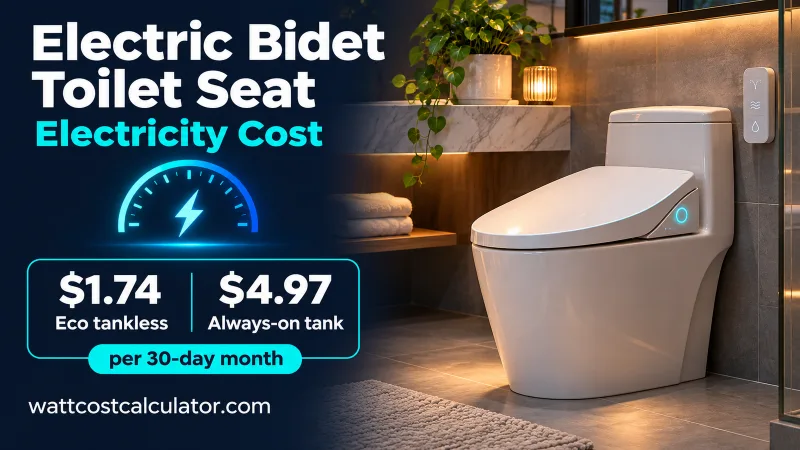
An electric bidet toilet seat with a heated seat and warm water typically costs between $0.06 and $0.17 per day—or $1.74 to $4.97 per 30-day month ($21.21 to $60.45 per year)—at the U.S. Energy Information Administration’s August 2026 residential average of 18.16¢/kWh. If you turn off the heated seat during warmer months and rely only on instant warm-water washing, the modeled cost drops below $1.00 per month ($11.93 per year). These are scenario calculations using manufacturer electrical specifications and stated standby schedules, not a quote for your utility tariff.
Why standby seat heating matters more than the wash cycle
Most shoppers focus on the headline wattage printed on a bidet box. For example, TOTO’s WASHLET K300 specification sheet (SW3036R) lists a maximum rated power consumption of 1,274 watts on a 120V/60Hz circuit, while the tank-type WASHLET C5 specification sheet (SW3084) lists 403 watts. Looking only at those peak ratings makes tankless instant-heat seats appear far more expensive to run, when the opposite is often true on an annual electricity bill.
The reason is duty cycle. A tankless bidet draws 1,000W to 1,274W only during the 30 to 90 seconds it actively heats incoming cold water for a wash. Over four washes a day totaling eight minutes of spray time, that instant water-heating load uses roughly 0.16 kWh per day. By contrast, a continuous 30W to 45W heated seat or insulated internal water reservoir runs for more than 23 hours every day, quietly accumulating 0.50 to 0.90 kWh daily just waiting to be used.
Use the interactive calculator below with an average 24-hour wall wattage or your own measured kWh value. In the continuous tank-type scenario below, maintaining an insulated reservoir and an always-on heated seat alongside brief daily washes averages roughly 38 watts across 24 hours.
What would this cost in your home?
Adjust the starting values to match your appliance and electricity plan.
Rate note: 18.16¢/kWh is the EIA August 2026 U.S. residential average (Table 5.6.A). EIA derives average revenue per kWh from utility sales and revenue data; it is a national benchmark rather than your exact utility plan. Checked November 14, 2026. Fixed monthly customer charges are excluded.
Tank-type vs. tankless bidet seat costs compared
Electric bidet seats fall into two main heating architectures: reservoir (tank-type) seats that keep a small internal water tank warm around the clock, and tankless (instantaneous) seats that heat water on demand with a ceramic heating element. Modern tankless units often pair instant water heating with occupancy sensors or scheduled Eco timers that drop seat temperature when the bathroom sits empty overnight.
| Bidet type and modeled schedule | Daily energy | 30-day energy | 30-day cost | Annual cost (365d) |
|---|---|---|---|---|
| Tank-type seat: continuous warm tank + always-on heated seat (38 W avg) | 0.912 kWh | 27.36 kWh | $4.97 | $60.45 |
| Tankless seat: always-on heated seat (22 W) + 4 daily washes | 0.700 kWh | 21.00 kWh | $3.81 | $46.40 |
| Tankless seat with Eco / occupancy sensor (1 W sleep 18 h/day + 4 washes) | 0.320 kWh | 9.60 kWh | $1.74 | $21.21 |
| Summer / seat heater OFF (1 W standby + 8 min/day instant warm wash) | 0.180 kWh | 5.40 kWh | $0.98 | $11.93 |
Notice the spread between the top and bottom rows: turning off a continuous seat heater during warm weather—or upgrading from an always-on tank model to an Eco-mode tankless unit—cuts annual electricity consumption by roughly $39 to $48 per year on a single bathroom fixture. In a two- or three-bathroom household, enabling Eco timers across every toilet can trim more than $100 off annual standby bills without giving up warm-water cleansing.
How each bidet feature affects your meter
Because an electric bidet seat combines four distinct electrical loads inside one housing, understanding which components run continuously versus intermittently makes it much easier to cut wasted kilowatt-hours:
- Heated seat element (30W to 60W cycling): This is the primary driver of monthly cost. Most seats warm to 86°F–104°F (30°C–40°C) using an embedded resistance wire. Keeping the toilet lid closed when not in use acts as thermal insulation, reducing how often the thermostat kicks back on.
- Warm-water reservoir vs. instant ceramic heater (300W–1,274W): Reservoir models reheat stored water periodically throughout the day even when nobody uses the bathroom. Instantaneous models eliminate reservoir heat loss completely and only spike to 1,000W+ while the spray wand is active.
- Warm-air dryer (200W to 350W): Running the built-in air dryer for two minutes per visit uses roughly 0.01 kWh—less than two-tenths of a cent—making its electricity cost negligible compared to 24/7 seat heating.
- Deodorizer fan, nightlight, and control board (1W to 5W): Electronics and wireless remote receivers stay energized continuously so the seat responds instantly when approached.
How your state’s electricity rate changes the monthly bill
Because a heated bidet seat runs 24 hours a day during winter, regional utility prices significantly change the payback of Eco features. Below is how the continuous tank-type scenario (27.36 kWh/month) compares against the Eco tankless scenario (9.60 kWh/month) across four EIA Table 5.6.A residential benchmarks.
| Location and EIA average | Tank-type always-on (27.36 kWh/mo) | Tankless Eco mode (9.60 kWh/mo) | Monthly savings with Eco |
|---|---|---|---|
| Washington — 14.63¢/kWh | $4.00 | $1.40 | $2.60/mo |
| United States — 18.16¢/kWh | $4.97 | $1.74 | $3.23/mo |
| New York — 28.65¢/kWh | $7.84 | $2.75 | $5.09/mo |
| California — 29.75¢/kWh | $8.14 | $2.86 | $5.28/mo |
In high-rate states like New York and California, an unoptimized tank-type bidet seat running 24/7 can cost about $95 to $99 per year, whereas an Eco-mode tankless seat stays under $35 per year. If you are planning a broader winter bathroom efficiency upgrade, compare this load with our bathroom floor heating electricity cost guide or check your local state benchmark in the U.S. electricity rates by state hub.
Three ways to cut bidet electricity use without losing comfort
- Enable Auto Energy Saver or Smart Learning Mode: According to TOTO’s official WASHLET energy-saving guide, built-in timers and occupancy sensors learn household traffic patterns and automatically lower seat and water temperatures during overnight or workday hours.
- Close the toilet lid after every use: Leaving the lid open allows convective room air to pull heat straight off the heated seat surface, forcing the element to cycle much more frequently—especially in cold or drafty bathrooms.
- Lower seat temperature by one notch (or turn it off May–September): Dropping the seat heater from High (~104°F) to Low (~86°F) cuts thermal loss to the room while keeping the seat comfortable on cold mornings. Turning the seat heater completely off in summer saves up to 80% of total annual kWh.
Electrical circuit safety and GFCI requirements
Even though average standby wattage is small, an electric bidet seat is a wet-area bathroom appliance with a 400W to 1,300W peak heating load. National electrical codes and manufacturer installation manuals require a dedicated or properly rated 120-volt GFCI (Ground Fault Circuit Interrupter) protected outlet positioned within reach of the unit’s 3- to 4-foot power cord. Avoid running extension cords across bathroom floors, and verify total circuit capacity if the same bathroom breaker feeds a hair dryer or a radiant heater.
Frequently asked questions
Is it cheaper to unplug a bidet seat when not in use?
Unplugging saves the full standby draw, but doing so repeatedly wears out the GFCI outlet, resets remote-control clocks or learned Eco schedules, and leaves you with a cold seat and cold water. Using the built-in Eco/Energy Saver button—or switching off only the seat heater in summer—captures most of the savings without losing convenience.
Does a 1,274-watt tankless bidet trip a bathroom circuit breaker?
On a standard 15-amp 120V circuit (1,800W max capacity), a 1,274W instant-heat bidet draws about 10.6 amps during active washing. It will not trip the breaker by itself, but running a 1,500W hair dryer or space heater simultaneously on the exact same circuit will exceed 20 amps and trip the breaker.
Do bidet seats still use electricity if I have a gas water heater?
Yes. Electric bidet seats connect exclusively to the toilet’s cold-water supply line via a T-valve and heat the spray water internally using electricity. Your home’s central gas or electric water heater is not involved unless you install a dual-line mixing valve model.
How does bidet energy compare to other home water-heating appliances?
Because a bidet warms only a few ounces of water per minute, its annual energy use (117 to 333 kWh/year) is a fraction of full-scale household laundry loads. You can compare high-efficiency water-heating appliances in our all-in-one washer-dryer combo guide or test custom scenarios on the main electricity cost calculator.
Sources and calculation method
Daily energy is calculated as watts × hours ÷ 1,000, and electricity cost equals kWh × residential price ($/kWh). Peak wattage ratings reflect manufacturer electrical specifications for 120V/60Hz North American models; daily kWh scenarios model typical 24-hour heated-seat duty cycles and four daily wash events. Annual totals multiply daily kWh by 365 days and exclude fixed utility customer fees or local sales taxes.
- TOTO WASHLET K300 Specification Sheet (SW3036R) — 120V/60Hz, 1,274W rated instantaneous heating power.
- TOTO WASHLET C5 Specification Sheet (SW3084) — 120V/60Hz, 403W rated tank-type power consumption.
- TOTO USA Official WASHLET Electrical & Eco Guide — GFCI 120V outlet guidelines and occupancy-sensor energy-saving modes.
- EIA Electric Power Monthly, Table 5.6.A — August 2026 state and U.S. residential average retail prices.
- U.S. Department of Energy (DOE) Energy Saver — general residential appliance standby and water-heating efficiency principles.
Last checked: November 14, 2026. This guide presents modeled electricity estimates from manufacturer electrical specifications and EIA average tariffs. Check your utility bill and product manual for your exact rate and model draw.
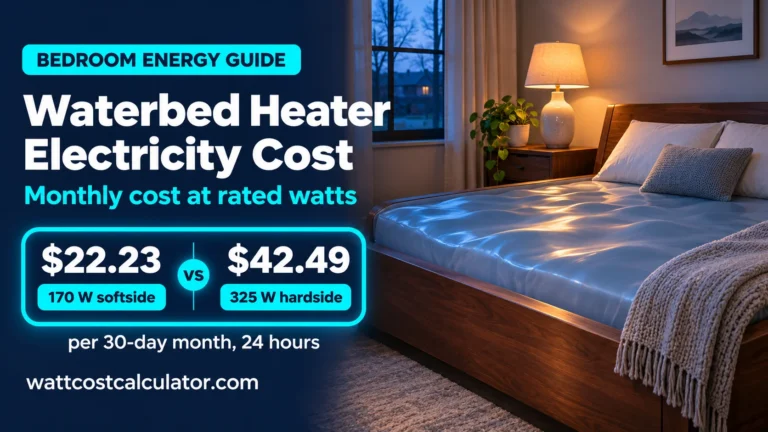
Waterbed Heater Electricity Cost: 170 W vs 325 W Per Month
A waterbed heater costs about $22.23 to $42.49 a month at 18.16¢/kWh if it runs 24 hours at 170 W or 325...
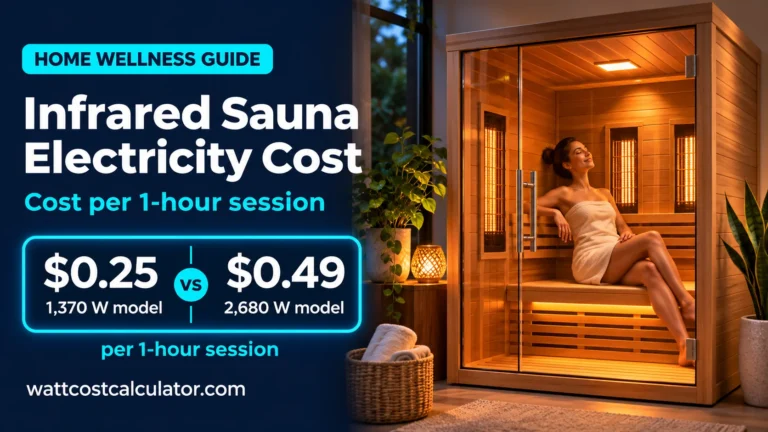
Infrared Sauna Electricity Cost: Cost Per 1-Hour Session by Model
An infrared sauna costs about $0.25 to $0.49 per one-hour session at 18.16¢/kWh, depending on model. Here is the cost per session...
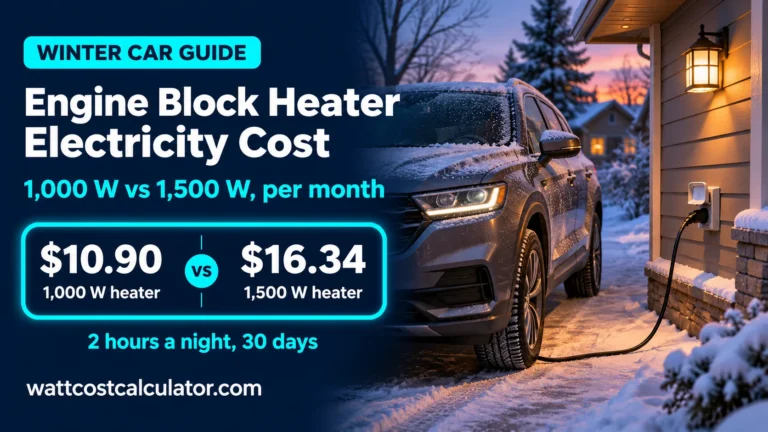
Engine Block Heater Electricity Cost: 1,000 W vs 1,500 W Per Month
An engine block heater costs about $10.90 to $16.34 a month at 18.16¢/kWh when plugged in 2 hours a night at 1,000...

Heated Dog Bed Electricity Cost: Small vs Medium Pad Per Month
A heated dog bed costs about $2.62 to $5.23 a month at 18.16¢/kWh if it runs 24 hours at 20 W to...