
- Compare complete cooking sessions
- Compare equal portions
- Compare energy per meal
- Why low watts do not automatically mean the lowest meal cost
- Four cooking scenarios: compare kWh per session
- Find the break-even point for your meal
- Count portions, preheating, and keep-warm time
- How to make the estimate reflect your kitchen
- Put your own numbers into the calculator
- Sources and calculation notes
- Estimate the cost with your own inputs
- What would this cost in your home?
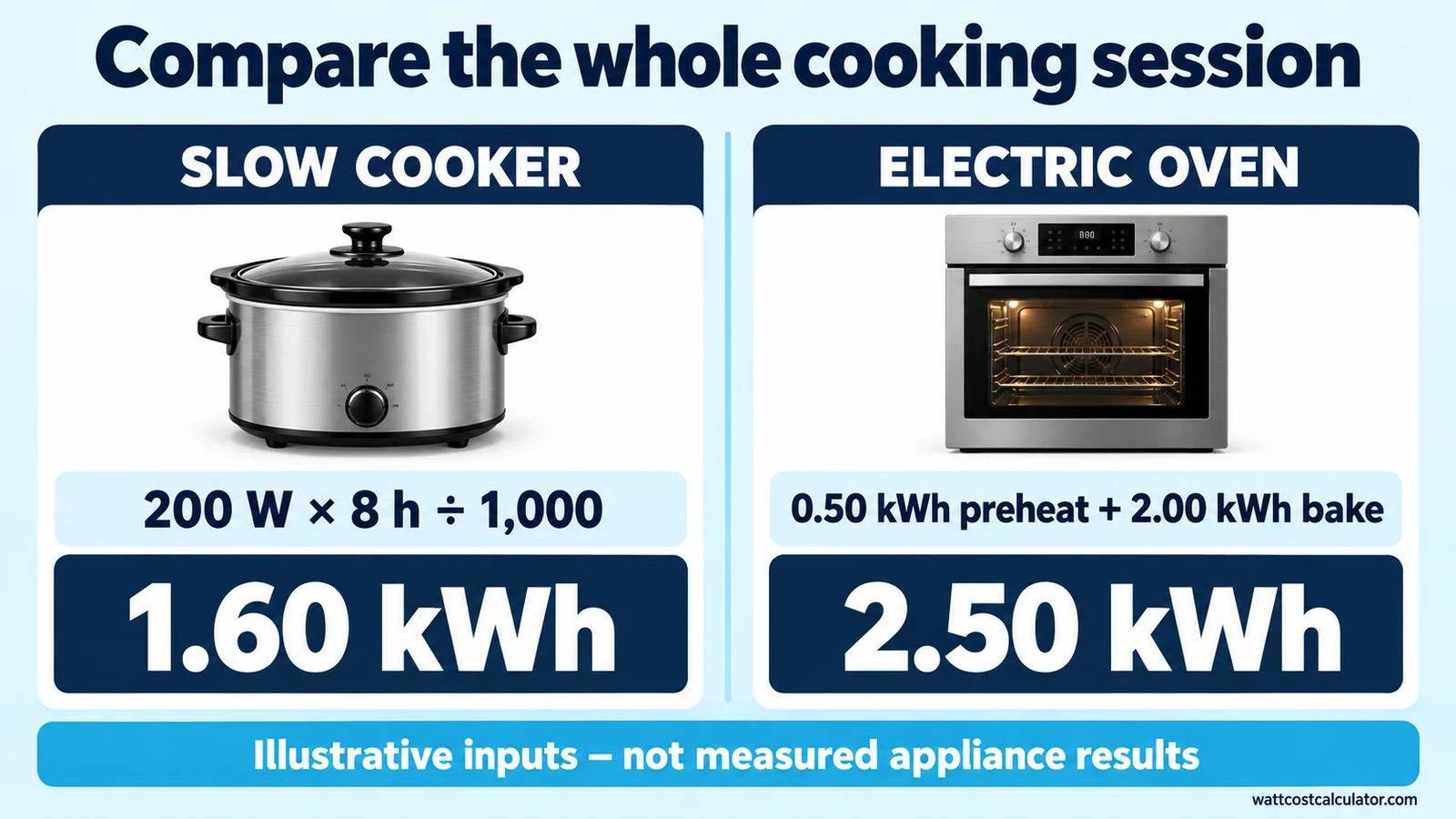
Slow cooker vs. oven electricity cost depends on the whole cooking session. In our illustrative example, a slow cooker averaging 200 watts for eight hours uses 1.60 kWh, costing about $0.29 per meal at 18.16¢/kWh. An electric-oven session using 2.50 kWh, including preheating, costs about $0.45. These session assumptions are editable in the comparison tool.
For a pot of fall chili or a winter stew, the slow cooker may be a convenient choice. But a short oven session, several dishes cooked together, or fewer hours on the slow cooker’s warm setting can change the result. Here is how to compare a meal you would actually cook, rather than multiplying the largest wattage printed on two appliance labels.
Compare complete cooking sessions
Enter complete-session energy for each method, including preheat, separate electric searing and keep-warm as applicable. The starting 1.60-kWh slow-cooker and 2.50-kWh oven examples match the comparison below. Set the number of meals you actually cook each month; the tool no longer assumes you repeat a recipe every day.
Compare equal portions
If an oven session uses 2.5 kWh for eight portions, its energy is 0.3125 kWh per portion. A slow cooker using 1.6 kWh for four portions uses 0.4 kWh per portion. Batch size can reverse a per-meal comparison even when the oven uses more for the whole session.
Compare energy per meal
Use complete-session kWh, including preheat and keep-warm. Presets are scenarios, not tested product results.
Rate reference: EIA August 2026 residential averages, released October 23; checked and reflected November 9, 2026. Examples are editable assumptions. Estimates cover entered electricity only. Method & limitations.The rate is the EIA U.S. residential average for August 2026, released October 23, 2026. Use the applicable variable electricity rate from your own bill for a personal estimate. Fixed fees and a specific customer’s taxes, credits, tiers, and time-of-use periods are not modeled here. Our guide to reading a U.S. electric bill explains which charges to look for.
Why low watts do not automatically mean the lowest meal cost
Watts describe the rate of electricity use. Kilowatt-hours describe the energy used over time. A low-power appliance running for eight hours can consume more energy than a higher-power appliance that finishes quickly. The useful comparison is total session kWh × your price per kWh, with the same number of portions and a suitable recipe on both sides.
Hamilton Beach says to find a slow cooker’s wattage on its rating label, located on the bottom. A rated input is a starting point, not proof of the average power across an entire recipe. For an electric oven, GE explains that the elements cycle on and off to maintain temperature. Treating a heating element’s rated wattage as continuous consumption can therefore overstate the cooking-stage energy.
Four cooking scenarios: compare kWh per session
All numbers in this table are transparent modeling inputs chosen for comparison. They are not product specifications, lab results, or recommended recipe times. The oven rows include preheat energy separately and use an assumed average power during cooking, rather than a continuously energized element. Choose a recipe designed for each method and verify safe doneness.
| Illustrative session | Energy calculation | Total kWh | Cost at 18.16¢/kWh |
|---|---|---|---|
| Slow cooker: eight hours | 0.20 kW average × 8 h | 1.60 | $0.29 |
| Slow cooker plus extra steps | 1.60 cooking + 0.20 electric searing + 0.16 keep-warm | 1.96 | $0.36 |
| Short electric-oven session | 0.40 preheat + (0.80 kW average × 1 h) | 1.20 | $0.22 |
| Long electric-oven session | 0.50 preheat + (1.00 kW average × 2 h) | 2.50 | $0.45 |
The short oven example costs less than the eight-hour slow-cooker example; the longer oven example costs more. These are different cooking scenarios, not interchangeable recipes. The point is to replace assumptions with your own session energy before declaring a universal winner.
Find the break-even point for your meal
If your complete oven session uses 2.50 kWh, an eight-hour slow-cooker session matches it at an average of 312.5 watts: 2.50 kWh × 1,000 ÷ 8 hours. Below that average, the slow-cooker stage uses less energy; above it, it uses more. Add any separate searing and warming energy to the slow-cooker total before comparing. This threshold assumes both methods use the same flat electricity rate.
At a 200-watt average, the eight-hour session is 1.60 kWh. That same session costs $0.24 at 15¢/kWh, $0.29 at 18.16¢, and $0.48 at 30¢. A higher rate makes the dollar difference larger without changing which appliance uses fewer kWh. With time-of-use billing, calculate each cooking stage at the price for its actual time window; see our time-of-use electricity guide.
Count portions, preheating, and keep-warm time
Our editorial recommendation is to compare cost per portion you will eat. A 1.60-kWh slow-cooker meal split into four portions uses 0.40 kWh per portion, or about 7.3¢ at the example rate. A 2.50-kWh oven batch producing eight portions uses 0.3125 kWh per portion, or about 5.7¢. That oven batch uses more total electricity while producing twice as much food. This example is useful only if the extra portions are genuinely wanted; add refrigeration and later reheating if comparing the full meal-prep workflow.
Also count the steps that are easy to leave out: browning ingredients on an electric cooktop, hours on keep-warm after cooking, and the oven’s preheat period. If the oven is already cooking a second dish, measuring the extra energy for adding your meal is more useful than charging its whole session to that meal. Added food can still change warm-up and cooking time; a second dish is not automatically free. Indoor heat also changes the wider household balance: in cooling season the AC may remove some of that heat, while in heating season it may offset part of another heat source. There is no single extra AC-kWh allowance that fits every kitchen. For a single small dish, our air fryer electricity-cost guide provides another comparison. For reheating one portion, see microwave electricity cost.
Keep the saving in proportion. The difference between our 2.50-kWh oven example and 1.60-kWh slow-cooker example is 0.90 kWh, about 16¢ per session. Repeated three times a week for 52 weeks, that is approximately $25.50 per year at 18.16¢/kWh, before any added warming or searing. Convenience, food quality, capacity, and existing equipment also matter when choosing a cooking method.
How to make the estimate reflect your kitchen
- Record the recipe, setting, total cooking time, warming time, and portions. Keep the comparison practical and the food outcome comparable.
- For a compatible countertop slow cooker, a suitably rated plug-in energy meter can record session kWh. Average watts = measured kWh × 1,000 ÷ session hours.
- For a hardwired or 240-volt oven, use available appliance energy reporting or appropriate circuit metering. An ordinary 120-volt countertop plug-in meter is not an oven meter. Whole-home interval data include other loads and cannot, by themselves, precisely isolate one appliance.
- Multiply the measured total kWh by your electricity rate, add any separately measured cooking steps, and divide by the portions you use.
Follow the appliance instructions and a suitable recipe. USDA guidance says to thaw meat or poultry before slow cooking and to keep the lid in place. Do not shorten a safe cooking process to meet an energy target. USDA also advises against reheating leftovers in a slow cooker.
Put your own numbers into the calculator
Try the comparison calculator above with complete-session kWh, meals per month, and your bill rate. For other appliances, use our Appliance Electricity Cost Calculator. For meal planning, compare our air fryer guide and microwave guide, then choose the cooking method that suits both the meal and your household.
Sources and calculation notes
- U.S. EIA, Electric Power Monthly, Table ES1.A: August 2026 U.S. residential average of 18.16¢/kWh, released October 23, 2026.
- Hamilton Beach FAQs: locating a slow cooker’s rated wattage. We have not assigned a manufacturer’s model to our hypothetical 200-watt average.
- GE Appliances, electric oven element operation during bake: thermostat cycling. The modeled preheat and average cooking-energy inputs are ours, not GE test data.
- USDA FSIS, Slow Cookers and Food Safety: safe preparation and leftover guidance.
Updated October 29, 2026. These are electrical-energy estimates for an electric oven and an electric slow cooker; gas-oven fuel costs are outside this comparison. All monetary totals use unrounded calculations before display rounding.
Estimate the cost with your own inputs
The 1.60 kWh starting point represents the slow-cooker meal scenario near the start of this comparison. Replace it with the total energy for either complete cooking session, including any preheat or keep-warm time you want to count.
What would this cost in your home?
Adjust the starting values to match your appliance and electricity plan.
Disclaimer: The figures on this page use statewide or standardized averages and the inputs shown. They are for general information only, not a utility quote, a bill, or financial advice. Check your own electricity bill and the official EIA or manufacturer sources for current figures.

Electric Oven vs. Induction Cooktop Electricity Cost: Holiday Cooking & Baking
Cooking a 31-minute weeknight meal on an induction cooktop uses roughly 0.65 kWh ($0.12 at 18.16¢/kWh), while a 4-hour holiday roast in...

Dishwasher Heated Dry vs. Air Dry: Energy Cost and Everyday Trade-Offs
Quick Scenario Summary In the scenario below, a dishwasher that runs one cycle a day with air drying uses about 0.9 kWh...

Air Fryer vs Toaster Oven Electricity Cost: Batch Size and Preheat
A basket air fryer and a countertop toaster oven can both circulate hot air. Which one costs less to cook dinner? The...

Toaster Oven vs Full-Size Oven: Electricity Cost by Meal
Quick Scenario Summary In the scenario below, three 20-minute toaster oven sessions a week use about 78 kWh a year and cost...