- Compare the same hot-water routine first
- Why heating watts do not settle the bill
- A transparent daily comparison: three 500-mL servings
- Calculate heating and keep-warm costs separately
- What would this cost in your home?
- When could keeping water hot use less electricity?
- Our recommendation: match the appliance to the routine
- Measure your actual tea day
- Compare your other kitchen habits
- Sources and method
- How to measure your own kettle
Electric kettle vs. hot water dispenser electricity cost depends on how much water you heat, how often you refill, and how long you keep it hot. In the illustrative comparison below, heating 1.5 liters for the day’s drinks uses 0.165 kWh in either appliance before storage losses. Adding a hypothetical 20-watt average keep-warm load for 12 hours adds 0.240 kWh. At an example 20¢/kWh, that makes the day’s energy charge about 3.3¢ for carefully portioned kettle boils versus 8.1¢ for the dispenser.

That estimate applies to the hot-water routine described above. A kettle repeatedly filled with more water than you use can reverse the comparison. For a winter tea routine, the useful question is not simply which appliance has fewer watts: it is how much useful hot water you get from the entire day’s electricity.
Compare the same hot-water routine first
Here, “hot water dispenser” means a countertop electric water boiler with a reservoir and keep-warm function. It does not mean a refrigerator dispenser, under-sink instant-hot tank, or tankless on-demand heater. Those need different inputs. A standard kettle heats a batch when requested; a reservoir boiler can heat a larger batch and replace heat lost while it waits.
For a fair comparison, match the total liters dispensed, starting water temperature, target temperature, and hours of availability. Include the first heat-up, refills, reboils, and storage losses. Do not compare three cups from a kettle with an entire five-liter tank unless that is genuinely your household’s routine.
Why heating watts do not settle the bill
Hamilton Beach lists a 1,500-watt input for its 40885 kettle. That describes power while heating, not energy per drink. A device using 1,500 watts for 2.2 minutes uses 0.055 kWh. Running it for twice as long doubles that energy, even though the wattage has not changed.
Likewise, a boiler’s heating rating should not be multiplied by every hour it remains plugged in. Its average keep-warm draw is a different quantity and depends on insulation, temperature setting, room conditions, water level, and cycling. Zojirushi describes its water boilers as appliances designed to maintain hot water throughout the day and discusses timer functions. Our 20-watt holding example below is an editorial assumption, not a specification for a Zojirushi model.
A transparent daily comparison: three 500-mL servings
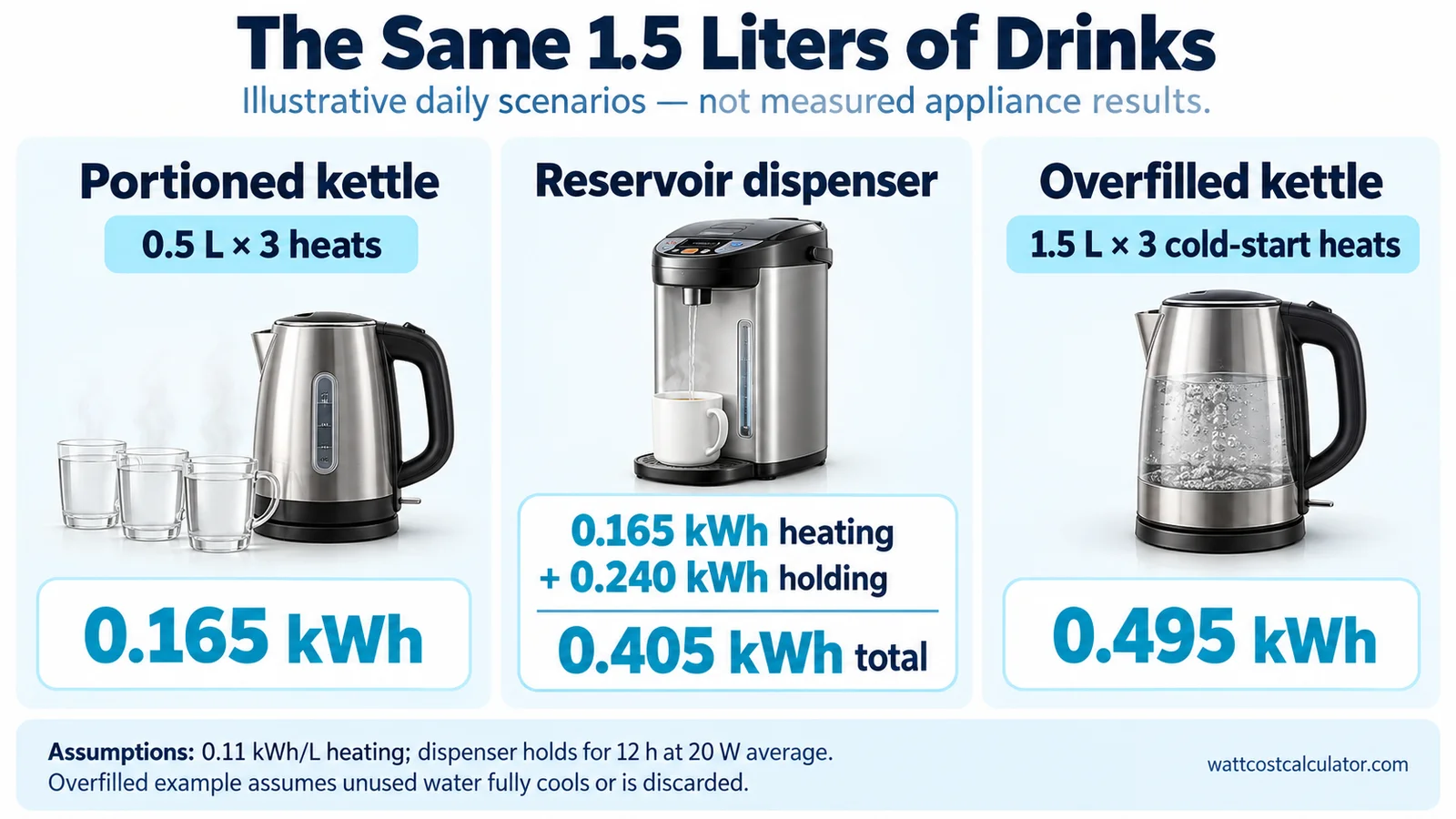
Assume you need 500 mL on three occasions, totaling 1.5 liters. To keep the arithmetic readable, use an illustrative electrical heating input of 0.11 kWh per liter from cold to the chosen hot temperature. This is not a universal conversion: starting and finishing temperatures, appliance losses, residual heat, and altitude affect actual results. For context, the ideal water-only heat calculation for 1 liter from 20°C to 100°C is about 0.093 kWh before appliance losses.
| Illustrative daily routine | Heating energy | Holding energy | Total kWh/day | 30 days at 20¢/kWh |
|---|---|---|---|---|
| Kettle: 0.5 L heated three times | 1.5 L × 0.11 = 0.165 kWh | None modeled | 0.165 | $0.99 |
| Dispenser: 1.5 L heated, then held 12 hours | 0.165 kWh | 20 W × 12 h = 0.240 kWh | 0.405 | $2.43 |
| Kettle: 1.5 L heated three times, only 0.5 L used each time | 4.5 L × 0.11 = 0.495 kWh | None modeled | 0.495 | $2.97 |
The last row deliberately assumes every boil starts cold, with the unused water discarded or allowed to cool completely. It illustrates overfilling; it is not a realistic prediction if the leftover water is still warm when reheated. The dispenser row assumes the stated water quantity can be heated within the appliance’s allowed fill range and the 12 hours refer to holding after heat-up. Add any extra water required by a particular model’s minimum level and count water left unused at the end of the day.
Calculate heating and keep-warm costs separately
Heating cost = heating kWh × electricity price in dollars/kWh.
Holding kWh = average keep-warm watts × holding hours ÷ 1,000.
Daily total = initial heat + refill/reheat energy + holding energy.
The calculator starts with 1,500 W for a combined 0.11 hours per day, or 6.6 minutes. That gives the table’s 0.165 kWh. Replace these with your own input watts and total active-heating hours. This is illustrative timing, not a claimed boil time for the linked kettle.
What would this cost in your home?
Adjust the starting values to match your appliance and electricity plan.
The second calculator isolates the hypothetical keep-warm stage: 20 W average for 12 hours. Add its unrounded daily cost to the heating cost to estimate a reservoir appliance’s full day. Do not add this holding stage again if your energy meter already measured the complete day. Both calculators assume daily repetition for their monthly and annual outputs.
To estimate the dispenser’s keep-warm cost, reuse the calculator with an assumed average draw of 20 W and 12 hours per day. That is 0.24 kWh per day, or $1.44 over 30 days at 20¢/kWh. Add the energy used to heat fresh water separately.
20¢/kWh is an example rate, not a current national average. Use your applicable variable charge from our electric bill guide. With time-of-use pricing, apply each period’s rate to the heating and holding energy used during that period. Fixed fees, taxes, and tariff changes are outside these examples.
When could keeping water hot use less electricity?
In this model, the dispenser’s 0.240 kWh holding overhead equals heating approximately 2.18 extra liters from cold: 0.240 ÷ 0.11. If repeated kettle overfilling wastes more heating energy than that holding overhead, the dispenser can come out ahead. This threshold assumes the useful-water heating energy is identical and excludes other differences between appliances. It is not a fixed number of cups at which all dispensers become cheaper.
Holding time matters too. At an assumed 20 W average, six hours adds 0.120 kWh, 12 hours adds 0.240 kWh, and 24 hours adds 0.480 kWh. At 20¢/kWh, those stages cost $0.72, $1.44, and $2.88 over 30 days, before heating any new water. Real average draw can differ across these schedules; multiplying one measured hour by a whole day is only a projection.
Our recommendation: match the appliance to the routine
For one or two spaced-out tea sessions, we would start by measuring the water needed and using the kettle within its marked fill limits. For a household drawing hot water repeatedly throughout the day, a reservoir dispenser may be worth its convenience even if it uses a little more electricity. Compare the full day’s kWh before buying an appliance solely to save on energy.
The difference between our portioned-kettle and dispenser examples is $1.44 per 30 days, or $17.52 over 365 identical days. The difference between the overfilled-kettle and dispenser examples is only $0.54 per 30 days. Neither scenario supports dramatic payback claims. Purchase price, capacity, cleaning, accessibility, and how quickly you need water can matter more than that difference.
Measure your actual tea day
- Choose a suitably rated plug-in electricity meter compatible with the appliance and follow both manuals. Keep electrical equipment away from splashes.
- Record starting water volume and temperature, drinks dispensed, refills, settings, and hours on. Compare days with similar demand.
- For the kettle, accumulate all heating sessions. For the dispenser, include initial heat-up and the entire holding period. Note leftover hot water so the two days have comparable boundaries.
- Multiply total measured kWh by your applicable rate. Repeat on several typical days before projecting a month.
Use the manufacturer’s timer or temperature settings only as instructed. Zojirushi lists delayed heating and selectable keep-warm temperatures on its CD-WCC models; features vary by model. Follow cleaning, minimum-fill, maximum-fill, and water-use instructions, and take care with hot surfaces and steam.
Compare your other kitchen habits
For another example of time changing an energy comparison, read slow cooker vs. oven cost per meal. Our microwave cost guide separates short active sessions from standby use, while air fryer electricity cost explains portion size and multiple batches. Try your own inputs above or open the full appliance electricity cost calculator to compare your daily routine.
Sources and method
- Hamilton Beach 40885 product page: example of a 1,500 W kettle rating, not a source for our assumed session timing.
- Zojirushi water boiler FAQs: intended keep-warm use and timer functions.
- Zojirushi CD-WCC product information: model-specific temperature and delayed-heating features, not a source for the hypothetical 20 W holding load.
Prepared October 27, 2026. Cost calculations by Seon. Water-only ideal energy uses 1 kg per liter and a rounded specific heat of 4.186 kJ/(kg·°C): 1 × 4.186 × 80 ÷ 3,600 ≈ 0.093 kWh. Actual electrical energy must also account for losses. Costs are calculated before display rounding.
Disclaimer: The figures on this page use statewide or standardized averages and the inputs shown. They are for general information only, not a utility quote, a bill, or financial advice. Check your own electricity bill and the official EIA or manufacturer sources for current figures.
How to measure your own kettle
Plug the kettle into a plug-in watt meter, boil one full pot, and read the energy in kWh shown on the meter. Divide that number by the liters boiled to compare models on the same basis. Then multiply by your electricity rate to get the cost per boil.

Electric Oven vs. Induction Cooktop Electricity Cost: Holiday Cooking & Baking
Cooking a 31-minute weeknight meal on an induction cooktop uses roughly 0.65 kWh ($0.12 at 18.16¢/kWh), while a 4-hour holiday roast in...
Dishwasher Heated Dry vs. Air Dry: Energy Cost and Everyday Trade-Offs
Quick Scenario Summary In the scenario below, a dishwasher that runs one cycle a day with air drying uses about 0.9 kWh...

Air Fryer vs Toaster Oven Electricity Cost: Batch Size and Preheat
A basket air fryer and a countertop toaster oven can both circulate hot air. Which one costs less to cook dinner? The...

Toaster Oven vs Full-Size Oven: Electricity Cost by Meal
Quick Scenario Summary In the scenario below, three 20-minute toaster oven sessions a week use about 78 kWh a year and cost...