
- Why 120V plug-and-play spas are not cheaper to run in winter
- What would this cost in your home?
- Winter hot tub costs: 240V insulated vs. 120V & inflatable
- Where the kilowatt-hours go inside a hot tub
- How your state’s electricity rate changes winter spa bills
- Four practical ways to cut winter hot tub electricity bills
- Frequently asked questions
- Sources and calculation method
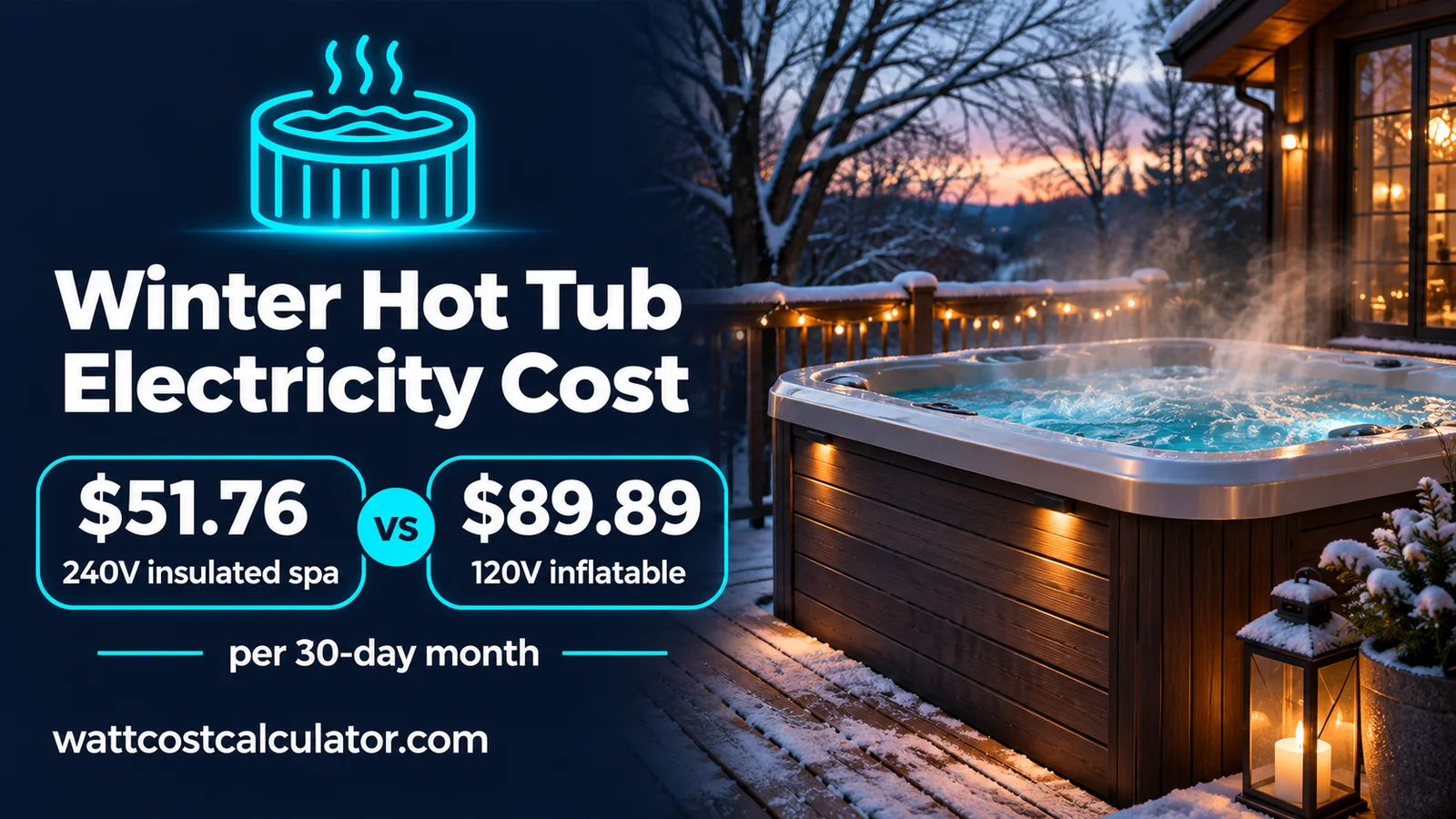
Maintaining a 102°F (39°C) outdoor hot tub through freezing winter weather typically costs between $1.73 and $3.00 per day—or $51.76 to $89.89 per 30-day month—at the U.S. Energy Information Administration’s August 2026 residential average of 18.16¢/kWh. By comparison, a mild-weather or heavily insulated 240V spa averages roughly $22.88 to $25.71 per month across the year. These figures model stated ambient temperatures, cover insulation, and heating cycles rather than a guaranteed utility quote for every home.
Why 120V plug-and-play spas are not cheaper to run in winter
Many first-time buyers assume a 120V “plug-and-play” hot tub costs less to operate than a hardwired 240V spa because its heater draws 1,000W to 1,500W instead of 4,000W to 5,500W. In winter, the physics of heat transfer works against that assumption. Heating 350 gallons of water by 1°F requires the same total thermal energy (roughly 2,918 BTUs, or 0.855 kWh of resistance heat) regardless of whether the heating element is wired at 120V or 240V.
Because a 120V heater delivers roughly one-third to one-fourth the wattage of a 240V element, it stays energized three to four times longer to recover lost heat—and on many 120V spas, the heater automatically shuts off whenever the high-speed jet pump runs. Worse, entry-level 120V hard-shell and inflatable spas often use thinner cabinet insulation and lighter vinyl covers, causing rapid conductive and evaporative heat loss whenever outdoor air drops near 30°F (-1°C).
Use the interactive calculator below with your spa’s average 24-hour wattage or measured kWh per day. In the winter 240V insulated-spa scenario below, standby heat loss, filtration, and four weekly soaks average roughly 396 watts across 24 hours (9.50 kWh/day).
What would this cost in your home?
Adjust the starting values to match your appliance and electricity plan.
Rate note: 18.16¢/kWh is the EIA August 2026 U.S. residential average (Table 5.6.A). EIA derives average revenue per kWh from utility sales and revenue data; it is a national benchmark rather than your exact residential tariff. Checked November 14, 2026. Fixed monthly account fees are excluded.
Winter hot tub costs: 240V insulated vs. 120V & inflatable
In its Portable Electric Spas Energy Conservation Standards analysis, the U.S. Department of Energy (DOE) noted an average household baseline of 1,699 kWh per year (~142 kWh/month, or $25.71/month at 18.16¢/kWh) across year-round operation. During freezing winter months, however, greater temperature difference between 102°F water and 30°F outdoor air pushes consumption sharply higher.
| Spa type & winter condition (102°F water) | Daily energy | 30-day energy | 30-day cost (18.16¢) | 90-day winter total |
|---|---|---|---|---|
| 240V full-foam spa (mild 55°F climate, 3 soaks/wk) | 4.20 kWh | 126.0 kWh | $22.88 | $68.64 |
| 240V full-foam spa (freezing 30°F winter, 4 soaks/wk) | 9.50 kWh | 285.0 kWh | $51.76 | $155.28 |
| 120V plug-and-play hard-shell (30°F winter, standard cover) | 11.50 kWh | 345.0 kWh | $62.65 | $187.95 |
| 120V inflatable hot tub (30°F winter, uninsulated walls) | 16.50 kWh | 495.0 kWh | $89.89 | $269.67 |
Most of a winter hot tub’s electricity goes to replacing heat lost through the cover, cabinet, and shell, rather than to running the jet pumps during a 30-minute soak. That is why cover and cabinet insulation matter more to the monthly bill than the wattage printed on the spa’s nameplate.
Where the kilowatt-hours go inside a hot tub
Every electric spa draws power across three distinct subsystems. Knowing which component dominates your meter helps you target actual savings:
- Standby resistance heater (1,500W to 5,500W cycling): Keeps water at 100°F–104°F 24 hours a day. Even a waterlogged foam cover that loses R-value can force the heater to cycle twice as often in January.
- Continuous low-watt circulation pump (40W to 120W): Dedicated 24/7 circulation pumps use roughly 1.0 to 2.8 kWh per day ($5.45 to $15.25/month) to filter water quietly. Older spas without dedicated circulators run a larger 1.5-HP main pump at 1,200W–1,800W for several hours daily for filtration, adding significantly more kWh.
- High-speed therapy jet pumps (1,500W to 3,000W): Running two jet pumps at full speed for 30 minutes four times a week adds only about 3 to 5 kWh per week ($2.30 to $3.90/month)—far less than standby heat loss.
How your state’s electricity rate changes winter spa bills
A freezing-winter hot tub consumes 285 kWh to 495 kWh per month in the scenarios above, so state tariff differences create large regional cost gaps. Below is how the 240V full-foam winter scenario (285 kWh/month) and 120V inflatable winter scenario (495 kWh/month) compare across four EIA Table 5.6.A residential averages.
| Location and EIA average | 240V insulated (285 kWh/mo) | 120V inflatable (495 kWh/mo) | 30-day savings with 240V foam |
|---|---|---|---|
| Washington — 14.63¢/kWh | $41.70 | $72.42 | $30.72/mo |
| United States — 18.16¢/kWh | $51.76 | $89.89 | $38.13/mo |
| New York — 28.65¢/kWh | $81.65 | $141.82 | $60.17/mo |
| California — 29.75¢/kWh | $84.79 | $147.26 | $62.47/mo |
In high-rate states like New York and California, running an uninsulated inflatable hot tub in winter can add nearly $150 per month to your electric bill, whereas a full-foam 240V tub stays closer to $82–$85/month. To check your state’s exact rate or compare other cold-weather heating loads, visit our U.S. electricity rates by state hub or see our heat pump auxiliary heat cost guide.
Four practical ways to cut winter hot tub electricity bills
- Check your cover weight (replace waterlogged foam): Heat rises, so the cover is your #1 thermal barrier. If your hardcover feels noticeably heavy when lifted, its vapor barrier has likely failed and waterlogged foam is conducting heat straight into the cold air. A worn cover that lets water into the foam can noticeably raise winter kWh, so check it before adding anything else.
- Add a floating thermal bubble blanket underneath the hardcover: A $25 solar/thermal blanket floating directly on the water surface reduces evaporation and cuts heat transfer to the underside of the lid, protecting the vinyl cover from chemical steam degradation.
- Drop standby temperature between weekend soaks: If you only use your 240V spa on Friday and Saturday nights, lowering the thermostat from 103°F to a cooler setting Monday through Thursday reduces the temperature difference against winter air and cuts standby heating.
- Block wind and schedule filtration off-peak: Placing a spa beside a privacy fence or windbreak cuts convective heat loss dramatically. If your utility uses Time-of-Use billing, program filtration cycles outside 4:00 PM–9:00 PM peak hours.
Frequently asked questions
Should I turn off or drain my hot tub in winter to save money?
Never turn off a filled hot tub in freezing weather without professionally winterizing (draining and blowing out all internal plumbing lines). Turning off the heater on a full tub risks cracked manifolds and pump seals from ice expansion, which can cost far more than the electricity you save. If you won’t use it all winter, properly drain and blow out the lines—or keep it in “Economy/Vacation” mode at 80°F–85°F.
Does a 240V 5.5kW heater use more electricity than a 120V 1.5kW heater?
No—for the exact same insulated tub volume and temperature, both use nearly identical kilowatt-hours to replace lost heat. The 240V heater simply runs at 5.5kW for 15 minutes instead of 1.5kW for 55 minutes, while allowing you to run therapy jets and the heater simultaneously in freezing air.
How much does an inflatable hot tub add to a winter electric bill?
Because inflatable spas lack rigid polyurethane foam cabinet insulation and use thin inflatable lids, they typically consume 350 to 500+ kWh per winter month ($64 to $90+ at the U.S. average rate). Placing 2-inch closed-cell XPS foam board underneath the tub and using a thermal cover blanket can noticeably reduce ground heat loss.
How does a hot tub compare to other winter home heating upgrades?
An outdoor 240V hot tub in winter uses about the same monthly kWh as a 30 sq. ft. heated bathroom floor running 24 hours a day (8.64 kWh/day in that guide, about 259 kWh a month), and more than winter pipe heating cables. You can test your local rate and custom daily wattage in the main electricity cost calculator.
Sources and calculation method
Daily energy is calculated as average 24-hour watts × 24 ÷ 1,000, and monthly cost equals 30-day kWh × residential rate ($/kWh). Winter scenarios model continuous 102°F water maintenance against 30°F ambient air for 240V full-foam, 120V hard-shell, and uninsulated inflatable enclosures; fixed utility customer charges and local taxes are excluded.
- U.S. Department of Energy (DOE): Energy Conservation Standards for Portable Electric Spas — DOE’s September 2022 estimate of 1,699 kWh per year per household.
- California Energy Commission (CEC): Title 20 Portable Electric Spas Regulations — state standby-power rules for portable spas.
- EIA Electric Power Monthly, Table 5.6.A — August 2026 state and U.S. residential average retail prices.
- U.S. DOE Energy Saver Guide — residential insulation and heat-loss principles.
Last checked: November 14, 2026. This guide presents modeled electricity estimates from DOE/CEC engineering standards and EIA average tariffs. Check your utility bill and spa specification plate for your exact rate and breaker requirements.
Waterbed Heater Electricity Cost: 170 W vs 325 W Per Month
A waterbed heater costs about $22.23 to $42.49 a month at 18.16¢/kWh if it runs 24 hours at 170 W or 325...
Infrared Sauna Electricity Cost: Cost Per 1-Hour Session by Model
An infrared sauna costs about $0.25 to $0.49 per one-hour session at 18.16¢/kWh, depending on model. Here is the cost per session...
Engine Block Heater Electricity Cost: 1,000 W vs 1,500 W Per Month
An engine block heater costs about $10.90 to $16.34 a month at 18.16¢/kWh when plugged in 2 hours a night at 1,000...

Heated Dog Bed Electricity Cost: Small vs Medium Pad Per Month
A heated dog bed costs about $2.62 to $5.23 a month at 18.16¢/kWh if it runs 24 hours at 20 W to...