- Why the humidifier and heated hose drive most of CPAP power use
- What would this cost in your home?
- CPAP electricity costs by humidifier and tube settings
- Battery backup planning: why settings matter during winter outages
- How your state’s electricity rate changes annual CPAP costs
- Three practical steps for safe, efficient CPAP power use
- Frequently asked questions
- Sources and calculation method
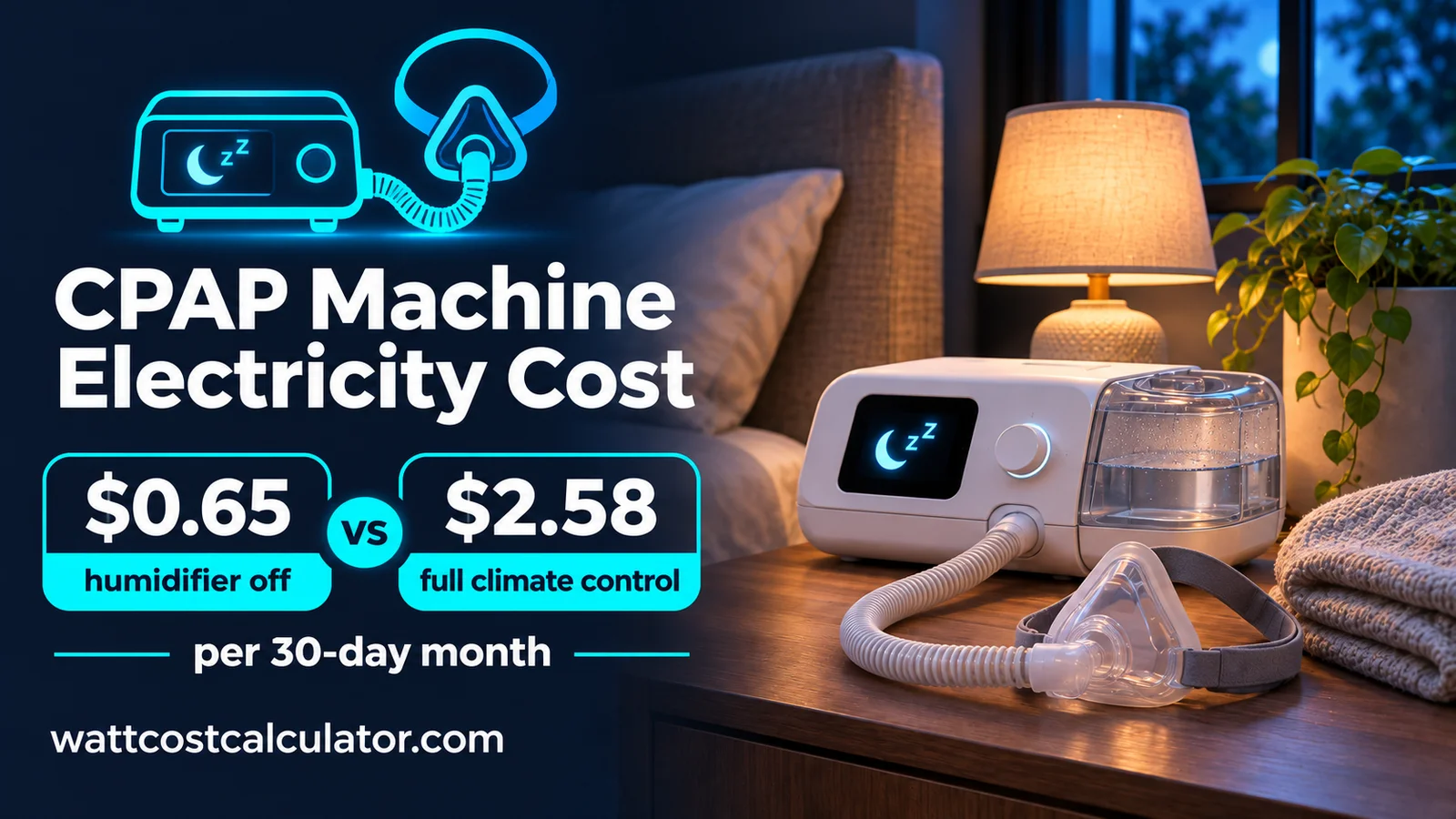
Running a modern CPAP machine for 8 hours every night typically costs around $0.09 per day, $2.58 per 30-day month, or $31.34 per year with both the heated humidifier and heated tubing enabled at the U.S. Energy Information Administration’s August 2026 residential average of 18.16¢/kWh. Turning off the heated humidifier and heated hose drops that modeled electricity cost to roughly $0.65 per month ($7.95 per year). These figures model stated nightly sleep schedules and manufacturer power specifications rather than a single fixed tariff for every utility plan.
Why the humidifier and heated hose drive most of CPAP power use
A CPAP blower motor itself is remarkably efficient—pushing therapy air at 8 to 14 cmH2O typically draws only 10W to 15W. What pushes a CPAP machine’s electrical load above 50 watts is thermal conditioning: warming distilled water inside the humidifier tub and energizing the fine resistance wire coiled inside heated tubing to prevent condensation (“rainout”) in cool bedrooms.
According to the official ResMed AirSense 11 User Guide, the unit ships with a 65W AC power supply (24V DC output) and has a typical power consumption of 56.1W and a peak consumption of 73.2W when humidification and ClimateLineAir heated tubing are active. That distinction matters little on a household wall outlet—where the entire year costs around $31—but becomes critical during winter power outages when running on a portable battery station.
Use the interactive calculator below with your machine’s active wattage and nightly sleep duration. In the preset scenario below, a CPAP running with full climate control averages 56.1 watts for 8 hours per night.
What would this cost in your home?
Adjust the starting values to match your appliance and electricity plan.
Rate note: 18.16¢/kWh is the EIA August 2026 U.S. residential average (Table 5.6.A). EIA derives average revenue per kWh from utility sales and revenue data; it is a national benchmark rather than your exact utility tariff. Checked November 14, 2026. Fixed monthly customer charges are excluded.
CPAP electricity costs by humidifier and tube settings
Because bedroom temperature, prescribed air pressure, and mask leak rate all affect how hard the heater plate works, the table below compares four common 8-hour nightly operating modes (plus 16 hours of 1.5W daytime cellular/display standby) at 18.16¢/kWh.
| CPAP operating mode (8 hrs/night) | Daily energy | 30-day energy | 30-day cost | Annual cost (365d) |
|---|---|---|---|---|
| Blower only (Humidifier & heated tube OFF; ~12 W avg) | 0.120 kWh | 3.60 kWh | $0.65 | $7.95 |
| Heated humidifier ON + standard non-heated tube (~38 W avg) | 0.328 kWh | 9.84 kWh | $1.79 | $21.74 |
| Full Climate Control: Humidifier + heated tube (56.1 W typical) | 0.473 kWh | 14.18 kWh | $2.58 | $31.34 |
| Cold bedroom / max humidity peak (73.2 W peak load) | 0.610 kWh | 18.29 kWh | $3.32 | $40.41 |
Even at maximum peak heat every single night of the year, a modern CPAP machine costs less than $3.40 per month on a standard residential electric bill—far less than running a bedroom space heater or even a continuously warm bidet seat.
Battery backup planning: why settings matter during winter outages
While $2 per month rarely breaks a household budget, power-outage backup runtime is where CPAP wattage becomes critical. A mid-sized 500 watt-hour (Wh) portable power station yields roughly 425 Wh through its AC inverter (accounting for ~15% DC-to-AC conversion loss) or roughly 460 Wh through a dedicated 24V DC CPAP converter:
- With heated humidifier & heated tube ON (56.1W via AC inverter): 425 Wh ÷ 56.1W = roughly 7.6 hours of continuous running, so the battery runs out before a full 8-hour night of therapy ends.
- With humidifier & heated tube OFF (12W via 24V DC converter): 460 Wh ÷ 12W = roughly 38 hours of continuous running. At the modeled 0.120 kWh per day (8 hours of therapy plus daytime standby), that is about 3.8 nights of uninterrupted therapy from the same battery.
How your state’s electricity rate changes annual CPAP costs
Because most CPAP therapy occurs overnight between 10:00 PM and 6:00 AM, it sits cleanly inside off-peak Time-of-Use (TOU) windows. Below is how the blower-only scenario (3.60 kWh/month) and full climate-control scenario (14.18 kWh/month) compare across four EIA Table 5.6.A residential averages.
| Location and EIA average | Blower only (3.60 kWh/mo) | Humidifier + heated tube (14.18 kWh/mo) | Annual cost (Full Climate) |
|---|---|---|---|
| Washington — 14.63¢/kWh | $0.53 | $2.07 | $25.25/yr |
| United States — 18.16¢/kWh | $0.65 | $2.58 | $31.34/yr |
| New York — 28.65¢/kWh | $1.03 | $4.06 | $49.43/yr |
| California — 29.75¢/kWh | $1.07 | $4.22 | $51.33/yr |
You can look up your own state’s residential benchmark in our U.S. electricity rates by state hub or compare overnight bedroom loads against other always-plugged electronics like a dual-monitor work desk or a home printer.
Three practical steps for safe, efficient CPAP power use
- Use a dedicated DC converter for battery backup or camping: Converting battery DC power up to 120V AC inside a power station—only for the CPAP brick to convert 120V AC back down to 24V DC—wastes 15% to 25% of battery capacity as heat. Using the manufacturer’s 24V DC adapter noticeably extends runtime.
- Check your humidity level by season: During humid summer months, lowering the humidifier setting from Level 4–5 down to Level 1–2 (or switching to passover mode without heat) cuts heater plate cycling while maintaining comfortable airflow.
- Never disable medical therapy to save pennies: Across the four states in the table above, a full year of CPAP humidification costs about $25 to $51. Prioritize prescribed sleep comfort and use a surge-protected outlet—never unplugging a medical device aggressively just to shave 1.5W of daytime standby.
Frequently asked questions
How much electricity does a CPAP machine use per night?
With both a heated humidifier and heated hose active, a typical 8-hour night consumes roughly 0.45 kWh to 0.59 kWh (about $0.08 to $0.11 at the U.S. average rate). With humidification turned off, nightly use drops to roughly 0.10 to 0.12 kWh (about $0.02 per night).
Does a CPAP machine draw power during the day when I am not sleeping?
Yes, a tiny amount—typically 1W to 2W to power the touchscreen standby circuit, Bluetooth radio, and cellular sleep-data modem, plus a brief post-therapy cooling cycle immediately after you wake up. Across 16 daytime hours, that standby draw adds roughly 0.024 kWh per day (~13 cents per month).
Can a CPAP machine run on a regular bedroom outlet or smart plug?
Yes, any standard 120V bedroom outlet easily handles a 65W–90W CPAP power supply (under 1 amp). However, avoid plugging medical sleep equipment into Wi-Fi smart plugs that could accidentally toggle off overnight via voice assistant routines or app schedules.
How does a CPAP compare to other overnight bedroom appliances?
A CPAP machine with full heated humidification uses roughly 40% to 60% of the electricity of a 10-hour 3D print job (0.8 to 1.2 kWh in that guide), and a fraction of a bedroom space heater. To test your exact utility tariff and custom nightly hours, use our main electricity cost calculator.
Sources and calculation method
Daily energy is calculated as (active watts × 8 hours + 1.5 W standby × 16 hours) ÷ 1,000, and electricity cost equals kWh × residential rate ($/kWh). Power figures reflect manufacturer electrical specifications for 65W modern CPAP units; backup battery estimates assume 85% AC inverter efficiency or 92% DC-to-DC efficiency. Fixed utility customer charges and taxes are excluded.
- ResMed AirSense 11 Official User Guide — 65W power supply unit, 56.1W typical power consumption, and 73.2W peak specifications.
- ResMed AirSense 11 Product Overview — 65W power supply unit and heated humidification and tubing system details.
- EIA Electric Power Monthly, Table 5.6.A — August 2026 state and U.S. residential average retail prices.
- U.S. Department of Energy (DOE) Energy Saver — general residential appliance standby and efficiency guidance.
Last checked: November 14, 2026. This guide presents modeled electricity estimates from manufacturer specifications and EIA average tariffs. Consult your healthcare provider or equipment supplier before altering prescribed humidification or backup-power configurations.

Cat Water Fountain Electricity Cost: Monthly Cost by Pump Wattage
A cat water fountain costs about $0.13 to $0.39 a month at 18.16¢/kWh if its pump runs 24 hours at 1 to...
Christmas Lights Electricity Cost: LED vs. Incandescent Holiday Displays
Lighting 600 incandescent mini Christmas bulbs for 6 hours a night costs roughly $7.85 per 30-day month at 18.16¢/kWh, whereas an equivalent...
Robot Vacuum & Auto-Empty Wash Dock Electricity Cost: Charging vs. Hot-Air Drying
A basic charging-only robot vacuum costs roughly $0.46 per 30-day month ($5.62/year) at 18.16¢/kWh, while an all-in-one mop-washing and hot-air drying station...
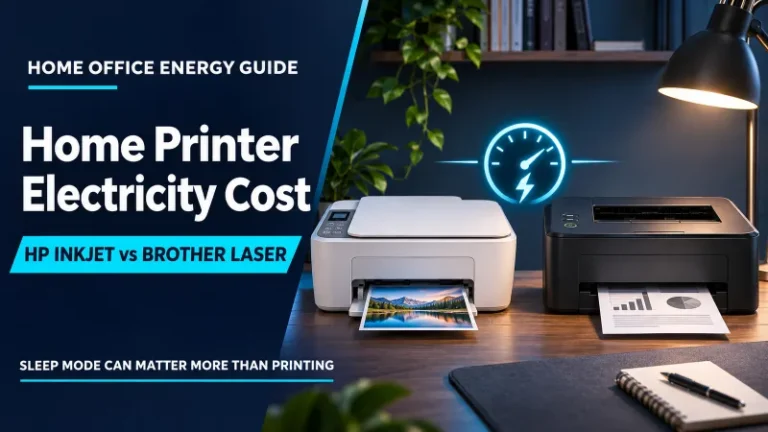
Home Printer Electricity Cost: HP OfficeJet Pro 9125e vs. Brother HL-L2405W
A lightly used HP OfficeJet Pro 9125e costs about $0.32 a month in electricity, while a Brother HL-L2405W left in its 4-watt...