
- Quick example: turn rack watts into kWh
- Calculate your own cost per finished load
- Account for the room around the rack
- What would this cost in your home?
- How to get a fair comparison
- What the dryer efficiency label can—and cannot—tell you
- Named model examples: heated airer and electric dryer
- When a heated rack may fit your routine
- Safety and indoor drying
- Frequently asked questions
A heated drying rack can draw far less power at any moment than a full-size electric dryer, but a low wattage number alone does not tell you which option costs less per finished load. Drying time, how much laundry fits, the room’s humidity, and whether you need a second cycle all matter. This guide shows you how to compare a rack’s rated or measured input with the dryer’s complete-cycle kWh, so both sides use a comparable finished load.
Heated racks are a niche option in the United States, and product designs vary: some warm rails, while others add a fan and cover. Treat wattage and drying time as model-specific. The example below states each input so you can substitute the figures for your own appliances.
Quick example: turn rack watts into kWh
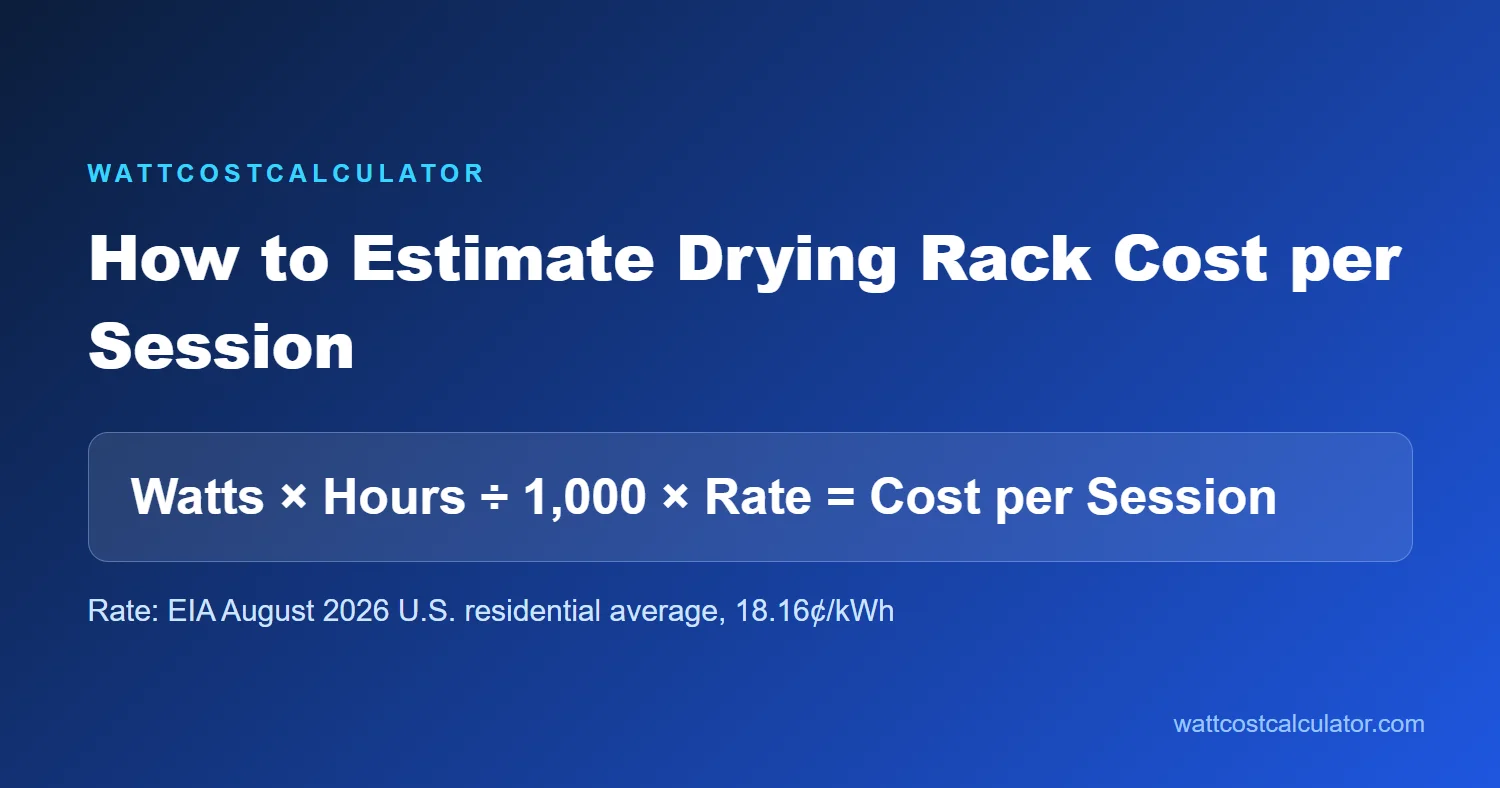
Suppose a rack is rated at 200 watts and runs for 6 hours. At constant rated power, that is 200 × 6 ÷ 1,000 = 1.2 kWh. At an example electricity rate of 20¢/kWh, the energy charge is 24¢ for that session. A dryer session using an illustrative 3.0 kWh would cost 60¢ at the same rate. Treat these figures as examples; rack power may cycle, and dryer energy varies with the load and cycle.
| Illustrative session | Energy input | Cost at 20¢/kWh | Four sessions/week, annualized |
|---|---|---|---|
| Heated rack: 200 W × 6 hours | 1.2 kWh | $0.24 | $49.92 |
| Electric dryer: example input | 3.0 kWh | $0.60 | $124.80 |
Annual example = kWh per session × sessions per week × 52 × rate in dollars per kWh. The table assumes each session finishes the same amount of laundry. In real use, a rack may hold only a small load or take longer, so compare similar dry laundry weight and dryness rather than assuming one rack session equals one dryer cycle. Fixed fees, taxes, gas charges and any extra drying cycle are excluded.
Calculate your own cost per finished load
Use the mini calculator with energy in kWh per completed load, loads per week, and your marginal electricity rate in cents per kWh. For the rack example, enter 1.2 kWh; for the dryer example, enter the measured kWh from its display or a suitable energy monitor. Calculate once for each appliance. If you only know the rack’s rated watts, estimate kWh as watts × hours ÷ 1,000, then replace that estimate with a measurement when possible.
Account for the room around the rack
Start with the rack’s session energy. If drying also requires a dehumidifier that would otherwise be off, include its additional energy. For example, a 0.7 kWh rack session plus 0.5 kWh of extra dehumidification costs 24¢ at 20¢/kWh. Compare against one complete dryer cycle for a similar load.
What would this cost in your home?
Adjust the starting values to match your appliance and electricity plan.
20¢/kWh is an illustrative input, not a current U.S. average. Use the energy rate on your bill. Reviewed October 30, 2026.
How to get a fair comparison
- Start with the same laundry. Weigh dry clothes or use a repeatable set of garments, and compare the final dryness you need. Do not compare a few delicate items on a rack with a full dryer drum.
- Measure the whole session. Include pre-treatment, preheat or fan operation, and any second run. For a rack, record the actual elapsed time and energy if your meter can safely measure the appliance. For the dryer, use a cycle energy display, model documentation, or a qualified whole-appliance monitor.
- Use the right equipment safely. A plug-in meter is appropriate only when the appliance plug, voltage and current rating match the meter. Many full-size U.S. dryers use a dedicated 240-volt circuit; do not use an ordinary plug meter, adapters, or open wiring. Use installed monitoring rated for that circuit or ask a qualified electrician.
- Repeat and note the conditions. Fabric type, spin speed, room temperature, humidity, spacing between garments, vent condition and selected dryer cycle can change results. A few comparable sessions are more informative than one unusual load.
What the dryer efficiency label can—and cannot—tell you
ENERGY STAR rates dryers with Combined Energy Factor (CEF), expressed as pounds dried per kWh; a higher CEF indicates more efficient energy use under the standard test. Standard and compact test loads differ, and the rating does not predict the exact cost of your particular load. Use your model’s test or measured kWh where available, then multiply by your utility rate. See the ENERGY STAR dryer criteria and the U.S. Department of Energy dryer information.
Named model examples: heated airer and electric dryer
These manufacturer specifications give the general comparison a concrete reference. The rack’s six-hour estimate below assumes its rated input stays constant; the dryer’s product page does not publish a directly comparable kWh-per-load figure.
| Appliance example | Model | Manufacturer-listed specifications | Energy-cost use in this guide |
|---|---|---|---|
| Freestanding heated clothes airer | SHARNDY ETW39AL-1AS | 230 W; 110–240 V; 1,335 × 660 × 1,000 mm | At constant rated input for 6 hours: 1.38 kWh, or about $0.28 at the example rate of 20¢/kWh |
| Top-load electric dryer with moisture sensor | Whirlpool WED6150PB | 7.0 cu. ft.; two moisture sensors; Timed Dry settings of 15, 30, 60 or 90 minutes | The cited product page does not give comparable cycle kWh; use complete-cycle energy for your load |
Sources: SHARNDY ETW39AL-1AS specifications and Whirlpool WED6150PB specifications. The model facts describe features and nameplate input; they do not show which appliance will finish your laundry more cheaply.
When a heated rack may fit your routine
A rack can be useful for delicate pieces, a small daily load, or clothing you prefer not to tumble. It may also shift moisture into the room, so ventilation and humidity management matter. If the rack handles only part of a load, the cost per garment or per pound is a better comparison than cost per appliance session.
A dryer can be more convenient for a large load and may finish faster. A heat-pump dryer has a different energy profile from a conventional resistance dryer, so use its own data rather than the illustrative 3.0 kWh example above. See our heat-pump dryer comparison and electric dryer cost guide. For cycle choices, read Sensor Dry vs. Timed Dry.
Safety and indoor drying
Follow the rack manufacturer’s placement, load, timer and supervision instructions. Keep the unit and laundry away from heaters, exits and combustible materials. Do not cover controls or use an appliance with a damaged cord. Indoor drying adds moisture to the room; ventilate appropriately and avoid prolonged damp conditions that can encourage condensation or mold.
Frequently asked questions
Is a heated drying rack always cheaper than a dryer?
No. Compare energy per equivalent quantity of laundry that reaches the same dryness. A rack can run for many hours or require multiple sessions, while dryer use varies by load, cycle and model.
Can I estimate rack cost from its wattage?
Yes, as a rough upper-bound scenario if it draws rated power continuously: watts × hours ÷ 1,000 gives kWh. Multiply kWh by your rate in dollars. A measurement is better if the rack cycles or includes a fan.
Does the calculator include my full utility bill?
No. It estimates the energy charge from your inputs. It excludes fixed service fees, taxes, demand charges and tier changes. Use the marginal rate that applies to the extra electricity you consume.
Try the mini calculator above with your own readings, then use our full electricity cost calculator for other appliances.
Reviewed October 30, 2026 by Seon. Method: cost = kWh × the entered rate. The rack scenario derives kWh from stated watts and hours; the dryer scenario uses an illustrative complete-cycle kWh input. Model features and rack wattage are attributed to manufacturer pages below. Actual cycle use depends on the selected model, load and conditions.
Disclaimer: The figures on this page use statewide or standardized averages and the inputs shown. They are for general information only, not a utility quote, a bill, or financial advice. Check your own electricity bill and the official EIA or manufacturer sources for current figures.
Note: The energy values in the examples on this page are illustrative assumptions, not manufacturer ratings. Check your appliance’s label or the manufacturer’s current specifications before relying on them.
All-in-One Washer Dryer Combo Electricity Cost: Heat Pump vs. Vented Units
A 120V heat-pump all-in-one washer dryer combo uses roughly 0.9 to 1.3 kWh per complete wash-and-dry load, costing $0.16 to $0.24 at...

Top-Load vs Front-Load Washer Electricity Cost: Hot Water and Spin
Quick Scenario Summary In the scenario below, a top-load washer using 0.65 kWh per cold-water load costs about $30.69 per year at...

Sensor Dry vs Timed Dry: Dryer Electricity Use per Load
Sensor dry can reduce the cost of overdrying, but the savings depend on how much electricity the two complete cycles actually use....

Laundry Cost per Load: Electricity for Washing and Drying
Estimate the complete electricity cost of washing and drying one load. Learn what to include, how to measure cycle kWh, and how...