
- Same drum size, different published energy use
- What the difference means on an electricity bill
- When could the higher purchase price pay back?
- Cycle time, venting, and upkeep are part of the decision
- Compare your own dryer cost
- Use your own loads in the savings estimate
- What would this cost in your home?
- Frequently asked questions
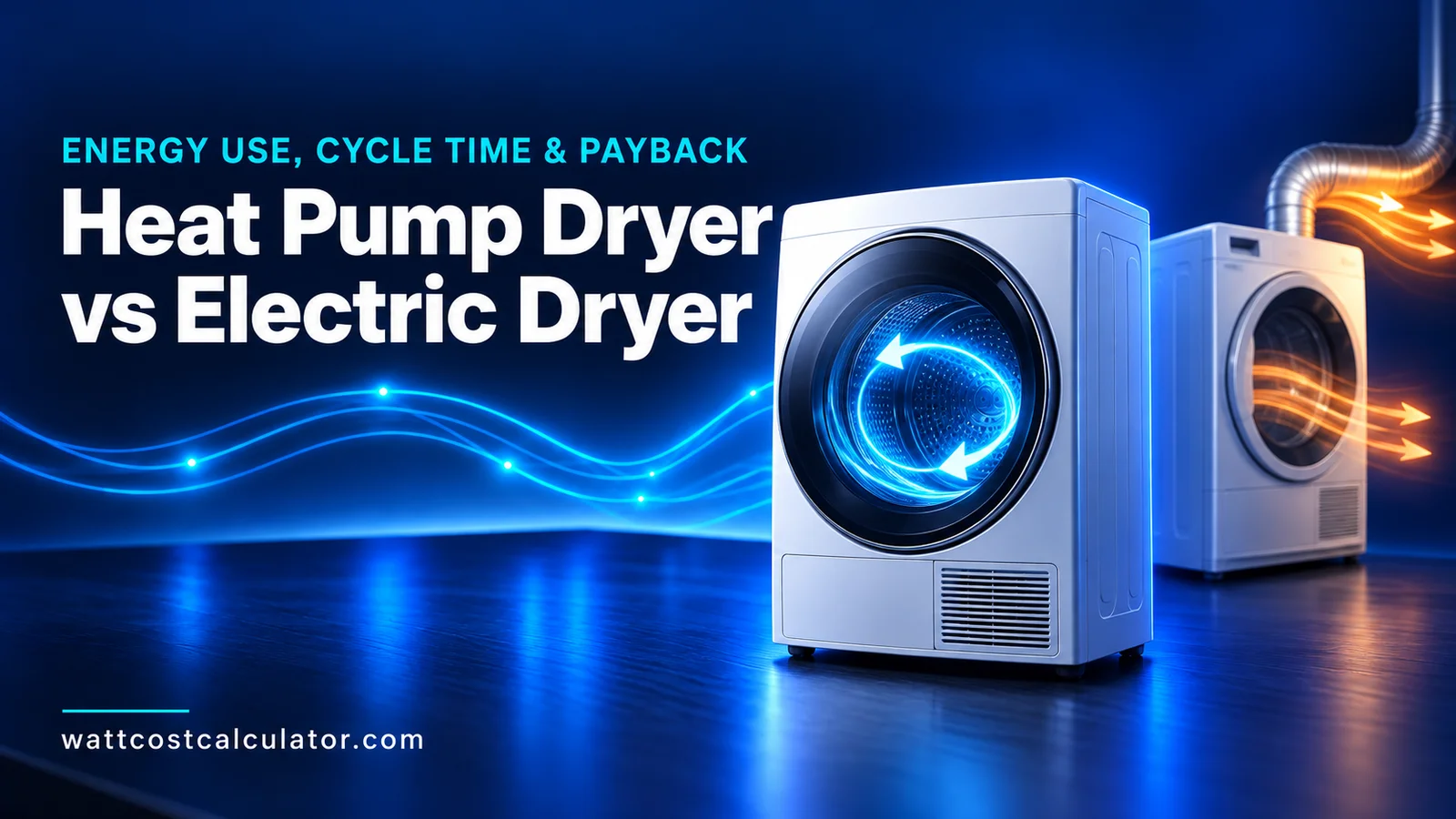
For two same-capacity ENERGY STAR-listed 7.3 cu. ft. dryers, the published annual-use estimates are 607 kWh for a vented electric model and 257 kWh for a heat-pump model. At the U.S. residential average of 18.16¢/kWh, that difference is about $64 per year at the test procedure’s 283 cycles per year. The heat-pump model’s listed test cycle is also 19 minutes longer. Your household’s result depends on how often you dry clothes, your actual rate, the exact models, and any purchase or installation premium.
The comparison uses the cited model data and stated assumptions. Savings vary by dryer and usage. The practical question is whether the lower energy use, ventless installation, and lower-temperature drying are worth the price and routine for your home.
Same drum size, different published energy use
To avoid comparing a compact dryer with a full-size one, this example uses two 7.3 cu. ft. electric dryers listed by ENERGY STAR: the vented LG DLE7400*E and the ventless heat-pump LG DLHC8402*. These are specific model families, not endorsements or a claim that they are the best current purchase. Check the current model label and availability before shopping.
| Measure | Vented electric: LG DLE7400*E | Heat pump, ventless: LG DLHC8402* |
|---|---|---|
| Estimated annual energy | 607 kWh | 257 kWh |
| Combined Energy Factor (CEF) | 3.94 lb/kWh | 9.30 lb/kWh |
| Estimated test cycle time | 56 minutes | 75 minutes |
| Capacity in listing | 7.3 cu. ft. | 7.3 cu. ft. |
| Exhaust vent | Vented | Ventless |
ENERGY STAR’s annual-use estimate uses 283 cycles per year under a standardized test procedure. Dividing the listed figures by 283 gives about 2.15 kWh per test cycle for the vented model and 0.91 kWh for the heat-pump model. Those are label-derived averages, not readings from a load in your laundry room. Actual use changes with load size, moisture left after the washer spin, fabric, settings, and how often the dryer runs.
What the difference means on an electricity bill
The EIA reported a U.S. residential average of 18.16¢/kWh for August 2026. It is a dated national comparison point, not your utility’s exact marginal rate. At that price, the two label estimates translate to about $110.23 and $46.67 per year at 283 cycles, a calculated difference of $63.56. The EIA average reflects average retail revenue per kWh; a household’s bill can include fixed charges, taxes, time-of-use periods, and other terms that a simple appliance estimate does not capture.
Here is how the same 350 kWh label difference scales if your household runs fewer or more loads. The table assumes that energy use scales in proportion to the listed 283-cycle estimate. It keeps the same 18.16¢ rate throughout so the scenarios are easy to compare.
| Loads per week | Vented model estimate | Heat-pump model estimate | Estimated annual difference |
|---|---|---|---|
| 4 | $81.02 | $34.30 | $46.72 |
| 5 | $101.27 | $42.88 | $58.29 |
| 8 | $162.04 | $68.61 | $93.43 |
These figures are energy-charge estimates based on the example models and linear scaling. They exclude fixed bill charges and assume the same cost per kWh at every hour and usage level. Your dryer’s measured kWh per load or current EnergyGuide label is a better starting point than treating this example as a typical household bill.
When could the higher purchase price pay back?
Use the price difference between the exact models you are considering, after rebates and required installation work. Then divide it by your estimated yearly electricity savings:
Simple payback in years = extra purchase and installation cost ÷ estimated annual bill savings
For example, if a heat-pump option costs $400 more after rebates and your home uses five dryer loads per week, the table’s modeled energy savings are about $58.39 per year. The simple payback is about 6.8 years ($400 ÷ $58.39). At four loads per week it is about 8.6 years; at eight loads per week it is about 4.3 years. The $400 premium is only a worked example, not a current price quote. Prices, rebates, maintenance, repair costs, and appliance life can change the result.
This is the useful consumer takeaway: the same efficiency difference has more value in a home that dries more loads or pays a higher electricity price. If you do only a few loads, use a lower-cost rate, or expect to replace the dryer again before the payback period, the electricity savings alone may not justify a premium. A ventless installation or lower-temperature drying may still matter to you for separate practical reasons.
Cycle time, venting, and upkeep are part of the decision
The listed test cycle is 56 minutes for the vented example and 75 minutes for the heat-pump example. That 19-minute difference is a test result for these model families; your actual cycles may be shorter or longer. If laundry has to be finished before work, school, or bedtime, compare the normal-cycle time and capacity in the exact model’s manual and owner feedback. ENERGY STAR notes that heat-pump dryers use lower temperatures, which can be gentler on clothes, but household results depend on the garment and program.
A heat-pump dryer recirculates air in a closed loop and removes moisture without sending exhaust through an exterior vent. That can solve a real space or venting problem in an apartment, addition, or laundry closet. It still needs a plan for the water it condenses: depending on the model, you may empty a tank or route a drain hose. Filter and heat-exchanger care also differs by model, so check the manufacturer’s maintenance schedule before you buy. “Ventless” makes installation more flexible; it does not mean “no setup or upkeep.”
A standard vented electric dryer may fit better when the house already has a suitable vent, a fast turnaround matters, and the lower upfront price is compelling. Keep the exhaust path clean and follow the manufacturer’s safety and installation instructions. Do not block a required vent or assume that an appliance can use an outlet simply because another dryer did.
Compare your own dryer cost
The widget starts with the vented model’s label-derived estimate of about 2.15 kWh per cycle and five loads per week. To test the heat-pump example, change energy per load to about 0.91 kWh. For a more accurate comparison, use your own meter reading or the exact model’s current energy label and enter your bill’s applicable rate.
Use your own loads in the savings estimate
If two complete dryer cycles differ by 1.2 kWh and you dry four loads a week, the example difference is 249.6 kWh over 52 weeks. At 20¢/kWh that is about $49.92 per year before any purchase or installation difference. Compare similar loads and include any follow-up drying time.
What would this cost in your home?
Adjust the starting values to match your appliance and electricity plan.
Our practical view: first compare two models with similar drum capacity and the same fuel type, then check their annual kWh and tested cycle time. Decide whether lower energy use, ventless placement, or lower-temperature drying solves a real problem for your household. If you are replacing a dryer that works and run only a few loads each week, calculate the payback before buying for energy savings alone. For your current appliance budget, see our electric dryer cost per load guide; for the wash cycle that comes before drying, see washing machine electricity cost: cold wash vs. hot-water energy. You can also use the Appliance Electricity Cost Calculator with your own rate and usage.
Frequently asked questions
Does a heat-pump dryer always save money?
No. It can use less electricity, but the bill savings depend on your loads, electricity rate, exact model difference, and price premium. A low-use household may not recover a higher purchase cost through energy savings during the time it owns the appliance.
Are the annual kWh figures a promise of what my dryer will use?
No. ENERGY STAR’s listing estimate is based on a standardized test and 283 cycles per year. The dataset says actual use varies with usage patterns, selected cycles, and load size. Treat the number as a comparison starting point, then use your own bill, a suitable meter, or the exact EnergyGuide information.
Does a ventless heat-pump dryer need a drain?
It must manage the water removed from wet laundry. Depending on the model and setup, that can mean emptying a collection tank or connecting a supplied drain hose to an approved nearby drain. Follow the model manual.
What should I compare besides kWh?
Compare capacity, test and owner-reported cycle time, electrical requirements, vent or drain setup, filter-cleaning routine, warranty, price after rebates, and repair availability. Those factors affect day-to-day usefulness and total ownership cost.
Sources: ENERGY STAR: LG DLE7400*E vented electric dryer record; ENERGY STAR: LG DLHC8402* heat-pump dryer record; ENERGY STAR dataset notes on annual-use assumptions; ENERGY STAR: Heat Pump Dryer; EIA: Average Price of Electricity to Ultimate Customers, August 2026.
Sources and rate reference checked October 29, 2026. Product listing figures are standardized estimates, not measurements made by WattCostCalculator.com. Cost examples use stated assumptions and exclude fixed fees and non-energy bill items.
Related reading: For a complete washer-and-dryer household estimate, use our laundry cost per load guide.
Disclaimer: The figures on this page use statewide or standardized averages and the inputs shown. They are for general information only, not a utility quote, a bill, or financial advice. Check your own electricity bill and the official EIA or manufacturer sources for current figures.
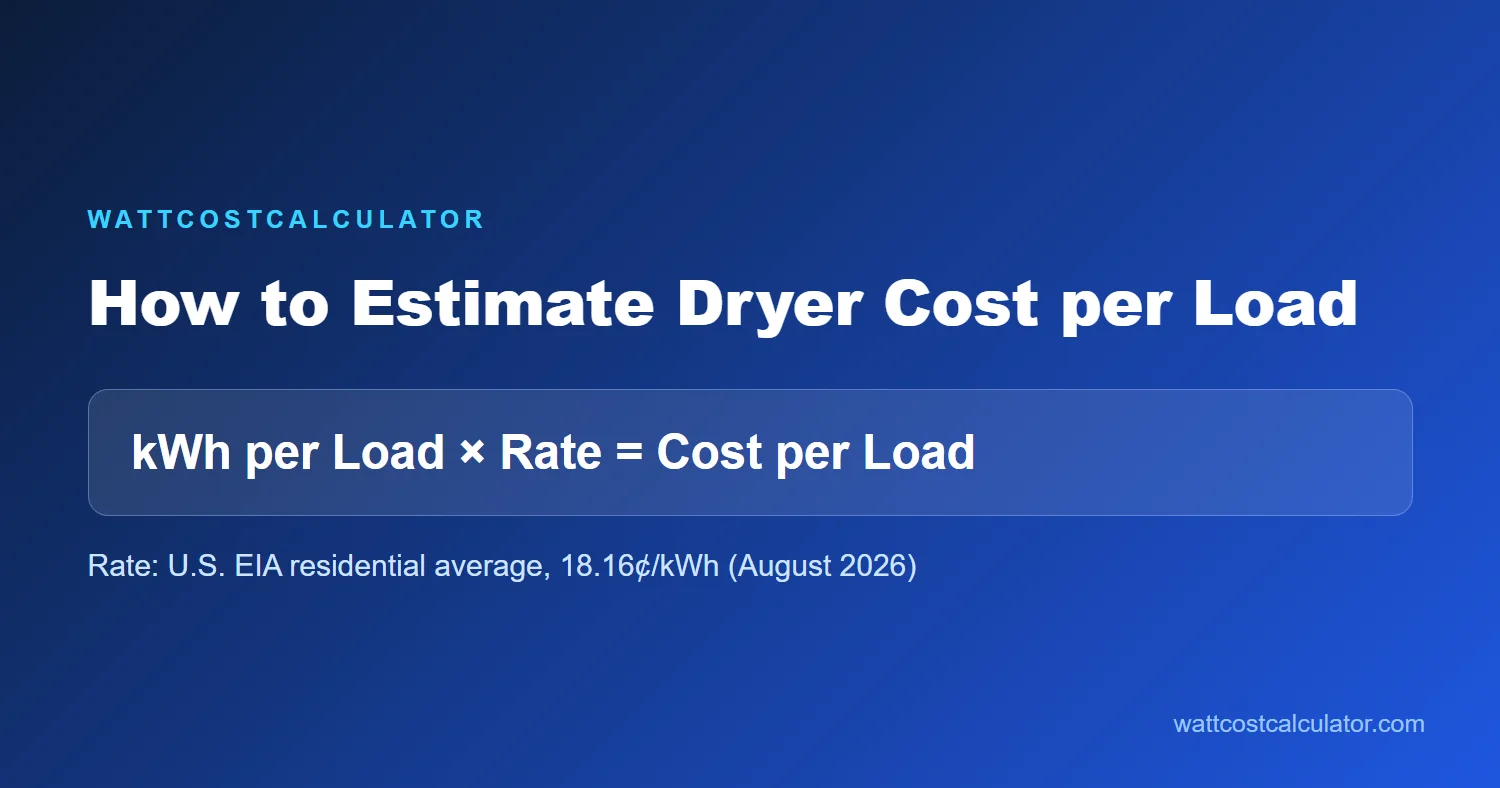
Using the ENERGY STAR annual estimates, a vented electric dryer at 607 kWh a year costs about $110 at 18.16¢/kWh. The LG DLHC8402 heat pump model, at 257 kWh a year, costs about $47 at the same rate, though its cycles take longer.
Rated annual estimates under the DOE test procedure (283 cycles per year), taken from ENERGY STAR product listings: the LG DLHC8402* heat pump ventless dryer is listed at 257 kWh per year with a CEF of 9.3, and a representative standard electric vented model is listed at about 608 kWh per year. These are not measured results from a home; actual use depends on load size, cycle choice and moisture level.
All-in-One Washer Dryer Combo Electricity Cost: Heat Pump vs. Vented Units
A 120V heat-pump all-in-one washer dryer combo uses roughly 0.9 to 1.3 kWh per complete wash-and-dry load, costing $0.16 to $0.24 at...
Top-Load vs Front-Load Washer Electricity Cost: Hot Water and Spin
Quick Scenario Summary In the scenario below, a top-load washer using 0.65 kWh per cold-water load costs about $30.69 per year at...
Sensor Dry vs Timed Dry: Dryer Electricity Use per Load
Sensor dry can reduce the cost of overdrying, but the savings depend on how much electricity the two complete cycles actually use....
Heated Drying Rack vs Electric Dryer: Electricity Cost per Load
A heated drying rack can draw far less power at any moment than a full-size electric dryer, but a low wattage number...